CMBR
The Expanding Universe
Nucelosynthesis
Stars
Electromagnetic Spectrum and light
100
What does CMBR stand for?
Cosmic Microwave Background Radiation
100
Whose theory is the expanding universe and when did they coin the term.
Edwin Hubble - 1929
100
Define Nucleosynthesis
The formation of atomic nuclei. It is how elements are formed.
100
What does the term luminosity mean?
The amount of energy (light) emitted from a stars surface
100
Light sits at what part of the electromagnetic spectrum?
Visible light
200
Describe what CMBR is
Left over radiation from the Big Bang
200
What is the mostly widely accepted theory about the end of the universe?
The universe will continue to expand leading to heat death/the big freeze
200
What element cannot be created during nucelosynthesis?
Hydrogen
200
On the H.R. Diagram, what information can be deduced about stars?
Their luminosity and the temperature of the surface of the star
200
At what rate does light travel?
300,000 km/s
300
CMBR is now present across what wavelengths?
Radiowaves and Microwaves/ low frequency waves
300
Describe what red shift is and how it can be used to support evidence of the big bang?
Red shift is the observation that wavelengths are moving to a lower frequency, it is associated with galaxies moving away from earth and shows that over time galaxies have receded at a faster rate.
300
Identify the abundance levels of hydrogen, helium and trace elements within the universe.
hydrogen - 75%
Helium - 24%
Trace elements - 1%
300
Stars in the Supergiant section of the H.R. Diagram above are Red giants. What star do they end their lifecycle as?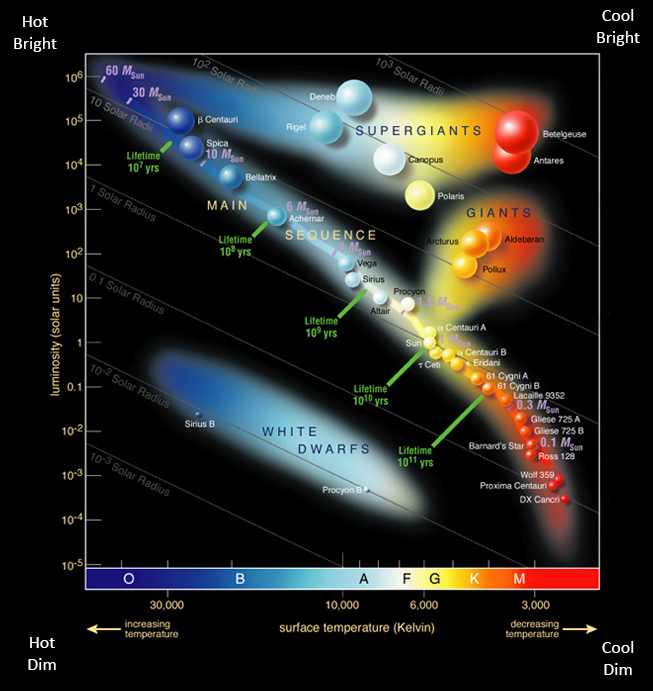
A white Dwarf
300
The closest star to earth was how many light years away?
4.2 light years
400
Describe the changes in wavelengths at the start of the big band compared to now and why this has taken place
Start of the Big Bang = High frequency wavelengths
Now = low frequency wavelengths
This change has happened as the universe expanded and cooled. Over time the wavelength has become stretched as the universe expanded fruther away from the Big Bang.
400
Describe what blue shift means?
Blue shift refers to the movement towards the blue end of the stellar spectrum. Meaning that it has higher frequency waves and galaxies are moving towards earth.
400

Where does the process of Nucelosynthesis occur?
Nucelosynthesis occurs within stars
400
On a spectral analysis like the one above, what information can be deduced about stars?
The stars composition (what its made from)
Lifecycle of the star
The stars movement
400
Describe the frequency of waves on the right hand side of the electromagnetic spectrum such as gamma rays.
High frequency waves, meaning they have a short wavelength and are associated with high temperatures
500
Describe why CMBR is evidence of the Big Bang
At the time fo the Big Bang, the universe was hot and dense. CMBR was the first light of the universe. Modelling has shown that the expansion of the universe has taken 13.8 billion years as has the stretching of wavelengths of CMBR. This has coincided with Hubbles expansion theory.
500
What does the doppler effect represent.
Waves closer to person are higher frequency where as waves that are further away are lower frequency. This is demonstrated by the use of a an ambulance siren.
500
Describe the process that contributes to the synthesis of elements heavier than iron.
Elements heavier than iron get synthesised when supernovas explode. This releases mass amounts of energy, which later cools and forms planets and heavy elements.
500
When a star ends its lifecyle, what are the three posibilities?
Black hole, Neutron star or White dwarf
500
Describe why looking at stars is like looking back in time?
Light can only tracvel at a set speed, being 300,00km/s, menaing it takes time for the lgiht to travel. The closest star to Earth is 4.2 light years away and the furthest observable star took 12.9 billion years for the light to reach earth.