Day and Night
Miscellaneous
Planets!
Our Place in Space
Stars
Wild Card
100
A __________ occurs when the Moon passes between the Sun and the Earth.
solar eclipse
100
What is the name of our galaxy?
The Milky Way
100
Exoplanets
100
what was keplers first law
Any body in orbit about another moves in an elliptical orbit with the central mass at one of the foci. In the case of the planets in our Solar System, these ellipses are very circular looking and are not very eccentric like the orbits of comets or asteroids.
100
What star is closest to Earth?
The Sun!
100
The Hubble
It is a NASA telescope
200
What do we call spinning of the Earth around the Sun?
Revolution
200
The gravitational pull of the Moon on Earth's oceans results in...
tides
200
What planet is this one?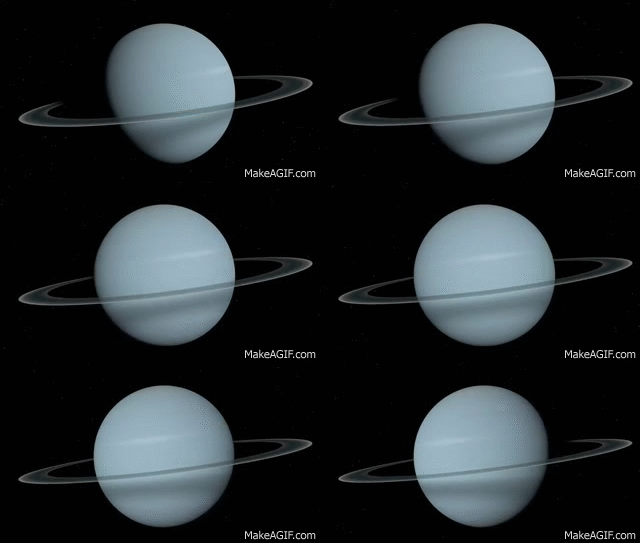
Uranus.
200
How long does a rotation of the Earth around its axis take?
About 24 hours
200
What is the name of this galaxy?
The Milky Way.
200
Name the rock planets.
Mercury, Venus, Earth and Mars.
300
The altitude and azimuth of your observed objects will change over the course of the night. Why is this?
The altitude and azimuth of observed objects change throughout the night because of the Earth's rotation, it is fixed to the observer
300
Fill in the blank:
the _____ the focal length of the eyepiece, the _____the field of view
Word Bank:
greater---lower---same
the greater the focal length of the eyepiece, the greater the field of view
300
Which category(s) of exoplanet (ES, SE, NS, JS) are not found in our Solar System?
SE
300
What is the only other planet in our solar system that is believed to be able to sustain life?
Mars
300
What does the HR-Diagram stand for
Hertzsprung-Russell Diagram
300
What is resolving Power?
The resolving power (also called angular resolution) is the ability of a telescope to separate two close images or to see fine detail in an image. Greater magnification WILL NOT resolve two images that are closer than the resolution of a telescope.
400
What phase of the moon is shown here? 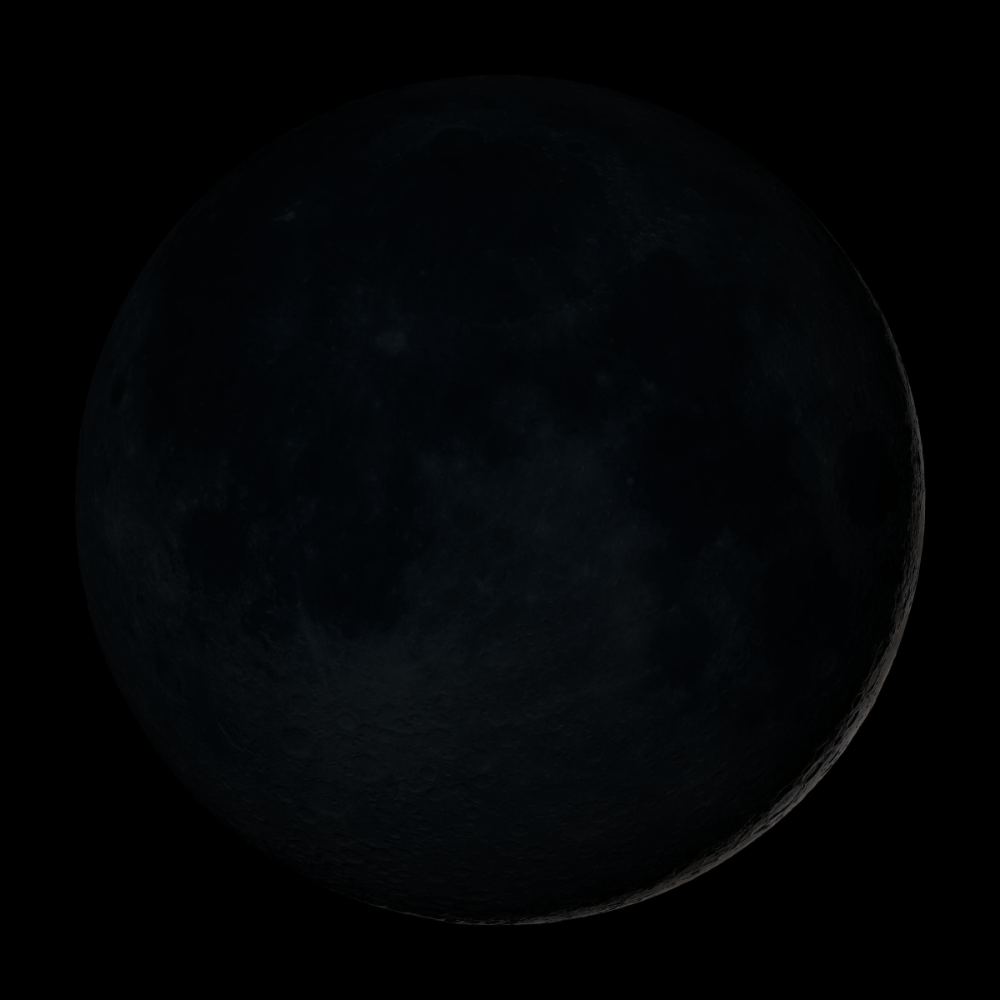
New Moon
400
Why type of spectra would each of these produce?
TOP : Continuous
Middle: Emission
Bottom: Absorption
400
What are the different types of craters?
simple craters, complex craters, and multi-ring basins
400
Why did mars atmosphere decrease in temperature compared from ancient times till now
It had water on it but since it was far away from the sun it froze and that cause a high albedo which caused temps to go down
400
What is a Galaxy?
Galaxies are systems that contain millions or even billions of stars
400
What are the 3 ways to discover exoplanets
Transit method, Radial Velocity Method, Direct Imaging
500
What causes our planet to have four seasons?
Seasons are the result of the tilt of the Earth's axis.
500
what is the 5 steps of the Scientific method ( in order )
(a) propose a hypothesis, (b) make specific predictions based on your hypothesis, (c) observe the natural world or conduct an experiment, (d) test your predictions against your measurements or observations, (e) conclude whether your hypothesis is valid or should be rejected
500
Explain how you would be able to tell by looking at the surface of a planetary body whether an external impact (asteroid) or an internal explosion/eruption (volcano) made the crater.
Impact craters will have ejecta and crater floors at a lower elevation that the surrounding area. They can be simple or complex, but the environment will show signs of having been impacted. Volcanic craters, on the other hand, will be at a higher elevation than the nearby terrain, and though they may show signs of lava flows, the ejecta characteristic of impact craters does not appear near volcanic craters. A caldera is a volcanic crater formed by the collapse of an empty magma chamber.
500
What is the name for the path that a planet takes around the Sun?
Orbit
500
On your starwheel it lists the latitude for which it has been drawn. How would the starwheel for latitude +50º differ?
You would have more circumpolar stars
500
Fill in the blank:
_______ light has _______ Wavelengths and _____ Frequencies
________light has _______ wavelengths and ______ Frequencies
Word bank:
BLUER --- LONGER -- REDDER -- HIGHER -- LOWER -- SHORTER
REDDER light has LONGER Wavelengths and LOWER Frequencies
BLUER light has SHORTER wavelengths and HIGHER Frequencies