Arts and Exploration
Social Emotional
Nature-Based
True or False
Every day scenarios
100
What is process art?
What is... an open ended project, where the goal of the project is not what the end product looks like but rather the enjoyment of the process of creation and the exploration of materials.
100
Why do toddlers and infants bite?
What is...Often times, toddlers bite because they do not have the language skills yet to communicate what they want or need. It is a typical behavior from children at this stage of development, stemming from a number of different things from experimenting with cause and effect, to feeling overstimulated, or tired.
100
What is a teacher's role when children find an unknown plant, insect, animal, object in nature?
What is... Remain calm, if it's appropriate and safe to remain in that spot a teacher's job is to ask the child open-ended questions about what they have encountered. For example an unknown bug, 'look how big it's wings are, I wonder if it came from far away. What do you think? What do you notice about it?' This fosters curiosity and deeper thinking skills.
100
It is appropriate to make children say 'I'm sorry'
FALSE - Children this young do not understand what 'sorry' means. They also may not feel sorry. Instead is ok to have them 'check in' on a peer, and talk to them about how their peer might be feeling, and how they might be feeling.
100
The bathrooms are dirty, there is laundry that needs to be done, the kitchen sink is full of dishes. None of this was your doing. Your whole team is present and your classroom is running smoothly and can be in ratio with just one teacher, what do you do?
What is... clean up even though it's not just your mess. We have a beautiful brand new space, we are a community and we all should be doing our part.
200
Is this process art? Why or why not?
What is... No this is not process art and it is not open-ended. This is a craft. The end products are all nearly identical - there is no space for creativity. Projects like these teach children there is only one way to do something. It limits their ability to be problem solvers, innovators and flexible thinkers.
200
Please explain what is restorative justice, and please give an example of how we teach it to the children in our care.
Restorative justice is teaching model focusing on repairing harm, building relationships, and resolving conflicts instead of relying on traditional punishments.
For example: A child is repeatedly unkind and exclusionary to peers. As a result, none of their peers want to play or engage with them. As educators when we recognize this situation, it is important to place ourselves on their level, and to factually explain to them, 'I notice when you are wrecking friends projects they don't want to play with you. It seems like they want some space from you because you are being unkind to them.' Then opening to conversation with prompting to help them figure out strategies to right the wrong, and what they can do moving forward.'
200
Explain two different opportunities educators can provide for infants/toddlers to engage in play in nature.
What is... get them outside and talk to them about the world around them!
One example of an activity is to give them a basket, take them on a walk and let them collect things they find along the way. Talk about what you notice with them, the color of the sky, the shape of rocks, the sounds you hear.
An example for infants would be to gather a few different natural materials/fabrics and let them explore the different textures with their hands and feet.
200
It is okay to speak about a child in front of them, positively or negatively.
FALSE. It is NEVER ok to speak negatively about a child in front of them. The only time you should be discussing a child's behavior in front of them is positively.
200
It's clean up time and a child is refusing to stop playing and help clean up the classroom. What do you do?
What is... depending on the child you can offer to save a project they are working on and they can come back to it later, use a who class motivator like if I see you cleaning you get a sticker, or you make it a challenge who can pick up more pieces faster the teacher or child.
300
Please explain, what is a provocation? Provide an example of how you might set one up outdoors.
What is... an intentional, open-ended setup of objects, materials, or questions designed to spark children's curiosity, extend their current interests, and inspire independent exploration without a predetermined end product.
An example might be that you set up a few piles of different natural materials (sticks, flowers, acorns, pinecones) and some gardening tools and the rest is up to the children to see where it goes!
300
A 3 year old opening a lunch container, a 2 year old getting outdoor gear on, and a 1 year old discovering how to feed themselves with a spoon independently, all have what in common?
What is... They are all self help skills that are important for children's growth and development. Being able to accomplish these tasks and tasks like them independently help children build confidence, stamina and problem-solving abilities.
300
A parent comes to you upset that their child is coming home dirty every day, they want to know why. How do you respond?
What is... give them an example of the activities their child has engaged in that day ex: maybe they were scooping mud into buckets and carrying it around and using stones as bricks to build a structure they were really proud of. You explain to parents all of the skills they are building by engaging in this kind of play - gross motor (moving buckets of mud) STEM + problem solving skills figuring out how to make stones stick together, and creativity etc. Assure parents that children always have the option to change their clothes and we will continue to do our best to help them clean up.
300
If a teacher/caregiver is dysregulated, children will be too.
TRUE. Children are sponges. Children often mimic behavior they see from trusted caregivers, as a way to understand themselves build connection with their adults and their environment. The calmer you are, the more regulated they will be.
300
A co-teacher is consistently leaving the classroom/playground without communicating where they are going. While you are technically in ratio, consistently being left alone for unknown amounts of time feels frustraiting /draining. How do you address this?
What is... talk to them directly and kindly about how their absence is posing challenges, and clearly express your need for clearer communication. i.e where they are going, how long it might be. Actively, continue to work as a team to keep clear communication open.
400
Explain how painting with a plunger beneficial to a child's growth and development?
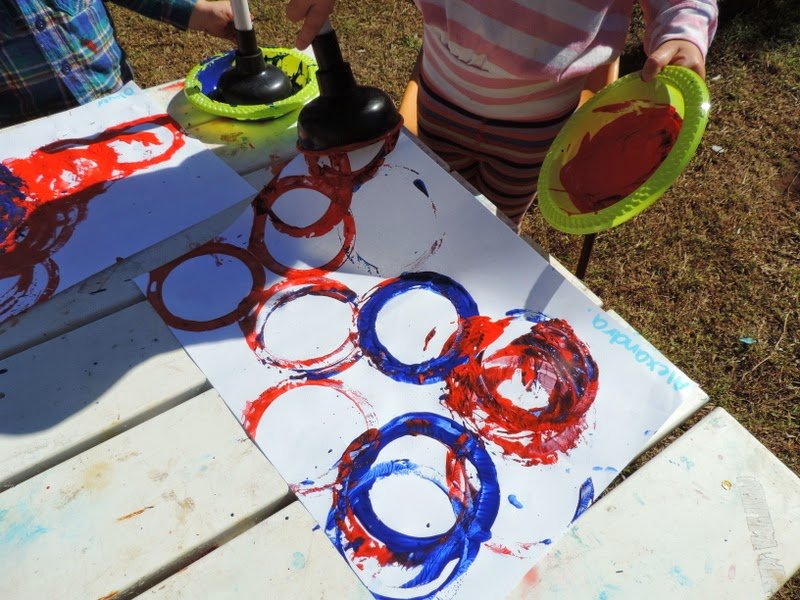
What is... Plunger painting (with designated plungers just for art) helps children build gross motor skills, explore cause and effect (shape overlapping, color mixing etc.) and fosters creative thinking skills by using an object that is not traditionally used in art. Each design ends up unique, and the process is SO much fun.
400
A child comes to you and says 'my peer hit me and I didn't like it.' What steps do you take to respond?
What is... get on their level. Ask the child if they talked to their peer about how it made them feel. If they say no, offer to support them by going with them and encourage them to speak to their peer. If they need help finding the words, prompt them to say the peers name and 'I didn't like when you hit me, please don't do that again.' Then encourage the other peer you are addressing to ask if their friend is okay, and if they can do anything for them.
We are teaching children to have advocacy skills, build empathy and problem solve.
400
Explain the benefits of having rest time outside.
What is... It helps promote calm behavior. Green spaces lower stress hormones, leading to fewer meltdowns and better emotional control. It gives them a peaceful brain break, to look up at the trees, listen to the wind, or the birds and whatever subtle sounds nature has to offer. It promotes opportunities for better sleep, natural sunlight and fresh air help children fall asleep faster and sleep longer. Nature helps children find a state of deep relaxation, it lowers stress levels all around.
400
You have just taken a child to the bathroom, they ask to go again. You do not have to take them.
FALSE. Part of our job as educators is to teach children to listen to the messages their bodies are sending them, when they are communicating a need it is our job to meet that need even if they have been to the bathroom 5 times already.
400
A child is having a difficult time separating from their parent/caregiver at drop off in the morning. How can you support the child and parent/caregiver during that initial separation and ease the transition?
What is... Work on building a solid trust between the child and yourself. Children who struggle with separation often are seeking familiarity, comfort and trust. You can reassure the child that our grown ups always come back, offer to let them help you with a special job/task, invite them to create a picture or something special they can give to their adult, offer to read a book, or some other activity you know they naturally gravitate towards and enjoy other times of day. Once the child is regulated, you can offer support to their adult sending a message to their to let them know they are okay and settled into a choice.
500
Sing a good morning/greeting song and explain why music and movement is an important part of ECE.
What is... Music and movement have been proven to strengthen brain pathways that support problem-solving, language, and memory, improve coordination and motor skills, build focus, listening, and attention skills that carry over into school readiness, aid in development of social-emotional skills like cooperation, confidence, and self-expression.
500
What is Social Emotional Learning and why does it matter?
What is... Learning the foundational pieces of being a human. These are skills that are learned through daily practice including: Building empathy, curiosity, self-expression, emotional regulation, independence, building stamina, problem-solving, creativity and inclusivity. These are skills children need in order to succeed in everything they do moving forward in school and in life.
500
Explain 4 different ways you could use these materials with your students. (Add additional materials if necessary)
. 

What is...
500
This is an appropriate incident report to send a parent. 'Your child was playing with a peer when the peer got angry and pushed her/him so your child fell down and scraped her knee. This left a huge scrape on your child's knee.'

FALSE. You do not need to include an image of a child's injury. This gives parents the impression you are placing the importance of photographing a child's injury rather than immediately providing them care. The language you use should be factual, not assuming emotions or intent of another child. A better example would be 'your child was playing with a peer, and a peer pushed your child. Your child fell and scraped their knee. We cleaned it, put a band aid on it and iced it. They are back to playing.
500
You are in ratio alone with a group of children, two children are having an argument that is escalating, another child is crying and has fallen and scraped their knee and you have another child who is dysregulated and attempting to elope. What do you do?
What is... do a risk assessment, walkie for back up from co-teachers/admin quickly explain location + situation and immediately follow child who eloping.