Eye muscles
Middle/inner ear structures
Receptor cells and sensory tissues
Miscellaneous vision questions
Miscellaneous hearing & equilibrium questions
100
What muscle abducts the eye?
Lateral Rectus Muscle
100
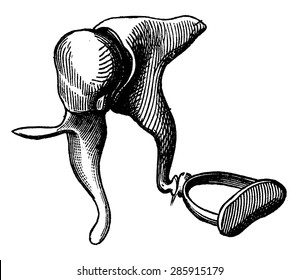
The name of this group of bones.
Ossicles.
100
Center of the retina - yellowish in color and highly pigmented.
Macula Lutea
100
What is the role of the cornea?
To bend and refract light
100
What is the technical term for ear canal?
External Acoustic Meatus (External Auditory Canal)
200
Muscle that rotates the eyeball in a clockwise rotation.
Inferior Oblique
200
Two structures of the inner ear that aid in balance and equilibrium.
Vestibule and Semicircular canals
200
respond in bright light and provide high-acuity color vision
Cons
200
In general, what results from the ciliary muscle contracting/relaxing?
Changes the shape of the lens
200

These ring-like structures on the left side of the image are partly responsible for our sense of equilibrium.
Semicircular canals.
300
Latin for straight
Rectus
300
The area where the stapes connects to the vestibule
oval window
300
are used in low light situations and give only gray tone vision
Rods
300
The technical term for our "blind spot".
Optic disc.
300
What is the function of the auricle?
Collect and funnel sound waves.
400
This muscle contracts in response to bright light.
Radial muscle(s) of the iris.
400
Name the three ossicle bones.
Malleus, Incus, Stapes
400
Fibrous tissue on which spiral organ (of Corti) rests
Basilar Membrane
400
What is the name of the gland that produces tears? Describe its location using appropriate regional and directional terms.
Lacrimal Duct - located Lateral and Superior to the Orbit
400
What structure serves as the boundary between the outer ear and middle ear?
Tympanic Membrane (Ear Drum)
500
Acts like a pulley, and is innervated by the trochlear nerve.
Trochlea
500
Tube that helps the ear equalize pressure.
Eustachian Tube
500
The name of the "hairs" that bend to facilitate hearing and equilibrium.
Stereocilia.
500
What are the main structures of the vascular tunic
choroid, ciliary body, suspensory ligaments, Iris
500
What is the primary role of the Cortex?
Organ of Hearing! Relays sensory information to the Vestibularcochlear nerve and sends it to the brain to be interpreted.