Star Birth
Star Death
Supergiants
Giants
Fun Facts
100
Which is more dense, a nebula or a star?
A star is more dense than a nebula.
A star gets its beginning as a nebula, but gravity pulls the matter into itself and also begins to rotate, eventually having great enough density and enough pressure to create enough heat & pressure for nuclear fusion to begin.
100
What happens when a star runs out of fuel?
Depending on the star's initial mass, it will either expel its outer layers to form a planetary nebula, and become a white dwarf (as our sun), or supernova then collapse into a neutron star or a black hole.
100
Name two examples of what can happen after a type II supernova.
1-Black Hole
2-Neutron star
100
About how big are white and black dwarfs?
They are both about the same size, and they both are about the size of Earth. (No black dwarf has ever been observed... but if any do exist they would be about the same size as white dwarfs. Theoretically the process would takes hundreds of billions of years, no black dwarfs are believed to exist yet.)
100
Of what are stars made out of?
Stars are made out of gas and dust... compressed. They are mainly H and He.
200
What is a nebula?
A large cloud of gas and dust in space, often illuminated and glowing, that can be found throughout the Milky Way. Nebulas are primarily composed of hydrogen and helium gas, along with smaller amounts of other elements and cosmic dust. They are often the sites where new stars are born, and hence are sometimes referred to as "stellar nurseries." Chemical reactions do occur in nebulae. If nebulae are near a star it can release intense radiation, including ultraviolet light, which can ionize gases and lead to chemical reactions. This ionization process strips electrons from atoms, creating charged ions that can then recombine or react with other ions.
So it can be thought of as a place where chemical reactions happen as well as a place where stars might be created.
200
What can escape a black hole?
Nothing can escape a black hole.
200
What causes a supernova?
A supernova is caused when a supergiant star runs out of fuel and implodes, then explodes.
As a massive star ages, it fuses heavier and heavier elements in its core, eventually reaching iron. Iron cannot be fused to release energy, so the core collapses rapidly under its own gravity since it no longer has fusion radiactive pressure.
The collapse is extremely rapid, and a huge amount of neutrinos are produced, carrying away energy.
Rebound and Explosion: The core rebounds after collapsing, launching a shock wave outwards that collides with the star's outer layers, causing a massive explosion. It loses about 90% of its mass.
200
What is a planetary nebula?
A planetary nebula is a glowing cloud of gas and dust that forms when a star like our sun reaches the end of its life (as a red giant) and sheds its outer layers during the process of becoming a white dwarf. The name is a misnomer; these nebulae are not related to planets. But those outer layers form a planetary nebula.
(Our sun would then have the core of the red giant it
had become... it is now a white dwarf. It's out material that dispersed as a planetary nebula.)
200
Do black holes have gravity?
Yes, they have immense amounts of gravity, with their mass confined to a singularity - infinitely small.
300
What element is made when hydrogen atoms combine through nuclear fusion?
The element that is created is helium.
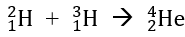
(deuterium + tritium makes helium)
300
What does a star's mass have to do with its lifespan?
A star with less mass lives longer than a star with more mass. It's an inverse relationship.
300
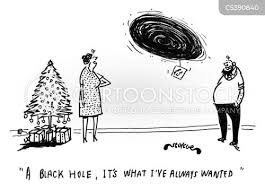
What is a black hole?
A dead super giant that has a mega-huge amount of gravity and eats anything which gets inside its event horizon. Once inside, there is no escaping ever.

300
What is a white dwarf?
The dense, hot core remnant of a red giant star that has exhausted its nuclear fuel. It's a stellar corpse, roughly the size of Earth but with the mass of the Sun. These remnants are formed when stars like our Sun shed their outer layers, creating a planetary nebula, leaving behind the core. A white dwarf is essentially the core of a red giant.
300
Which is bigger, a neutron star, or a white dwarf?
A white dwarf (about the size of our Earth) is bigger than a neutron star (about 20 km or 13 miles in diameter). A neutron star has much more mass, but it has an incredibly dense mass occupying a very small space.
400
What is a star called when it is just starting to form, but it hasn't started nuclear fusion yet?
It is called a protostar.
400
What happens to a supergiant star after it dies?
It explodes into a supernova.
Once it can no longer fuse any elements, gravity takes over and it collapses more and more, until it finally explodes! (Supernova), losing about 90% of its mass.
It then begins to be compressed by gravity again. This time it doesn't stop untl it's a neutron star or a black hole.
400
What is a neutron star?
A neutron star is the extremely dense star that remains after a super giant's death and is composed of only neutrons. It also spins extremely fast. It typicallt has more mass than our sun, but is only 20-30 km in diameter. (13 - 20 miles)
400
What is a black dwarf?
A fully dead whire dwarf. When a white dwarf cools, over hundreds of billions of years, it is not hot enough to rediate heat or light. Hence, a black dwarf. It's the final stage of a low-to-medium mass star's life cycle, like our Sun. It is believed that no black dwarfs exist in the universe because it takes too long for a white dwarf to cool down.
400
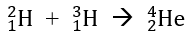
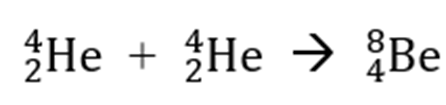
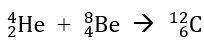
What is nuclear fusion?
Nuclear fusion is the nuclear process by which atoms combine to form heavier atoms by fusing. Example:
or
or
500
DAILY DOUBLE How does a star form?
Stars are born within nebulae through a process of gravitational collapse, where dust and gas particles clump together, ultimately forming a protostar. As the protostar collapses it begins rotatating and heating up as it becomes more dense, nuclear fusion begins, transforming it into a main-sequence star. If there is not enough matter for it to get hot enough to support nuclear fusion of hydrogen, it never becomes a star.
500
What are the radio signals that a neutron star emits?
The radio signals are called pulsars. Pulsars are neutron stars which are rotating very rapidly - sometimes a thousand cycles per second!
A pulsar is a rapidly rotating neutron star that emits beams of electromagnetic radiation, like a cosmic lighthouse. These beams sweep across space, creating the "pulses" that we observe from Earth.
500
About how long does a supergiant star’s life last?
About 1 to 10 million years.
500
About how long does a giant star’s life last?
Giant stars have relatively short lifespans compared to smaller stars. Massive stars, including those that become giants, can burn through their fuel quickly, leading to lifetimes ranging from a few million to tens of millions of years, instead of billions of years.
500
Does a white dwarf run on fuel?
No, a white dwarf does not run on fuel. It has exhausted all of its fuel and is not hot enough to fuse the heavier atoms in its core.
600
Show the progression of a star about the size of our sun for its life cycle. Describe the process, including what is going on in the core at each stage.

A --> C --> D
Main sequence --> Red giant --> white dwarf:
In main sequence (A) it "burns" only H to He;
when all of the H is fused from the core it becoems a red giant (C) where it begins to fuse He.
When the He is gone, it is compressed down to a white dwarf (D). It is simply the core of the red giant now. No fusion going on now. But it is still very hot. Takes a long time to cool down.
600
Show the progression of a star about 10 times the mass of our sun for its life cycle. Describe the process, including what is going on in the core at each stage. What does it become when it dies?

Main sequence --> Supergiant --> Neutron star:
(It doesn't have enough mass to become a black hole.) A --> B --> neutron star
In main sequence (A) it "burns" only H to He;
when all of the H is fused from the core it becomes a Supergiant (B) where it begins to fuse He.
When the He is gone, it undergoes a supernova and after is compressed down beyond the electron degeneracy pressure which stops smaller suns from further compression. But, though a big boy, it does not have enough gravitational force to overcome the neutron degeneracy pressure. So it is now composed of just neutrons... hence, a neutron star.
600
How large does a star's mass have to be (in terms of multiples of the mass of the sun) in order to become a black hole.
and
After the supernova explosion it would undergo, how large must its mass now be in order to become that
black hole?
20 - 30 Msun (18 Mo - ok)
and
> 3.0 Msun
600
Describe the difference between a red giant and a supergiant. (Include their mass and what they would become.)
A red giant comes from a star which was the size of our sun to nearly 8 times that size . After becoming a red giant, our sun would compress down to about the size of our sun or less. Those stars which after their red giant experience and dying drop down to greater than 1.44 Msun will become a neutron star. But red giants do not typically do this - they become white dwarfs.
So a supergiant reduces down to > 1.44 Msun, while a red ginat ends up < 1.44 Msun, and hence white dwarf.
Supergiants become either neutron stars or black holes... dependant on their mass.
600
Describe two ways in which we can indirectly observe or detect evidence of black holes.
:-)
Black holes can't be directly observed due to their strong gravity that prevents light from escaping. However, their presence can be inferred through indirect observations of their gravitational effects on surrounding objects and by detecting the radiation emitted by matter falling into them:
1) Gravitational Influence on Stars and Galaxies:
Black holes have incredibly strong gravity that can warp the spacetime around them. This gravitational influence can be observed by tracking the orbits of stars and gas clouds that orbit the black hole.
2. Accretion Disk Radiation:
As matter falls into a black hole, it forms a hot, swirling disk of gas and dust called an accretion disk. The intense friction and compression within the accretion disk cause it to emit powerful radiation, including X-rays, which can be detected by telescopes.