Stars
H - R Diagram
Miscellaneous
The Sun
Using an H - R Diagram
100
The Color of a Star depends on its:
a. Size
b. Temperature
c. Shape
d. Magnitude
Answer: b. Temperature
100
Put the colors of stars in order from HOTTEST to COOLEST.
Blue, White, Yellow, Orange, Red
100
Stars are composed mainly of what two elements?
Hydrogen and helium
100
Cooler areas that produce dark areas on the sun's surface.
Sun Spots
100
What category do the Sun and most stars belong to?
Main Sequence
200
The color red represents the color of the __________ stars in the universe
Coolest
200
The H-R Diagram shows the relationship of a star's surface temperature and its: a. Color b. Apparent Magnitude c. Size d. Luminosity
Answer: d. Luminosity
200
What kind of star is the sun? (Refer to temperature, brightness)
Answer: Average temperature and brightness; main sequence.
200
A straight stream of gas shooting out from the area of a sunspot.
Solar flares
200
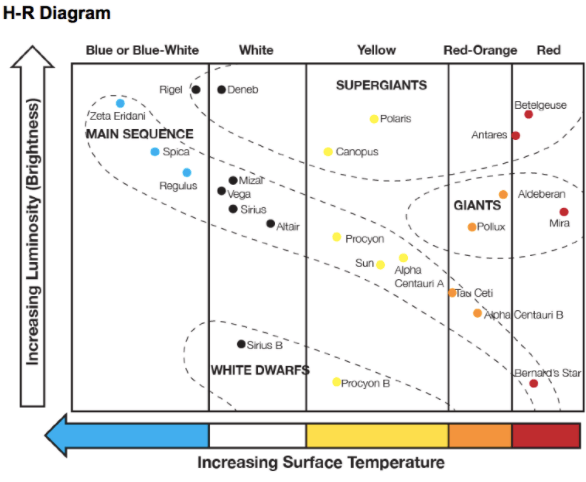
Which star is the dimmest?
Barnard's Star
300
The brightness of a star as seen from planet earth is known as: __________________.
Apparent Magnitude
300
Where are red giants and red supergiants located on an HR diagram?
The top right
300
What characteristic of stars can be measured using luminosity?
Brightness
300
Solar flares cause this beautiful phenomenon visible in the northern (or southern) regions of the Earth.
Aurora borealis, Aurora australis, or Northern Lights
300
Which star is the hottest?
Zeta Eridani
400
How is it possible for a star that is actually dimmer than another star to appear brighter to an observer on Earth?
Because it is closer to Earth, the apparent magnitude is greater. Distance
400
Describe a star located at the top left corner of an HR diagram.
Bright and hot
400
What is the name of the process by which stars get their energy?
Nuclear fusion
400
The zone where matter heats, rises, cools, and sinks.
Convection Zone
400
Which star is the coldest giant?
Mira
500
Star A has an apparent magnitude of -4 and an absolute magnitude of 2.
Star B has an apparent magnitude of 3 and an absolute magnitude of -8
Which star is brighter?
Answer: Star B is brighter because it has a more negative absolute magnitude.
500
Fill in the blanks:
A white dwarf is but than the sun.
Hotter, Dimmer
Hotter, Smaller
500
What is the largest layer of the Sun?
Corona
500
The layer of the sun that gives off light. It is often called the sun's surface.
Photosphere
500
Which star is the hottest supergiant?
Rigel