Thermo-Thrills
Momentum Mayhem
Electric Avenue
Kinetic Komedy
Potentially Hilarious
100
The energy needed to raise the temperature of 1 kg of a substance by 1 K.
What is
SPECIFIC HEAT
100
The average net force exerted on the object multiplied by the time interval over which the force acts.
What is
AN IMPULSE
J = F . t
100
The ratio of the net charge on one plate to the potential difference, measured in farads, between two plates of a capacitor.
What is
CAPACITANCE
100
The movement of an object at a constant speed around a circle with a fixed radius.
What is
UNIFORM CIRCULAR MOTION
100
The energy of a compressed spring or a stretched rubber band.
What is
ELASTIC POTENTIAL ENERGY
200
A device which converts thermal energy to mechanical energy.
What is
A HEAT ENGINE
200
A type of collision where two objects stick together and move on with a common final velocity.
What is
PERFECTLY INELASTIC COLLISION
200
The distance between the plates where a constant electric field of 250 N/C is between a set of parallel plates that have a potential difference between them of 12.0 V.
What is
0.048 METERS
200
The velocity of the beach ball relative to the ground when Lois and Leo are riding their unicycles side by side. They are heading east at a speed of 3.5 m/s. Lois tosses a large beach ball over to Leo with a velocity of 0.76 m/s north.
What is
3.6 m/s 12o North of East
200
Compare the kinetic energies for a biker and bike (with a combined mass of 80.0 kg) traveling at 3.00 m/s and the same biker and bike traveling twice as fast.
What is
KE2 is 4x greater than KE1.
300
The law which states that whenever there is an opportunity for energy dispersal, the energy always spreads out.
What is
THE SECOND LAW OF THERMODYNAMICS
300
The law which states that if no net external torque acts on a closed system, then its angular momentum does not change.
What is
THE LAW OF CONSERVATION OF ANGULAR MOMENTUM
300
The law which states that the force between two charged particles varies directly with the product of their charges and inversely with the square of the distance between them.
What is
COULOMB'S LAW
300
The law that states for every action there is an opposite and equal reaction.
What is
NEWTON'S THIRD LAW
300
The law which states that within a closed, isolated system, energy can change form, but the total amount of energy is constant.
What is
THE LAW OF CONSERVATION OF ENERGY
400
The thermal energy lost by a 1.0-kg block of aluminum is at a temperature of 50°C when its temperature is reduced by half
The specific heat of aluminum is 897 J/(kg •K).
What is
- 22,425 JOULES
400
The time it takes for a force with a magnitude of 9.0 N to stop the skateboard and dog when a 24.0-kg dog running at a speed of 3.0 m/s jumps onto a stationary skateboard that has a mass of 3.6 kg.
What is
8 SECONDS
400
The current measured by Ammeter #1.
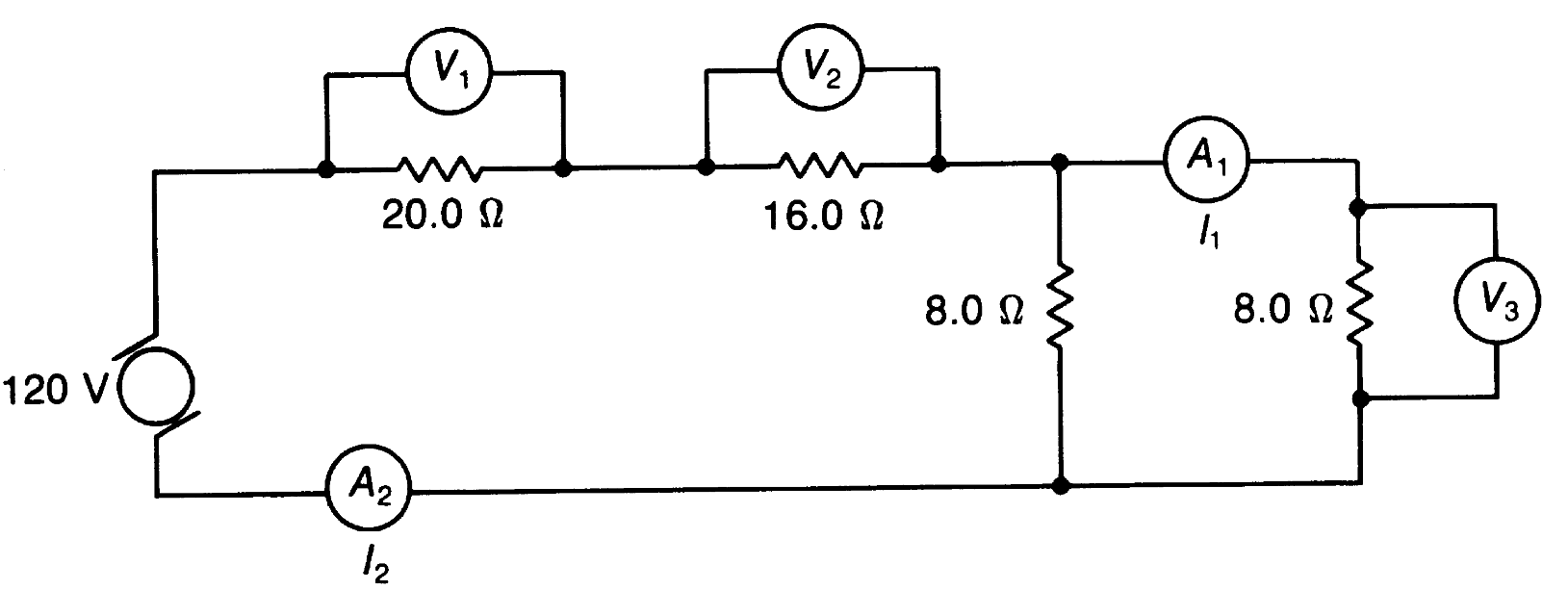
What is
1.5 AMPERES
400
The resultant and equilibrant of the following three forces act on a single small mass: 50.0 N 30° south of east, 100 N 45° south of west, and 100 N 45° west of north.
What is
101 N, 14o SOUTH OF WEST (RESULTANT)
101 N, 14o NORTH OF EAST (EQUILIBRANT)
400
During a contest that involved throwing a 7.0-kg bowling ball straight up in the air, one contestant exerted a force of 810 N on the ball. If the force was exerted through a distance of 2.0 m, how high did the ball go from the point of release?
What is
24 METERS
500
The thermal energy that is absorbed by a 250-g block of ice as it is removed from the refrigerator at -8.0°C and warmed to room temperature (22oC).
Heat of fusion of water is 3.34 x 10⁵ J/kg.
Heat of vaporization of water = 2.26 x 10⁶ J/kg
Specific heat of ice = 2060 J/(kg-K)
Specific heat of water = 4180 J/(kg-K)
Specific heat of vapor = 2020 J/(kg-K)
What is
110,610 JOULES
500
A ball with a mass of 12 g is moving at 15 m/s. It collides with a second ball with a mass of 36 g moving at 5 m/s in the same direction. After the collision, the 12-g ball moves at 6.0 m/s. How great is the change in momentum of the 36-g ball?
What is
0.11 kg-m/s
500
The distance two protons must have if the electrostatic force between them is equal to the weight of a single proton.
A proton has a mass of 1.67 x´10-27 kg and a charge of 1.60 x 10⁻¹⁹ C.
What is
0.12 METER
500
The time it takes for a plane which drops a rescue capsule from an altitude of 8500 m to fall to Earth, assuming air resistance is negligible?
What is
42 SECONDS
500
A 50.0-kg skater and skateboard leaves the right side of the ramp shown below at a speed of
7.0 m/s. If the ramp is frictionless, what was his initial speed at the top of the left side of the ramp?
What is
4 m/s