Elimination
Substitution
Graphing
Vocabulary/Grab Bag
Linear Inequalities
100
x + 3 y = 5
2x - 3y = -8
(-1,2)
100
y = 2
3x + 2y = 10
(2,2)
100
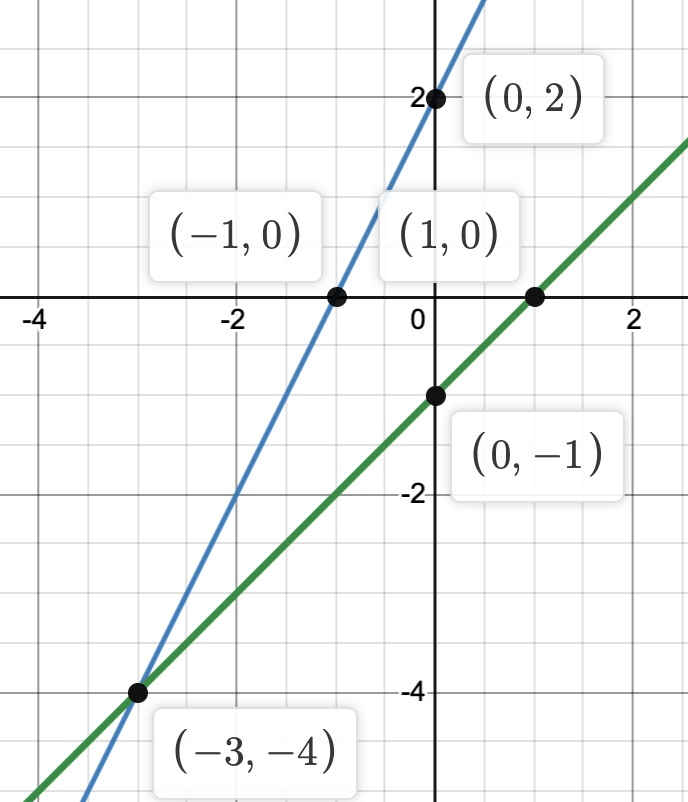
y = 2x + 2
y = x - 1
(3,-4)
100
What are the 3 methods of solving systems of equations?
graphing, substitution, and elimination
100
When graphing linear inequalities what does < and > mean?
Dashed/Broken Line
200
4x - 3y = 16
5x + 3y = 20
(4,0)
200
y = x + 1
2x + y =10
(3,4)
200
y = 2x + 5
y = x + 3
(-2,1)
200
What do you use in identifying which side to shade in the graph of a linear inequality?
Test Point
200
If we graph y > 3, will we draw a horizontal line or a vertical line?
horizontal line
300
-2x - 9y = -25
-4x - 9y= 23
(-1,3)
300
y = 5x - 1
2y = 3x + 12
(2,9)
300
3x - 2y = 8
x + y = 6
(4,2)
300
True/false: If a sign is greater than or less than, the line be dotted.
False.
300
A greater than or equal to sign will result in which type of line?
solid
400
4x - 9y = 2
12x - 5y = -38
(-4,-2)
400
2x - 3y = -2
y= -4x + 24
(5,4)
400
y = 1/2x + 2
y = 1/4x + 4
(8,6)
400
Lines should always be written in this form before graphing.
It should be in slope-intercept form
400
How is graphing inequalities different than graphing systems of equations?
they use dotted lines sometimes and you have to shade to find the solution
500
5x + 2y = 48
3x + 2y = 32
(8,4)
500
x + y = 10
-y = 5 + x
no solution
500
4x - 5y = 15
8x + 5y = 45
(5,1)
500
When solving a system of equations, what method is used in looking for opposite variables and cancelling both?
Elimination
500
Solve the inequality (graph)
y ≤ x − 2
Start at (0,-2), move up one right one, solid line shade below.