The Constitutional Convention
The Constitution
Congress & the branches
Powers of state & national government
Amendments
100
Why is Shays’ Rebellion an important event in U.S. history?
A. It was the beginning of a civil war.
B. It led to the Constitutional Convention.
C. It showed the strength of the Massachusetts militia.
D. It highlighted government power under the Articles.
B. It led to the Constitutional Convention.
100
Why is James Madison known as the “Father of the Constitution”?
A. He came up with the three compromises that were reached.
B. He knew more about government than anyone else present.
C. He was the oldest delegate to the Cons6tu6onal Convention.
D. He was well prepared to lead the discussion at the convention.
D. He was well prepared to lead the discussion at the convention.
100
What is the primary work of Congress?
A. to make laws for the country
B. to debate whether laws are constitutional
C. to determine who will be the candidate for president
D. to be the chief executives of the states they represent
A. to make laws for the country
100
All of these are advantages to having states share a common market except that
A. it creates a single national economy.
B. trade outside of the country is prohibited.
C. a large business can be located in several states.
D. goods and resources can move more easily across the country.
B. trade outside of the country is prohibited.
100
An amendment to the Constitution can be ratified by three-fourths of the
A. Senate.
B. citizens.
C. state legislatures.
D. Supreme Court justices.
C. state legislatures.
200
In the period after independence, what did Congress fear about a strong central government?
A. states would have too much power
B. rights for which people fought would be lost
C. another war would occur between Great Britain and America
D. laws would be passed to prevent people from colonizing new territories
B. rights for which people fought would be lost
200
What was the greatest concern of the opponents to the Constitution?
A. taxation would be eliminated
B. selection of George Washington as president
C. replacement of the Articles of Confederation
D. giving up state power to form a stronger Union
D. giving up state power to form a stronger Union
200
All of these are duties of the executive branch except:
A. negotiating treaties.
B. carrying out the laws.
C. proposing new taxes.
D. nominating federal judges.
C. proposing new taxes.
200
The rule of law aims to
A. ensure that no one is above the law.
B. enable Congress to write legislation.
C. limit the power of the police.
D. support the First Amendment.
A. ensure that no one is above the law.
200
Which of these would not be protected by the First Amendment?
A. criticizing officials in an editorial
B. debating controversial issues in class
C. promoting ideas that are unpopular
D. damaging property in a protest march
D. damaging property in a protest march
300
What was the long-term effect of the Northwest Ordinance of 1787?
A. Territories eventually became states.
B. The farmers of Massachusetts rebelled.
C. George Washington was elected president.
D. Slavery was expanded in the United States.
A. Territories eventually became states.
300
How is the Constitution organized?
A. into parts called articles
B. into sentences called sections
C. into columns called delegations
D. into paragraphs called statements
A. into parts called articles
300
What name is given to the Supreme Court’s power to declare a law unconstitutional?
A. federalism
B. veto power
C. impeachment
D. judicial review
D. judicial review
300
How does freedom of the press help maintain a democratic society?
A. It provides jobs for journalists.
B. It allows individuals to be informed.
C. It prevents politicians from giving opinions.
D. It requires newspapers to charge a low price.
B. It allows individuals to be informed.
300
The right to a speedy trial falls under the
A. Second Amendment.
B. Third Amendment.
C. Sixth Amendment.
D. Tenth Amendment.
C. Sixth Amendment.
400
What did the Great Compromise decide?
A. representation in Congress
B. the names of political parties
C. the system of checks and balances
D. process of selecting the president
A. representation in Congress
400
Why does each state have two senators?
A. to balance the rights of large and small states
B. so the Senate does not become overcrowded
C. to assure there are enough people to pass the laws
D. so that one can take over if the other is unavailable
A. to balance the rights of large and small states
400
Which of these powers should be in the middle section of this Venn Diagram?
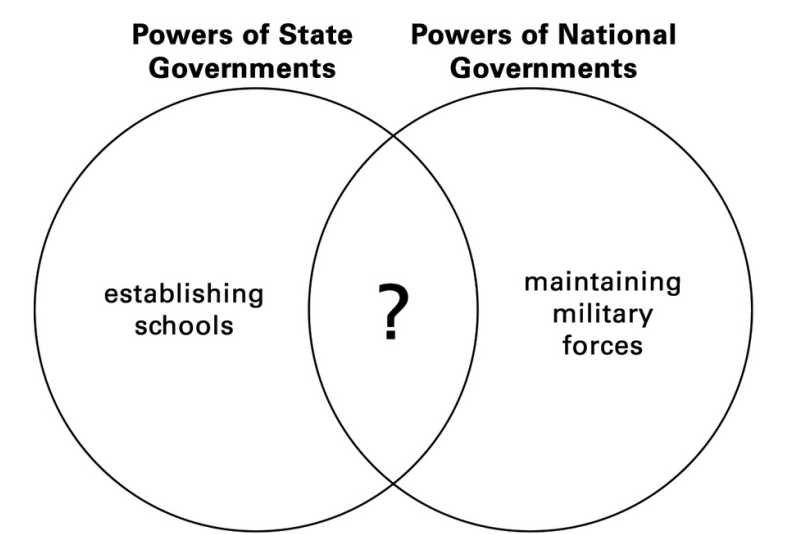
A. raising taxes
B. declaring war
C. printing money
D. negotiating treaties
A. raising taxes
400
Which of the following would be a violation of the rule of law?
A. The same rules apply to all people applying for a protest permit.
B. The requirements for a protest permit vary depending on the applicant.
C. All protest permit applications go through the same review process.
D. The laws regarding protest permits can be viewed online
B. The requirements for a protest permit vary depending on the applicant.
400
To which of these experiences did these three amendments respond?
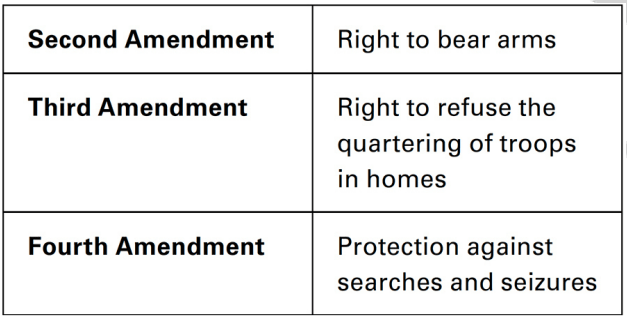
A. slavery in America
B. the relocation of Indigenous people
C. British colonial rule of America
D. the treatment of immigrants in America
C. British colonial rule of America
500
The delegates to the Constitutional Convention agreed to establish a republic. Which of these describes a republic?
A. a country led by a president
B. a government led by a powerful few
C. a parliamentary form of government
D. a country led by elected representatives
D. a country led by elected representatives
500
Which of these describes a federal system of government like that described in the U.S. Constitution?
A. Government is run by one political party.
B. A single leader makes all of the government decisions.
C. Individual states have power over the national government.
D. Power is shared by the national and state governments.
D. Power is shared by the national and state governments.
500
In 1788, why did several states refuse to approve the U.S. Constitution?
A. It did not list the rights of the people.
B. It did not include the branches of government.
C. It did not indicate who would be the chief executive.
D. It did not allow for changes to be made in the future.
A. It did not list the rights of the people.
500
One purpose of the Bill of Rights is to
A. determine the election process.
B. limit the power of the federal government.
C. rewrite the Constitution.
D. outline the responsibilities of Congress.
B. limit the power of the federal government.
500
Why are these two amendments included in the Bill of Rights?
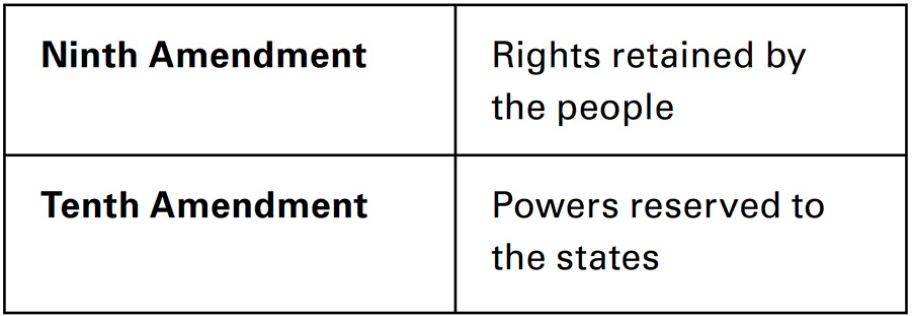
A. to prevent the addition of rights
B. to give states the power to limit rights
C. to allow for changes to the Constitution
D. to keep a balance of power and rights
D. to keep a balance of power and rights