Heat Transfer 1
Heat Transfer 2
Land Vs Water
Water Cycle
RANDOM
100
What type of heat transfer is when hot fluids rise and cool fluids sink?
What is Convection
100
Heat moves from the _____ object to the ______ object. DOUBLE POINTS
hotter ; cooler
100
Which surface generally absorbs and heats up from solar energy more quickly?
A. Land
B. Water
C. Deep Ocean Water
D. Ice in Polar regions
A. Land
100
What is the process by which liquid water changes into water vapor?
Evaporation
100
Which source provides most of the energy that drives Earth’s atmospheric movement?
A. Moon
B. Sun
C. Ocean Tides
D. Tectonic Plates
B. Sun
200
The transfer of heat through electromagnetic waves
Radiation
200
Beneath the Earth's crust hot magma is rising and cool magma sinking.
Convection
200
Why do coastal areas often have smaller temperature changes than inland areas?
Water heats and cools more slowly than land
200
Which of these is an example of precipitation?
a. Air
b. Snow
c. Clouds
b. snow
200
What is an Aquifer?
A layer of rock which can transmit groundwater
300
What type of heat transfer occurs through direct contact when objects are touching?
What is Conduction
300
Feeling the warmth from a campfire.
Radiation
300
A region experiences several days of warm, sunny weather followed by increased cloud cover and rain. Which explanation best connects the weather to the water cycle? DOUBLE POINTS
a. Sunny weather prevented water from entering the atmosphere
b. Cloud cover caused all surface water to freeze
c. Warm temperatures increased evaporation, and the water vapor later condensed into clouds and precipitation
d. Rain caused water vapor to disappear from the atmosphere
c. Warm temperatures increased evaporation, and the water vapor later condensed into clouds and precipitation
300
What process moves water vapor from the atmosphere to Earth’s surface as rain, snow, sleet, or hail?
Precipitation
300
A weather station records warm temperatures, strong winds, and high humidity. Which condition most likely contributed to these observations?
a. Low evaporation and sinking dry air
b. Increased evaporation adding water vapor to rising air
c. Freezing water removing energy from the atmosphere
d. Condensation stopping all air movement
b. Increased evaporation adding water vapor to rising air
400
What method of energy transfer is this?
(Description: Heat flows from the hotter cup into the cooler hands. )
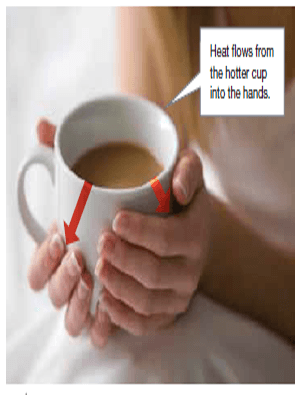
Conduction (energy transfer via contact)
400
People sitting around a campfire are able to feel the heat from the fire. How are the people able to feel the heat from the fire without touching the fire?
a. The heat from the fire travels through the ground and heats the ground around the people.
b. The heat from the fire is conducted through air molecules to the people.
c. The heat from the fire rises in the air and then settles around the people.
d. The heat from the fire radiates from the fire to the people.
D
400
What is the main cause of differences in solar heating between Earth’s equator and its poles?
A. Earth’s oceans stopping sunlight
B. Earth’s curved surface and the angle of incoming sunlight
C. Moon blocking sunlight at the poles
D. Earth’s atmosphere producing sunlight
B. Earth’s curved surface and the angle of incoming sunlight
400
Which is the opposite of condensation? DOUBLE POINTS
a. Runoff
b. Evaporation
c. Precipitation
d. Transportation
b. Evaporation
400
A coastal city and an inland city are at the same latitude. During summer, the inland city becomes much hotter during the day. Which explanation best uses evidence about solar energy and Earth’s surfaces?
a. Land warms faster than water, so the inland surface transfers more heat to the air during the day
b. The inland city receives no solar energy at night
c. Ocean water causes inland air to stop moving
d. Water warms faster than land, so the inland surface transfer more heat to the air during the day
a. Land warms faster than water, so the inland surface transfers more heat to the air during the day
500
What method of heat transfer is shown here?
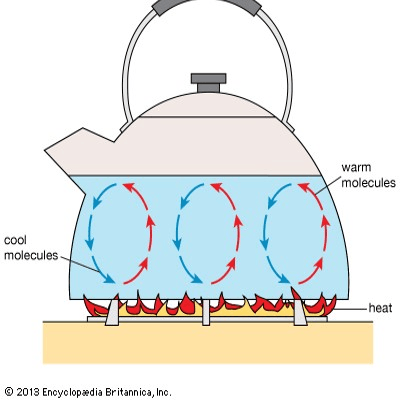
Convection heating (hot fluid rises, cool fluid sinks)
500
Stirring a cup of hot tea causes a metal spoon to get warm. Which statement best explains why the spoon gets warm?
a. Heat energy transfers from the metal spoon to the hot liquid.
b. Heat energy transfers from the hot tea to the spoon.
c. Heat energy transfers from the air to the hot liquid, and then to the spoon.
d. Heat energy transfers from the hot liquid to the cup, and then to the spoon.
B
500
During the day, land heats faster than nearby ocean water. Which local wind pattern is most likely to occur?
a. Both land and ocean air move upward at the same speed
b. Air stops moving because land and water have different temperatures
c. Warm air rises over the ocean, and cooler air moves from land toward the ocean
d. Warm air rises over land, and cooler air moves from the ocean toward land
d.
Warm air rises over land, and cooler air moves from the ocean toward land
500
Which sequence correctly describes part of the water cycle?
a. Freezing → precipitation → evaporation
b. Precipitation → condensation → evaporation
c. Evaporation → condensation → precipitation
d. Condensation → evaporation → precipitation
c. Evaporation → condensation → precipitation
500
A town has had unusually warm temperatures for a week. Scientists observe that nearby plants and lakes are releasing more water vapor. Which prediction is best supported by these observations? DOUBLE POINTS
a. The town will experience no changes in weather
b. More water vapor will permanently stop cloud formation
c. More water vapor may lead to increased cloud formation and possible precipitation
d. The atmosphere will lose all of its moisture
c. More water vapor may lead to increased cloud formation and possible precipitation