Hindbrain S&F
Midbrain S&F
Forebrain S&F
Lobes S&F
Cortexes S&F
100
Located above the spinal cord
Medulla Oblongata
100
Location of mid-brain
Between the hid-brain and the fore-brain
100
Structures that sit at the end of each hippocampal arm and is important for processing and receiving memories
Amygdala
100
Controls judgement, planning, decision making, emotions, inhibition, and motor movements
Frontal Lobe
100
Controls motor movements, located behind frontal lobe
Motor Cortex
200
Located just above the Medulla and towards the front also controls facial expressions and arousal
Pons
200
A net-like formation of cells, extends from the hind-brain into the mid-brain
Reticular Formation
200
A small structure right next to and underneath the Thalamus; controls body temperature, sexual arousal, hunger, thirst, the endocrine system
Hypothalamus
200
Responsible for visual processing (sight)
Occipital Lobe
200
Located on the outermost layer of the brain
Cerebral Cortex
300
Located on the bottom rear of the brain and is responsible for fine muscle movements, balance, and posture (little brain)
The Cerebellum
300
Pea-sized gland that controls several other hormone glands in your body; sometimes called the master gland
Pituitary Gland
300
The two arms surrounding the thalamus where memories are processed
Hippocampus
300
Located between sensory cortex and occipital lobe
Parietal Lobe
300
Located between the motor cortex and parietal lobe
Sensory Cortex
400
Regulates heart-rate, blood flow, and respiratory movements
Medulla Oblongata
400
Regulates arousal and the ability to focus attention
Reticular Formation
400
Receives information from all of the senses except smell; sits at the top of the brain stem
Thalamus
400
Two areas of the brain; one controls production of language and the other controls understanding or meaning of language
Broca's Area and Wernicke's Area
400
Is responsible for touch sensation
Sensory Cortex
500
Begins at the end of the brain stem and continues down almost to the bottom of the spine; consists of nerves that carry incoming and outgoing messages between the brain and the rest of the body
Spinal Cord
500
What is the highlighted area
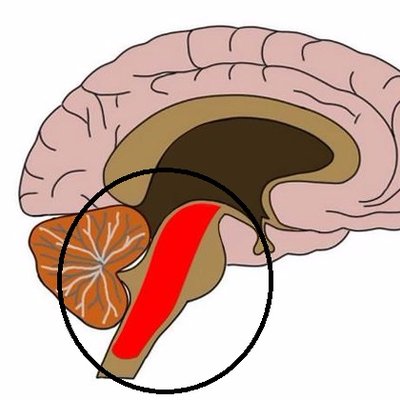
Reticular Formation
500
Allows the transfer of information between the two hemispheres and is located near the center of the brain
Corpus Callosum
500
Located underneath the frontal lobe, motor cortex, sensory cortex, and parietal lobe
Temporal Lobe
500
Gray wrinkled surface made of densely packed neurons
Cerebral Cortex