People
Economic
Social
Political
Vocabulary
100
Who was Jacob Riis, and why was he important?
An immigrant from Sweden and a photojournalist; he highlighted the inequality faced by factory laborers and immigrants mostly in the housing sector, demonstrating the poor conditions of tenement housing through writing and photography.
100
Define "monopoly"
Total control over goods and services in a market
100
Where did many immigrants live during the Gilded Age?
Tenement housing
100
Which Gilded Age politician was the "poster child" of the Spoils System?
Roscoe Conkling
100
Define the Spoils System.
System when political positions were rewarded to loyal supporters & used like currency, rather than rewarded to those most qualified.
200
Tell me who one of the following women was, and explain why they were important: Elizabeth Cady Stanton or Susan B. Anthony
Stanton: writer & philosopher of the women's rights movement, wrote Declaration of Sentiments, organized Seneca Falls, Co-founder/president of NAWSA, all while married w/ 7 kids.
Anthony: Public speaker and social organizer of women's rights movement, arrest & fined for illegally voting in 1872 election, lobbied Congress every year for women's suffrage, dying 14 years before it was passed.
200
Name the primary industries of all four "Robber Barons/Captains of Industry".
Vanderbilt: steamships and railroads
Rockefeller: oil and railroads
Carnegie: Steel
Morgan: Finance
200
Explain the precedent set by the Supreme Court case Plessy v. Ferguson.
Separate but equal is acceptable for public services as long as they are actually equal; "separate treatment alone does not imply inferiority."
200
What was the difference between "Stalwart" and "Half-breed" Republicans?
Stalwarts were strict on civil rights and pro-Spoils System; Half-breeds were moderate on civil rights and anti-Spoils system
200
The term "Gilded Age" comes from a novel by which American author?
Mark Twain
300
Explain the significance of at least two of the following people: Booker T. Washington, W.E.B. Dubois, Ida B. Wells.
Booker T.: wrote the Atlanta Compromise; argued that equality will follow when Blacks prove their economic value, accept segregation for now
W.E.B.: wrote the Talented Tenth & Double Consciousness theories; the educated minority of Blacks should fight for equality, education is the key to equality
Ida B.: the Power of Truth; exposing violence and inequality will correct it, women & Black rights activist, unique intersectionality as African American and woman
300
Why is Andrew Carnegie considered a perfect example of the "American Dream"?
He is an immigrant who started working in a factory at age 13 and rose up to become one of the most powerful businessmen in history.
300
How were Susan B. Anthony and Elizabeth Cady Stanton notably different?
Stanton was married with 7 children, Anthony never married.
300
Explain the Compromise of 1877.
Also known as the Corrupt Bargain, the compromise between Democrats and Republicans allowed Republicans to retain control of the Presidency as long as they backed off of Reconstruction in the South.
300
What was Hull House?
A complex in Chicago established by Jane Addams that employed college-educated women focused on helping immigrants find housing, employment, etc.
400
Explain why the Ulysses S. Grant administration is impactful - include both positive and negative impacts of his presidency and specifically identify a scandal his administration was involved in.
Initially successful Reconstruction president, eliminated the KKK, his administration was plagued with economic recession (Panic of 1873) and corruption, including the Credit Mobilier, Whiskey Ring, and Belknap scandals.
400
Explain the difference between Horizontal and Vertical Integration, and give a historical example of each.
Horizontal = buying out competitors to control more of a market. Vanderbilt's steamships & railroads
Vertical = controlling every stage of a production process. Rockefeller's oil and railroads
400
Define the Cult of True Womanhood/Cult of Domesticity and explain it's impact.
A set of social expectations for women surrounding four cardinal virtues; piety, purity, submission, domesticity; and splitting life into "public" and "private" spheres where men and women were meant to stay. The culture argues that women are morally superior and therefore must be protected from the dirt and corruption of public life.
400
Explain what Jim Crow laws were and why they were impactful.
Jim Crow laws were state, county, and city laws that deliberately restricted the rights of Black Americans. They came in both de jure (by law) and de facto (in fact) forms, and most commonly resulted in the segregation of public services, restriction of suffrage, restriction of intermarriage, and employment and housing restrictions. These laws created loopholes that prevented African Americans from achieving legal equality until the 1950s and 60s.
400
Identify & define the Reconstruction Amendments (each of them!)
13th: abolished slavery/involuntary servitude
14th: birthright citizenship
15th: the right to vote shall not be restricted on basis of race
500
Knowing that this political cartoon was published at the beginning of President Arthur's term, explain how this cartoon is ironic.
The cartoon is ironic because it depicts Arthur "conjuring" political appointments out of a hat, actively promoting the Spoils System. Yet as his term progressed, President Arthur actively opposed the Spoils System and signed the Pendleton Civil Service Reform Act.
500
Tell me who one of the following men was, and explain why they were important: Cornelius Vanderbilt, John D. Rockefeller, Andrew Carnegie, J.P. Morgan
Vanderbilt: steamship & railroad tycoon who entered business by overthrowing monopolies; he was famous as the first "robber baron" exemplifying corporate greed and power using horizontal integration
Rockefeller: Ruthless oil and railroad who eliminated competition using vertical integration; controlled 90% of U.S. oil production at his peak, one of the richest men who ever lived.
Carnegie: Steel tycoon who was famous for his vocal support of labor unions and his "Gospel of Wealth" speech as well as donating hundreds of millions upon his death; also famous for violently quelling worker strikes.
Morgan: Banking tycoon who kept multiple industries afloat and aided other tycoons in eliminating competitions, monopolized several industries, bailed out the Federal government twice
500
Define the Chinese Exclusion Act, and explain why it was impactful.
The Chinese Exclusion Act banned Chinese immigration for a period of 10 years and enacted harsh financial and criminal punishments on Chinese people trying to immigrate or on those who helped them. It's impactful because it's targeting a specific racial group and it was justified using harmful racial accusations. It made it difficult, if not impossible, for existing legal immigrants to become citizens, vote, etc. It also, ironically, reduced white employment in the U.S. by nearly 30%.
Eventually it would influence the Immigration Act of 1924, which had even bigger consequences that we'll talk about.
500
Explain the Pendleton Civil Service Reform Act and why it was important.
The Act created merit-based political appointments, civil service exams, prohibited campaign donations on federal property, made it illegal to fire/demote federal employees for political reasons. It was a bipartisan bill introduced by a Democratic representative & supported by a Republican president that essentially destroyed the Spoils System.
500
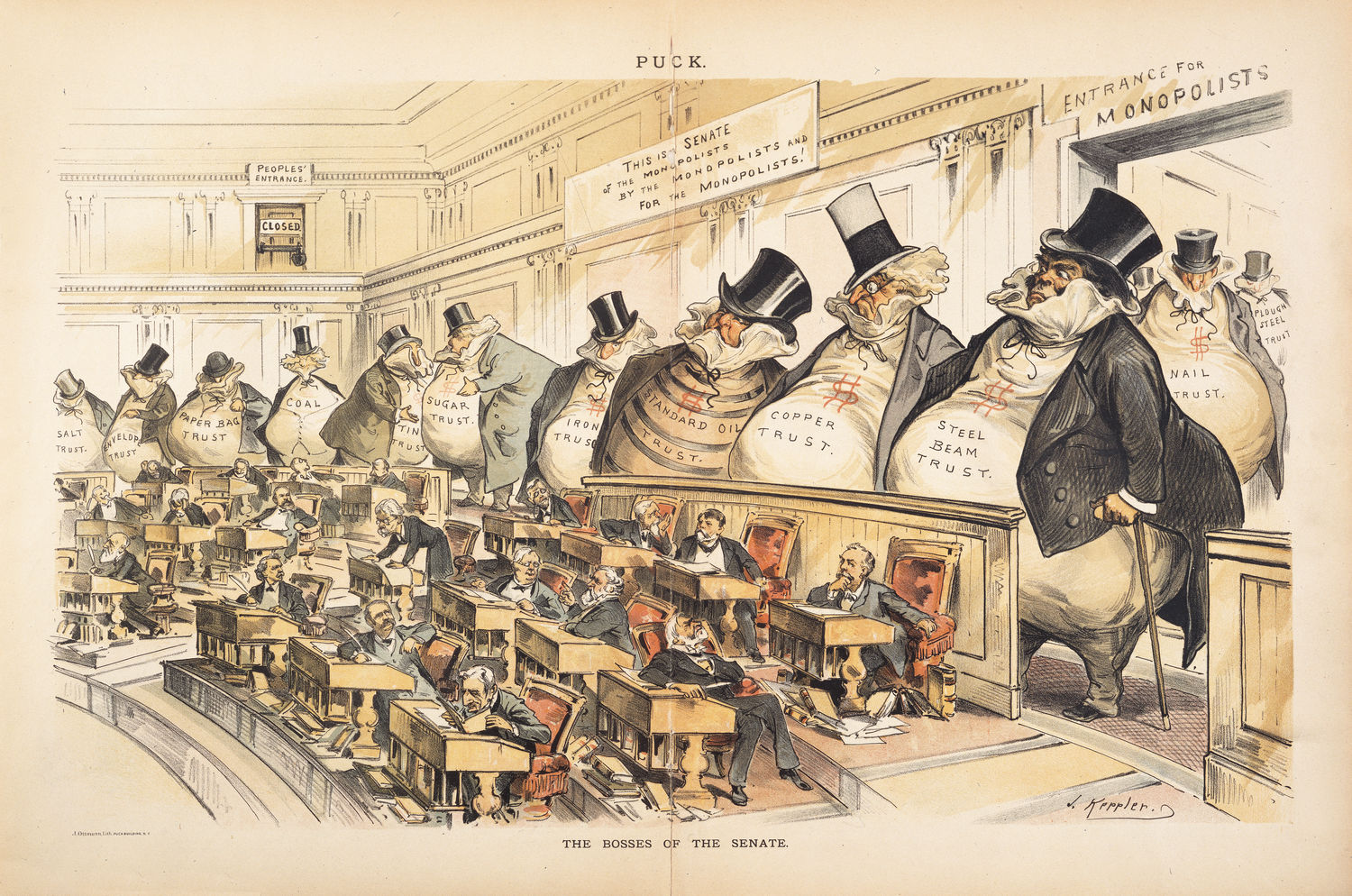 Which two historical lenses does this cartoon most directly fall under?
Economic and Political