Conflicts between Popes and Monarchs
England Takes Shape
The Crusades
The Reconquista
Decline in Medieval Society
Vocabulary
100
When the Pope excommunicated Henry IV, it meant that the emperor
A was no longer considered part of the Church.
B lost his throne.
C would be put to death by the papal court.
D had to give up his property and land.
A was no longer considered part of the Church.
100
The ancestors of William the Conqueror were Viking raiders whose descendants became known as
A Anglo-Saxons.
B Germans.
C Byzantines.
D Normans.
D Normans.
100
The main purpose of the Crusades was to
A drive Muslims out of Spain.
B conquer the Byzantine empire.
C repel a Turkish invasion of Europe.
D win back control of the Holy Land.
D win back control of the Holy Land.
100
Who are the Moors?
Muslims in Spain
100
The Hundred Years’ War was a long struggle over who would rule
A Spain.
B the Holy Roman Empire.
C England.
D France.
D France.
100
What is the Iberian Peninsula?
present-day Spain and Portugal
200
The monarchy in France was made strong by
A Henry IV.
B Otto the Great.
C Philip II.
D Gregory.
C Philip II.
200
The Magna Carta was intended to protect the rights of
A the king of England.
B the English barons.
C the Catholic Church.
D all English citizens.
B the English barons.
200
What was the result of the first Crusade that ended in 1099?
A The Turks defeated the Byzantine empire.
B The Crusaders captured Jerusalem.
C The Muslims were driven out of Spain.
D European armies looted Constantinople
B The Crusaders captured Jerusalem.
200
What region was the center of Moorish culture on the Iberian Peninsula?
A Castile-León
B Aragon
C Majorca
D al-Andalus
D al-Andalus
200
The spread of the Black Death from Asia to Europe was mostly the result of
A the Second Crusade.
B the Hundred Year’s War.
C increased trade.
D pilgrimages to the Holy Land.
C increased trade.
200
A writ of habeas corpus protects people from
A cruel and unusual punishment.
B unfair taxation and seizure of property.
C secret arrest and imprisonment.
D trial by jury.
C secret arrest and imprisonment.
300
Pope Gregory VII and Holy Roman emperor Henry IV initially disagreed about
A how the pope should be elected.
B where to set the borders of the Holy Roman Empire.
C who had the right to choose bishops.
D how the emperor should be chosen.
C who had the right to choose bishops.
300
The Clash between Henry II and Becket
Henry II appoints Becket to be the archbishop of Canterbury.
?
Becket resists.
Becket is murdered.
What event correctly replaces the question mark in the table?
A Henry demands the right to appoint bishops.
B Henry attempts to limit the power of the Church.
C Henry calls for a new crusade to capture the Holy Land.
D Henry declares he is head of the Church in England.
B Henry attempts to limit the power of the Church.
300
What impact did the Crusades have on Jews and Muslims in Europe?
A Jews allied themselves with Crusaders against Muslims.
B Jews and Muslims banded together to resist persecution.
C The Church declared that Jews and Muslims were not to be harmed.
D Attacks on Jews and Muslims increased.
D Attacks on Jews and Muslims increased.
300
Which statement best describes Spain under Moorish rule in the 800s?
A There was peaceful interaction among Muslims, Christians, and Jews.
B Christians were in constant rebellion against their Moorish rulers.
C Christians and Jews enjoyed complete freedom without restrictions.
D The Moors banned the practice of Christianity.
A There was peaceful interaction among Muslims, Christians, and Jews.
300
In addition to deaths caused by the disease, how did the bubonic plague affect medieval society? Choose the TWO correct answers.
A New nation-states formed in Europe.
B A new crusade was launched.
C Manors experienced a shortage of workers.
D Towns and villages were abandoned.
C Manors experienced a shortage of workers.
AND
D Towns and villages were abandoned.
300
Under English law, a writ is issued by
A the monarch.
B Parliament.
C the Church.
D a court of law.
D a court of law.
400
The Concordat of Worms settled a conflict between
A Richard I and Saladin.
B France and England.
C the Normans and the Anglo-Saxons.
D the pope and the Holy Roman emperor.
D the pope and the Holy Roman emperor.
400
Read the quote from the Fifth Amendment of the U.S. Constitution.
“No person shall be . . . deprived of life, liberty, or property, without due process of law; nor shall private property be taken for public use, without just compensation.”
Which of the following first established the basis for these rights?
A the Magna Carta
B the Norman Conquest
C the Hundred Years’ War
D the Concordat of Worms
A the Magna Carta
400
In the Middle Ages, who would have been considered a heretic by the Church?
A a European knight who did not join the Crusades
B a Christian who did not follow accepted Church teachings
C a Muslim who fought against Christian crusaders in Jerusalem
D a Jew who refused to convert to Christianity
B a Christian who did not follow accepted Church teachings
400
Which sentence best describes the city of Córdoba in the tenth century?
A Córdoba was a center of Catholic learning.
B Córdoba was the largest city in Europe.
C Córdoba was the capital of Granada.
D Córdoba was the seat of the Inquisition.
B Córdoba was the largest city in Europe.
400
During the Black Death, when surviving serfs asked for higher wages, how did manor lords respond?
A They agreed to increase the serfs’ wages.
B They exiled all serfs from their manors.
C They released serfs from their feudal bonds.
D They passed laws that limited the movement and wages of serfs.
D They passed laws that limited the movement and wages of serfs.
400
What happened when a person faced the Inquisition?
A The person promised service as a monk.
B The person’s fitness to join a crusade was tested.
C The person’s beliefs were investigated.
D The person agreed to give up all worldly goods.
C The person’s beliefs were investigated.
500
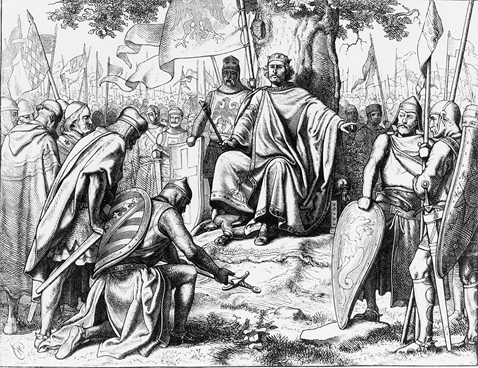
Does this picture depict a time before or after Henry was excommunicated by Pope Gregory VII?
A after, because nobles rallied to support their emperor against the pope when he excommunicated Henry
B after, because nobles in the Holy Roman Empire swore allegiance to the pope when Henry was excommunicated
C before, because Gregory freed nobles from their oath of loyalty by excommunicating him
D before, because the pope took the crown away from Henry when he excommunicated him
C before, because Gregory freed nobles from their oath of loyalty by excommunicating him
500
Which of the following were direct results of the Norman conquest of England? Choose the TWO correct answers.
A A strong feudal system emerged in England.
B Parliament was formed.
C Anglo-Saxon became the language of law and government.
D All those in a position of power were of Norman birth.
A A strong feudal system emerged in England.
AND
D All those in a position of power were of Norman birth.
500
How did the knights of the Fourth Crusade violate the original purpose of the Crusades?
A They attacked Constantinople.
B They lost control of Jerusalem.
C They persecuted European Jews.
D They harassed Christian pilgrims.
A They attacked Constantinople.
500
At its height, Muslim Spain attracted many...
A foreign students who wanted to study philosophy, math, and medicine
B Christian crusaders who wanted to drive the Muslims out of Spain
C Jews and Christian heretics who wanted to escape the Inquisition
D missionaries who wanted to convert Muslims to Christianity
A foreign students who wanted to study philosophy, math, and medicine
500
Read the passage below.
“The Black Death originated in Asia and swept westward along trade routes. It was spread by the fleas on rats and people infected with the disease. Hoping to avoid the disease, many Europeans fled cities for the countryside. Before the epidemic died out, as many as one third of all Europeans had died from the plague.”
Which phrase in the passage relates to the reason that Italy was one of the first places in Europe to be affected by the Black Death?
A “originated in Asia”
B “swept westward along trade routes”
C “spread by the fleas on rats and people infected with the disease”
D “many Europeans fled cities for the countryside”
B “swept westward along trade routes”
500
What was the main cause of the Peasants’ Revolt?
A attempts to limit the movement and wages of serfs
B failure of authorities to end the bubonic plague
C lack of work for peasants on the manors
D demands for reform in the Church
A attempts to limit the movement and wages of serfs
600
The Ottonian kings claimed to be successors to
A the pope.
B the Roman emperors.
C the Byzantine emperors.
D Henry IV.
B the Roman emperors.
600
How did the Magna Carta change the relationship between the people and their king?
It made it clear that the king MUST OBEY the law.
600
How did the Crusades help open trade routes between Europe and the Middle East?
European traders supplied the crusader kingdoms established in the Holy Land.
600
The seen picture here marker the completion of the...
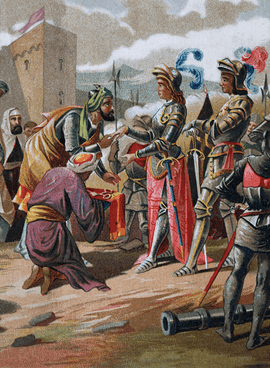
A Reconquista
B Crusades
C Hundred Years' War
D Norman conquest
A Reconquista
600
Explain how the effects of the Black Death were felt across all social classes and economic levels.
People of all social classes and economic level died from the bubonic plague.
600
What does a secular leader mean?
nonreligious leader; non-Church leader