Projectile Motion
Forces and Momentum
Circular Motion
Gravitation
Relativity
100
What is the shape of the path followed by a projectile launched at an angle to the horizontal?
A parabola.
100
State Newton’s third law of motion.
For every action there is an equal but opposite reaction.
100
A 0.2 kg ball swings in a circle of radius 1.5 m at 2 m/s. What is the centripetal acceleration?
2.67 m/s²
100
What is the gravitational force between two 10 kg masses separated by 2 m?
1.7×10⁻¹⁰ N
100
What letter is commonly used to represent the speed of light?
c
200
If a projectile is launched horizontally from a cliff, which component of its velocity remains constant (ignoring air resistance)?
The horizontal component.
200
A 5 kg object accelerating at 3 m/s23 m/s2. What is the net force?
15 N
200
This force provides centripetal force for a car turning on a flat road.
Friction
200
State Newton’s Universal Law of Gravitation.
The force between two masses is proportional to the product of their masses and inversely proportional to the square of the distance between them.
200
Which of Enstein's postulates states that the speed of light in vacuum is the same for all observers.
This is the second postulate.
300
For a projectile launched at angle θ with speed v, this is the vertical component of its initial velocity.
vsinθ
300
A 2 kg object moving at 5 m/s collides and sticks with a 3 kg object initially at rest. What is their final velocity?
(Assume the momentum is conserved).
2 m/s
300
Even if speed is constant in circular motion, this quantity is changing.
Velocity
300
If gravitational force provides the centripetal force for a satellite, what happens to the required speed as the orbital radius increases?
The speed decreases.
300
What is meant by time dilation in special relativity?
Moving clocks run slower compared to stationary observers.
(time passes more slowly for a moving observer)
400
This equation is used to calculate the time of flight for a projectile that lands at the same height it was launched.
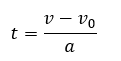 (time to max height, then double)
400
A 0.5 kg ball moving at 10 m/s rebounds at 8 m/s in the opposite direction in 0.1s. What is the average force exerted on the ball?
90 N
400
If the frequency of rotation doubles, by what factor does the centripetal force change for a mass in uniform circular motion?
Four times (quadrupled).
400
Calculate the gravitational field strength 1000 km above Earth's surface?
7.3 m/s²
400
As velocity approaches the speed of light, gamma approaches this.
Infinity
500
A ball is thrown at 20.0 m/s at 30.0° above horizontal. What is its horizontal range?
35.3m
500
Calculate the average force a ball of mass 250g moving at 6m/s at 45° to the wall, exerts on a wall if the collision takes a time of 0.005s and it rebounds at 45° at the same speed.
450 N
500
Draw a vector diagram showing acceleration acts towards the centre of the circle.

500
What are Kepler's three laws of Planertary motion?
1. Planets follow elliiptical orbits with the sun at one focus.
2. A planet sweeps equal amount of area in an equal time (greater speed at perihelion and slower at aphelion).
3. Relates the period of a satellite to the radius of it's orbit.
500
Calculate the relativistic momentum of a 2 kg object moving at 0.8c.
8.00x10⁸ kg m/s