Endothermic vs exothermic
Enthalpy & Phase Change
Collision Theory
Reaction Progress Diagrams
Catalyst & Inhibitors
100
What term is used to describe a process where energy is absorbed & the change in enthalpy is positive
Endothermic
100
What is the symbol and termed use to describe the total heat energy used or released by a system?
Enthalpy
Delta H
100
For a chemical reaction to happen, reactant molecules must ______
Collide
100
What type of chart or graph visually describes the energy changes taking place over the entire course of a chemical reaction?
Reaction Progress Diagram
100
What substance slows down the rate of reaction for a chemical reaction when added?
Inhibitor
200
What term is used to describe when a chemical process releases energy and the change in enthalpy is negative.
Exothermic
200
What is the standard unit of measurement when calculating Enthalpy for a reaction or phase change?
kJ/mole
200
What two things must be true for collisions in a chemical reaction in order for the reaction to occur?
Collisions must have the right orientation and the right amount of energy
200
What is the minimum amount of energy required to kickstart a chemical reaction and get reactants over the energy barrier?
Activation Energy
200
What type of substance speeds up a chemical reaction without being consumed by the reaction itself?
Catalyst
300
What is the specific process that always requires the input of energy in order to start a chemical reaction?
Breaking of chemical bonds
300
What is the specific type of enthalpy that describes the energy flow that occurs when a solid melts into a liquid?
Delta H fus
300
Increasing this variable speeds up a reaction because it increases the energy of particle collisions by raising the average kinetic energy.
Temperature
300
What specific value on a reaction progress diagram is found by calculating the difference in energy between products and reactants?
Change in Enthalpy
Delta H
300
How does a catalyst speed up the rate of reaction?
By lowering the activation energy (energy required to break bonds)
400
What is the specific process that always releases energy in a chemical reaction?
Forming new chemical bonds
400
What is the specific type of enthalpy that describes the energy flow that occurs when a liquid converts into a gas?
Delta H vap
400
When we increase ____, more reactant molecules are added into a fixed volume which directly increases the rate of the reaction.
Concentration
400
What is the name of the temporary, high-energy state that is found at the very peak of a reaction progress diagrams' curve?
activated complex or transition state
400
How does an inhibitor slow down the rate of reaction?
It raises the activation energy of a reaction
500
If a reaction has a negative change in enthalpy, is energy a reactant or a product?
A product
500
What is the specific term for the energy change that occurs when a solute dissolves into a solvent?
Delta H soln
500
True or false:
Increasing the concentration of a reactant increases the rate of reaction because it results in higher energy collisions.
False-- higher energy collisions are the result of increased temperature not concentration
500
Label all of the parts of the following reaction progress diagram
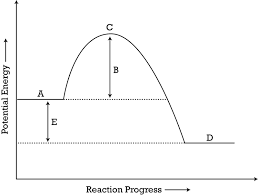
A - Reactants
B - Activation Energy
C - Transition state/activated complex
D - Products
E - Change in Enthalpy/Net Energy
500
Does adding a catalyst change the overall enthalpy of a reaction?
No-- the catalyst only changes the activation energy of the reaction. The energy of the reactants and the products remains the same.