Take a good look in the MIRROR
Want to go for a SPIN?
What's my
move?
move?
Give it a little push
Can I change for a different size?
100
What is the rule when reflecting over the y-axis?
Negate the x and keep the y
100
When rotating 180 degrees what happens to (x, y)?
Negate both
100
Identify the transformation, be specific
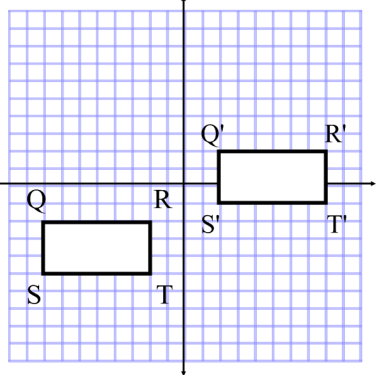
Translation 10 right and 4 up
100
What is the translation rule?
(x + 6, y - 4)
6 units right and 4 units down
100
After a dilation are the figures congruent or similar?
Similar, same shape but different sizes
200
Reflect (3, 5) over the x-axis
(3, -5)
200
What quadrant would the figure be in after a rotation of 90 degrees clockwise?
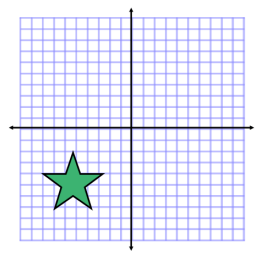
II
200
Identify the transformation, be specific
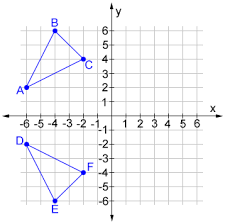
Reflection over the x-axis
200
State the translation rule: (3, 7) to (1, 10)
2 left and 3 up
200
Which side is similar to BC in triangle XYZ?
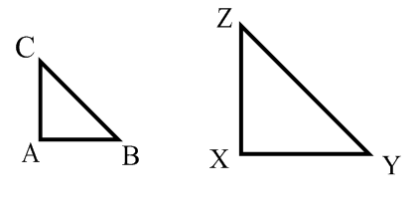
YZ
300
Reflect (-7,-4) over the y-axis.
(7,-4)
300
What quadrant would the figure be in after a rotation of 90 degrees counterclockwise?
IV
300
Identify the transformation, be specific
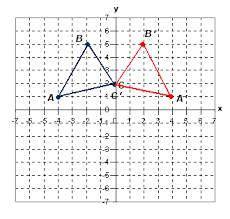
Reflection over the y-axis
300
Translate point B(2, 7) under the rule (x + 2, y + 4) to find B'
B'(2+2, 7+4)
B'(4, 11)
300
Point M(12, -3) was dilated by a scale factor of 1/3. What are the coordinates of M'?
M'(4, -1)
400
Point A(3, 4) was reflected to create point A'(3, -4). Identify the line of reflection.
Reflection over the x-axis
400
What quadrant would the figure be in after a rotation of 180 degrees?
I
400
Identify the transformation, be specific.
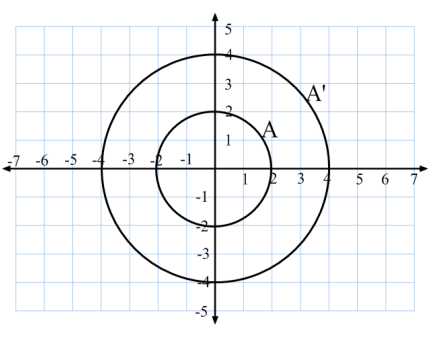
Dilation by 2
400
Translate the point G(-4, -5) 3 units left and 2 units down. Where is G' located?
G'(-4-3, -5-2)
G'(-7, -7)
400
Identify the scale factor of the dilation.
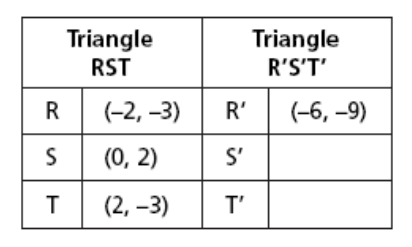
Scale Factor = 3
500
The points (-1,5) (0,-8) (3,-2) and (-6,0) where reflected over the y-axis. Which point would have the same x-coordinate before and after the reflection?
(0,-8) It's a zero coordinate so it doesn't change!
500
Identify the rotation, degrees and direction

Rotation of 90 degrees clockwise
500
Identify the sequence of transformations.
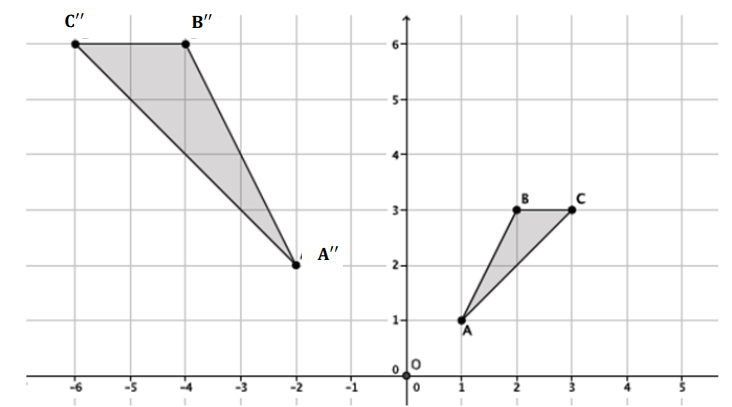
Dilation and reflection
500
Points A(5, 8) and B(9, 6) were both translated using the same rule. If is A'(2, 10), where would B' be located under the same translation?
Rule: (x-3, y+2)
B'(9-3, 6+2)
B'(6,8)
500
What are the coordinates for H' after the dilation? 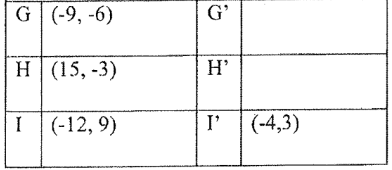
H'(5, -1)