Vocabulary & More
Translations
Reflection
Rotation
Dilation
100
What does it mean for two figures to be congruent?
Same shape and Size
100
A square with side length 2 units is translated 5 units up. What happens to its area?
The area remains the same.
100
The given graph depicts a rigid transformation.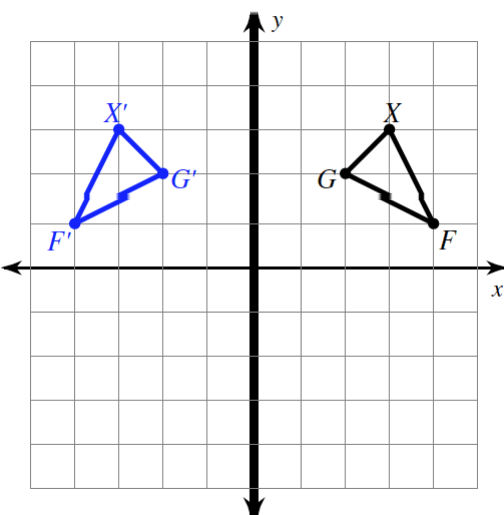
What is a reflection in the y-axis?
100
The given graph depicts a rigid transformation.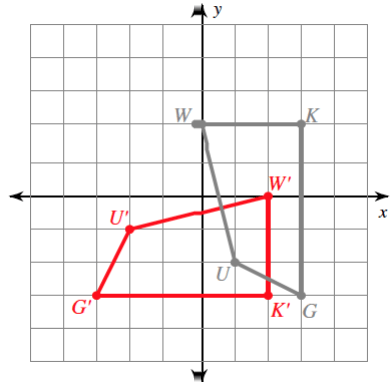
What is a 90-degree clockwise rotation?
100
What are the dilations forms that change the size of the figure, but not the shape?
Enlargement and Reduction
200
Name the three types of rigid transformations.
Translation, reflection, rotation.
200
Translate point A(–2, 4) by the rule (x, y) →
(x + 3, y – 2). What is A′?
(1, 2)
200
The figure has been reflected over this line.
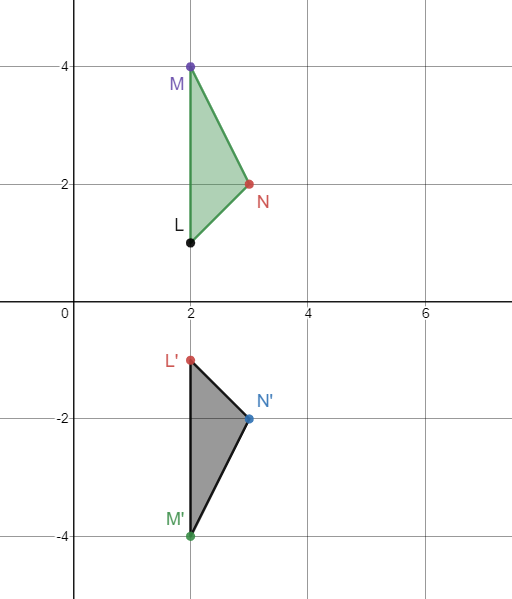
What is the x-axis?
200
A square is rotated 90° counterclockwise, then translated up 3 units. How is its size affected?
Size unchanged.
200
Point A has dilated from (25, 15) to A'(5, 3). Is this considered an Enlargement or a reduction?
Reduction
300
A triangle has vertices at (0,0), (2,0), (1,3). Another triangle has vertices (–2,0), (0,0), (–1,3). Describe the transformation(s) that prove the triangles are congruent.
Reflection across -y axis
300
Write a Sequence of transformations that moves point P(–5, 0) to P′(2, 7).
(x + 7, y + 7)
300
Reflect point (4, –2) across the y-axis. What is the new point?
(–4, –2)
300
The given graph depicts rigid transformations of the pre-image *. This triangle represents a Rotations of * 90-degrees counterclockwise about the origin. 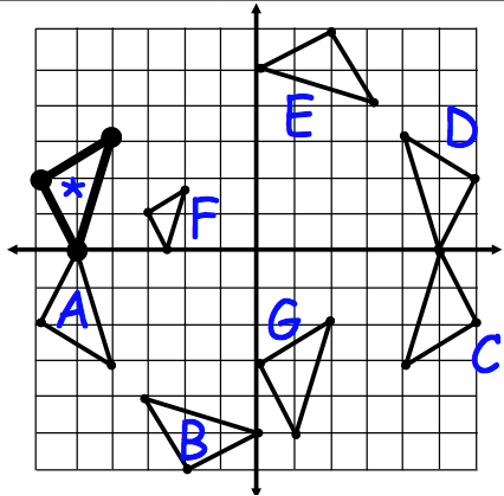
What is figure B?
300
Triangle PQR has coordinates of P(1,2), Q(2,4), R(3,2) is dilated has a scale factor of 3. What are the coordinates of the new point R'?
R' (9,6)
400
True or False: Dilations are rigid transformations.
False, surprise that is your next unit;)
400
Translate triangle with vertices (1,1), (2,3), (3,1) 4 units right. List new coordinates.
(5,1), (6,3), (7,1)
400
A triangle at (1,2), (2,4), (3,2) is reflected over the y-axis and then translated 1 unit down. Write its new coordinates.
(–1,1), (–2,3), (–3,1)
400
Rotate point (0, 5) 180° about the origin. What is the new point?
(0, –5)
400
A triangle has the vertices of (-2, 2) (12, -4) and (6, 10). If the triangle undergoes a dilation with a scale factor of one half, what will be the new vertices of the image?
(-1, 1) (6, -2) (3, 5)
500
Two triangles are congruent. One has sides 3, 4, 5. What are the side lengths of the other triangle?
3, 4, 5
500
A figure is translated left 2 and up 3. Describe this movement using a coordinate rule.
(x – 2, y + 3)
500
Reflect triangle with vertices (1,1), (2,2), (3,1) across the x-axis. List new coordinates.
(1, –1), (2, –2), (3, –1)
500
Rotate point (–3, 2) 90° clockwise about the origin.
(2, 3)
500
A student dilates figure FGH with the center of dilation at the origin to form figure F'G'H'. The coordinates of point F of FGH are (-4,10). After dilating the figure, the coordinates of point F' on figure F'G'H' are (-6, 15).
If the coordinates of point G are (3, 8), what will be the coordinates of point G'?
(4.5, 12)