Vocabulary
Translations
Reflection
Rotation
100
What is the original figure before a transformation called?
The pre-image.
100
How can you tell if an image was translated?
The distance from the points in the pre-image to the image are all the same.
We can slide the pre-image to the image.
100
What is the line of reflection?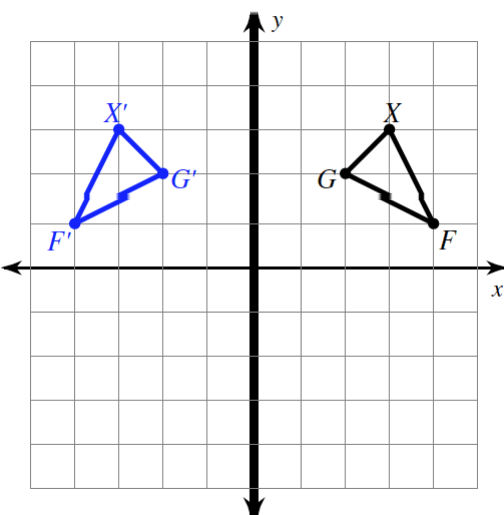
The y-axis.
100
What is another word for rotation?
A turn.
200
How do you tell the difference between the pre-image and image?
By the prime notation on the image.
200
Translate point A(–2, 4) by the rule (x, y) →
(x + 3, y – 2). What is A′?
(1, 2)
200
What is the line of reflection?
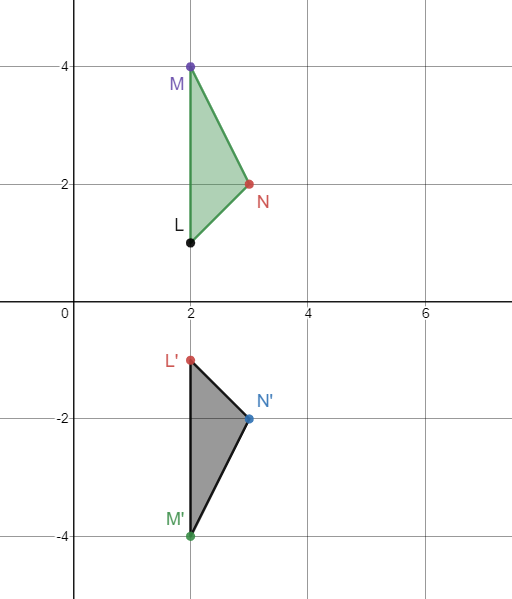
The x-axis.
200
What is the equivalent rotation to 180-degree counterclockwise?
180-degrees clockwise.
300
What is another word for translation?
A slide
300
Write a the rule that moves point P(–5, 0) to P′(2, 7) after a translation.
(x + 7, y + 7)
300
Reflect point (4, –2) across the y-axis. What is the new point?
(–4, –2)
300
What is the angle of rotation?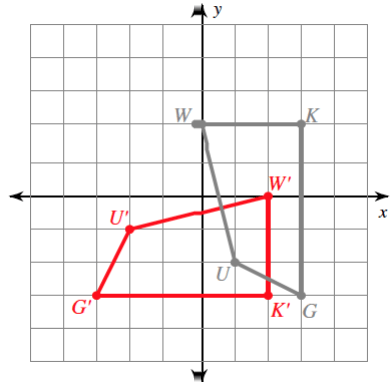
90-degree clockwise
270-degree counterclockwise
400
What is a rigid motion?
A transformation that preserves size and shape.
The pre-image and image are congruent.
400
Translate triangle with vertices (1,1), (2,3), (3,1) 4 units right. List new coordinates.
(5,1), (6,3), (7,1)
400
Reflect triangle with vertices (1,1), (2,2), (3,1) across the x-axis. List new coordinates.
(1, –1), (2, –2), (3, –1)
400
Rotate point (0, 5) 180° about the origin. What is the new point?
(0, –5)
500
Name the three types of rigid transformations.
Translation, reflection, rotation.
500
A figure is translated left 2 and up 3. Describe this movement using a coordinate rule.
(x – 2, y + 3)
500
A triangle at (1,2), (2,4), (3,2) is reflected over the y-axis and then translated 1 unit down. Write its new coordinates.
(–1,1), (–2,3), (–3,1)
500
Rotate point (–3, 2) 90° clockwise about the origin. What is the new point?
(2, 3)