Structure in Plants
Translocation and Transpiraition
Circulatory System
The Heart
Blood
100
Sate the name of the vessels that transport water through a plant
Xylem
100
State one factor that affects the rate of transpiration
One from:
- humidity
- temperature
- AVP
100
What type of circulatory system do fish have?
Single Cirucuit circulatory system
100
State the name of the chamber of the heart with the thickest wall
Left ventricle
100
Red blood cells and white blood cells are components of blood. State the name of one other major component of blood.
- Plasma
200
What are stomata?
Stomata are pores surrounded by two guard cells (which control gas exchange).
200
State two parts of a plant that are sinks for sucrose
any two from:
- buds
- roots
- storage
- organs
- flowers
- fruits
- seeds
- growing leaves
- nectarines
200
What are the main 3 organs that circulatory system pumps to?
- Brain
- Lungs
- Heart
200
How does blood enter the heart?
a. through arteries into the atria
b. through arteries into the ventricles
c. through veins into the atria
d. through veins into the ventricles
c. through veins into the atria
200
 Label A and C
A: Red blood cells
C: White blood cells
300
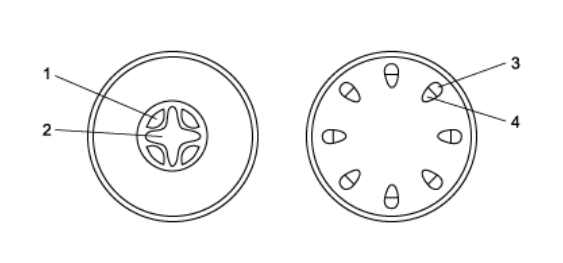 Identify 1, 2, 3, AND, 4
1, 4, xylem
2, 3, phloem
300
How are leaves adapted to diffusion?
- They are thin
- There are spaces between cells
- Lots of stomata on undersides of leaves
300
State and explain 2 advantages of a double circulatory system.
1. Higher pressure to body
Faster transport of oxygen and nutrients
Faster removal of carbon dioxide
Meets high metabolic demands
Supports active lifestyle
Separation of oxygenated and deoxygenated blood
Tissues receive fully oxygenated blood
Increases efficiency of aerobic respiration
Maintains steep oxygen concentration gradient
300
One risk factor for coronary heart disease is an unhealthy diet. State two other risk factors for coronary heart disease.
- excersice
- genetics/family history
- life style habits (smoking, etc.)
300
State three ways in which a red blood cell is different to a white blood cell
- nucleus
- shape and size
- function
400
Why is xylem a tissue?
(hint: classification)
Composed of cells with similar structures
Working together to perform shared functions
400
Sucrose is used in the cells of the sinks in a plant. Describe the uses of sucrose by sinks.
Any 3 from:
- sucrose is converted to glucose
- provides energy
- growth/reproduction/flowering/active transport/cell division
- stored as starch/sucrose
- used to make cellulose
- converted to amino acids
400
Describe how one way valves maintain one way flow of the blood and why it matters
One-way valves open to allow blood to flow forward when pressure behind the valve is greater than pressure in front.
They close when blood tries to flow backwards, preventing backflow.
This ensures blood flows in the correct direction through the heart and veins.
It is important because it maintains efficient circulation and ensures oxygen and nutrients are delivered to tissues effectively.
400
Exercise causes heart rate to increase. Explain why exercise causes an increase in heart rate.
Detecting the stimulus
Exercise → muscles contract more → use more oxygen and produce more carbon dioxide
Increase in CO₂ detected by chemoreceptors in blood
Heart rate response
Heart rate increases → pumps blood faster
More oxygen delivered to muscles
More carbon dioxide removed
Supports aerobic respiration in muscle cells
Meets higher metabolic demands
Maintains energy supply for contraction
400
Describe how platelets in the blood prevent disease.
- clot blood/form a barrier/seal the wound
- prevents the entery of (named) pathogens
500
Describe the pathway taken by a molecule of carbon dioxide, from the air outside a leaf to a spongy mesophyll cell.
1. Enters trhough the stomata between guard cells
2. moves through interconnecting air spaces
500
How and why do flowers wilt?
how:
- when they lose water through transpiration faster than they can absorb it, causing cells to lose turgidity
Why:
- Decrease surface area to decrease transpiration rate to decrease the amount of water loss
500
Explain how the structure of arteries and veins relates to the difference in the pressure of the blood transported by these vessels?
- arteries have tick salls to whithstand high pressure
- arteries have a thick layer of elastic tissue to strech due to the changing pressure
- arteries have tick layer of muscular tissue to change pressuer
- artieries have narrower lumen to maintain high pressure
- veins have valves to prevent backflows due to low pressure
- veins have thin walls to provide less resistance to blood floweing at low pressure
- veins have thin walls so blod is moved by contraciton of surrounding muscles
500
Describe how the structure of a vein differs from the structure of an arterie.
- presence of valves
- thinner wall
- thinner muscle layer
- thin elastic layer
- wider lumen
500
Describe 3 differences in appearance and the roles between a red blood cell, a phagocyte and lymphocyte.
Red blood cells
- smaller than phagocyte
- biconcave shape
- no nucleous
- contains haemaglobin
Lymphocyte
- little cytoplasm
- larger nucleus
- active immunity
Phagocyte
- lobed/irregular shaped
- engulf pathogens