Triangle Basics
Classifying Triangles
Pythagorean Theorem
Hypotenuse & Legs
Similar Triangles
100
What is the sum of the measures of the angles in any triangle?
Answer: 180°
Explanation: No matter the type of triangle, all three interior angles always add up to 180°.
100
What do you call a triangle with all sides equal?
Answer: Equilateral Triangle
Explanation: “Equi” means equal, so all sides are the same length.
100
Which equation represents the Pythagorean Theorem?
Answer: a² + b² = c²
Explanation: This formula is only used to justify right triangles.
100
What is the hypotenuse?
Answer: The longest side of a right triangle
Explanation: It is always opposite the right angle.
100
1.) What symbol means “is similar to”?
Answer: ~
Explanation: This symbol shows triangles have the same shape (same angles, proportional sides).
200
What unit is most commonly used to measure angles?
Answer: Degrees
Explanation: Angles are measured in degrees, not inches or centimeters.
200
What type of triangle has exactly two equal sides?
Answer: Isosceles Triangle
Explanation: An isosceles triangle has two congruent sides and two congruent angles.
200
In a right triangle, what does the variable c represent?
Answer: The hypotenuse (the longest side)
Explanation: The hypotenuse is always opposite the right angle.
200
Where is the hypotenuse located in a right triangle?
Answer: Across from the right angle (largest angle in a right triangle).
Explanation: The hypotenuse never touches the right angle.
200
What must be true about corresponding angles and sides in similar triangles?
Answer: The angles are congruent (equal) and the sides are proportional.
Explanation: Similar triangles always have equal matching angles. Different size = proportional sides
300
True or False: Any three side lengths can form a right triangle.
Answer: False
Explanation: The side lengths must satisfy the pythagorean theorem in order to be considered a right triangle.
a^2+b^2=c^2
300
A triangle has side lengths 7 cm, 9 cm, and 11 cm. How is it classified by sides?
Answer: Scalene triangle
Explanation: All three sides are different lengths.
300
Find the hypotenuse if the legs are 5 and 12.
Answer: 13
Explanation: 5² + 12² = 25 + 144 = 169, and √169 = +/-13.
Reject the negative root. c=13 units
300
1.) In a triangle with side lengths 9, 12, and 15, which side is the hypotenuse?
2.) Which are the legs?
3.) What do the legs form in a right triangle?
Answer:
1.) 15
2.) 9 and 12
3.) The legs form the right angle
Explanation: The hypotenuse is the longest side.
300
1.) If ΔABC ~ ΔFED, which angle corresponds to ∠A?
2.) What side corresponds to side BC?
3.) What is the measure of ∠F?
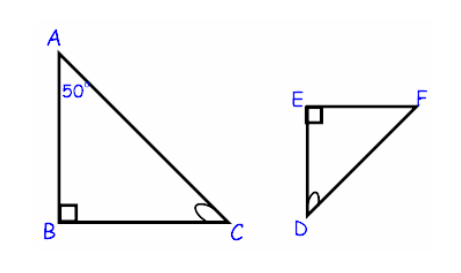
Answer:
1.) ∠F
2.) side ED
3.) 50 degrees
400
A triangle has angles measuring 95°, 50°, and 35°. How is it classified by angles?
Answer: Obtuse
Explanation: A triangle is obtuse if one angle is greater than 90°.
400
1.) What type of triangle has one right angle?
2.) How many degrees is a right angle?
3.) Describe the other 2 angles in a right triangle.
Answers:
1.) Right Triangle
2.) 90 degrees (contains exactly one 90 degree angle)
3.) 2 acute angles
400
Which set of numbers does NOT form a right triangle?
(5, 12, 13) (8, 15, 17) (6, 8, 10) (7, 9, 12)
Answer: 7, 9, 12
Explanation: These numbers do not satisfy a² + b² = c².
400
Solve for the missing side:
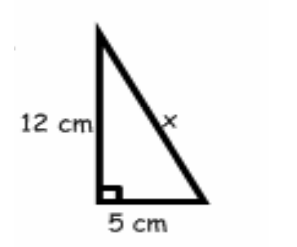
Answer: 12^2+5^2=x^2
169=x^2
sqrt169=sqrt(x^2)
+-13=x
Reject the negative root. x = 13 cm
400
Set up a proportional and find the missing length: 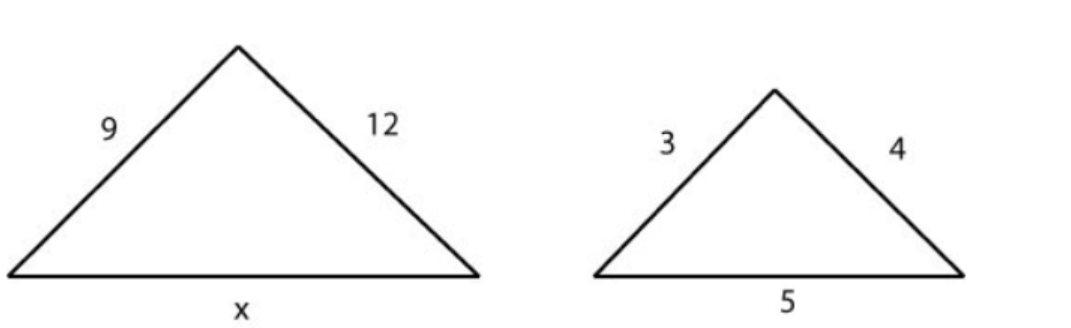
Answer: 9/3=x/5 cross multiply
3x=45 (divide both sides by 3)
x = 15 units
500
Two angles of a triangle are 42° and 68°. What is the measure of the third angle?
Answer: 70°
Explanation: 180 − (42 + 68) = 70.
500
A triangle has angles 30°, 60°, and 90°. Classify it by angles and sides.
Answer:
By its ANGLES: Right triangle
By its SIDES: Scalene triangle
Explanation: It has a right angle, and all sides are different.
500
A right triangle has legs of 9 cm and 12 cm. Find the hypotenuse.
Answer: 15 cm
Explanation: 9² + 12² = 81 + 144 = 225, and √225 = +/-15.
Reject the negative root. c = 15 units
500
A 10-foot ladder touches the side of a building at a point 8 feet above the ground. How far is the base of the ladder from the building?
Answer:
Let x = the length/distance of base of ladder from the building.
x = 6 ft; the distance of the base of the ladder from the building is 6ft.
Explanation: 8^2+x^2=10^2
64 + x^2=100
x^2=36
sqrt(x^2)=sqrt36
x = +-6
Reject the negative root. x = 6ft
500
Set up a proportion and find the missing side length: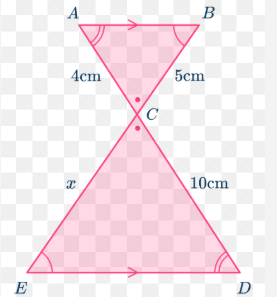
Answer:
5/x=4/10 Cross multiply
50 = 4x (divide both sides by 4)
12.5 cm = x