Mass, Weight, and Force
Distance, Displacement, and Vectors
Speed, Velocity, and Acceleration
The First and Second Laws
The Third Law and Free-Body Diagrams
FINAL JEOPARDY
100
The quantity of matter in an object. Measured in kilograms, it is a measure of inertia and it is the same on the Moon as on Earth.
What is mass?
100
Magnitude only, with no direction attached. Distance, speed, time, mass and energy are all this kind of quantity.
What is a scalar?
100
The rate of change of velocity. Give its SI unit, and name the three different ways an object can have a non-zero value of it.
What is acceleration, in m/s squared; speeding up, slowing down, or changing direction?
100
State Newton's first law of motion, and give the other name it goes by.
What is: an object at rest stays at rest and an object in motion continues at constant velocity unless acted on by a non-zero net force - the law of inertia?
100
State Newton's third law of motion.
What is: if A exerts a force on B, then B exerts a force on A that is equal in magnitude and opposite in direction?
200
A 2.0 kg textbook sits on a desk. Give its weight in newtons, and say what changes if you carry it to the Moon.
What is about 19.6 N - and on the Moon the weight drops while the mass is still 2.0 kg?
W = mg = (2.0\ \kg)(9.81\ \m/s^2) = 19.6\ \N
200
A runner completes exactly one lap of a 400 m oval track. Give the distance travelled and the displacement.
What is 400 m of distance and zero displacement?
200
A velocity-time graph shows a horizontal line above the time axis. Say what the object is doing, and name the mistake a student makes who reads it as “sitting still.”
What is moving at constant velocity with zero acceleration; the mistake is reading a velocity-time graph as if it were a position-time graph?

200
A net force of 24 N acts on a 6.0 kg cart. Give the acceleration, and say how its direction relates to the net force.
What is 4.0 m/s squared, pointing the same way as the net force?
a = \frac{\Sigma F}{m} = \frac{24\ \N}{6.0\ \kg} = 4.0\ \m/s^2
200
Everything drawn on a free-body diagram is a force acting on the one object you chose. Name two kinds of arrow that must never appear on it.
What are a force the object exerts on something else, and an invented force such as a “force of motion” or an outward centrifugal force?
300
A student writes “the ball has force.” Say why that sentence is meaningless in physics, and rewrite it so it can be drawn and calculated.
What is: force is an interaction between two objects, not a property an object carries - write it as “the bat exerts a force on the ball”?
300
Two forces act on a crate at the same time: 40 N east and 30 N north. Give the magnitude of the resultant.
What is 50 N?
R = \sqrt{(40\ \N)^2 + (30\ \N)^2} = 50\ \N
300
A car drives 60 km at 30 km/h, then another 60 km at 60 km/h. A student answers 45 km/h for the average speed. Say what they did wrong and give the correct answer.
What is: they averaged the two speeds instead of dividing total distance by total time; the answer is 40 km/h?
v_{avg} = \frac{d_text{total}}{t_text{total}} = \frac{120\ \km}{2.0\ \h + 1.0\ \h} = 40\ \{km}/h
300
A hockey puck slides across the ice and gradually slows to a stop. Say why, and say what is wrong with “it ran out of force.”
What is: friction acts on it - motion needs no force to keep going, only to change, so nothing has to be used up?
300
The two skaters in the picture push off each other. A student says the two forces in a third-law pair cancel, so nothing could ever accelerate. Say exactly what is wrong with that.

What is: a third-law pair acts on two different objects, and forces only cancel when they act on the same object - that is the first law, not the third?
400
A car cruises in a straight line at a steady 25 m/s. Give its net force, and say whether it is in equilibrium.
What is: the net force is zero, and yes it is in equilibrium - equilibrium means constant velocity, which does not have to be zero?
400
A student writes “-8 m/s is slower than +3 m/s.” Say what is wrong with that, and say what the negative sign is actually telling you.
What is: the sign is a direction, not a size; -8 m/s is faster than +3 m/s, travelling the other way?
400
A thrown ball is momentarily at rest at the very top of its flight. Give its acceleration at that instant, and say what that tells you about velocity and acceleration.
What is 9.81 m/s squared downward - zero velocity does not mean zero acceleration?
400
A block rests on a ramp tilted 30 degrees from horizontal. A student writes FN = mg. Say why that is wrong, give the correct expression, and say how you should actually find it.
What is: the normal force is perpendicular to the surface, so FN = mg cos 30 degrees - and you solve for it from net force equals zero perpendicular to the ramp rather than assuming it?

F_N = mg\ \cos\theta = mg\ \cos 30^\circ
400
An apple falls toward Earth. Compare the two forces in that third-law pair, then compare the two accelerations.
What is: the forces are equal in magnitude and opposite in direction, but a = forcenet divided by mass, and Earth's mass is enormous, so Earth's acceleration is immeasurably small?
500
A triple-beam balance and a spring scale both read 2 kg for the same object at sea level. Take both to the Moon and read them again. Say what each one now reads and why.
What is: the balance still reads 2 kg because it compares masses, and the spring scale reads about one sixth as much because it measures force and the Moon's gravity is weaker?
500
A hiker walks 6.0 km north, then 8.0 km east. Give the displacement as a magnitude and a direction, and say why the distance is a different number.
What is 10.0 km at 53 degrees east of north - the distance is 14.0 km, because distance is total path length and displacement is only the change in position?
R = \sqrt{(6.0\ \km)^2 + (8.0\ \km)^2} = 10.0\ \km, \quad \theta = \tan^{-1}\!\left(\tfrac{8.0}{6.0}\right) = 53^\circ

500
A car moving at +25 m/s brakes to a stop in 40 m. Give its acceleration, and explain why the negative sign by itself does not tell you the car slowed down.
What is about -7.8 m/s squared - the car slowed because the acceleration and the velocity have opposite signs, not because the acceleration is negative?
v_f^2 = v_i^2 + 2a,\ \Delta xRightarrow a = \frac{0 - (25\ \m/s)^2}{2(40\ \m)} = -7.8\ \m/s^2
500
You stand on a bathroom scale inside an elevator. Your mass is 60 kg and the elevator accelerates upward at 2.0 m/s2. Say whether the scale reads more or less than your normal weight, and give the reading.
What is more - about 709 N, because the normal force minus the weight equals mass times acceleration?
F_N - mg = ma \ \Rightarrow\ F_N = m(g+a) = (60\ \text{kg})(9.81\ \m/s^2 + 2.0\ \m/s^2) = 709\ \N
500
The block in the picture is being dragged across level ground at constant velocity by a rope. Name every force acting on the block, and give the net force.
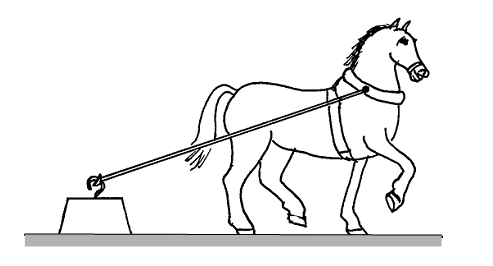
What is: weight down, normal force up, tension along the rope, and kinetic friction opposing the sliding - and the net force is zero, because the velocity is constant?
500
A 1200 kg car travelling at 20 m/s brakes to a stop in 50 m on level road. Give the car's acceleration, give the magnitude of the net force the road exerts on it, and name where each of those two answers comes from.
What is -4.0 m/s2 and 4800 N; the acceleration comes from the constant-acceleration equation vf squared equals vi squared plus 2a times displacement, and the force comes from Newton's second law, net force equals mass times acceleration?
a = \frac{(0\ \m/s-20\ \m/s)^2}{2(50\ \m)} = -4.0\ \m/s^2; \quad \Sigma F = ma = (1200\ \kg)(4.0\ \m/s^2) = 4800\ \N