Minerals
Igneous Rocks
Metamorphic Rocks
Sedimentary Rocks
Plate Tectonics
Mixed Bag
100
List the 5 characteristics that define minerals.
1. Naturally occurring
2. Solid
3. Specific chemical composition
4. Inorganic
5. Crystal structure
100
The processes that form all igneous rocks.
Melting and cooling
100
How metamorphic rocks are formed.
Changes to a rock due to heat and pressure.
100
The 3 types of sedimentary rocks.
1. Clastic
2. Chemical
3. Organic/biologic
100
This phenomenon is the reason the tectonic plates move.
Convection Currents
100
The most abundant element in the Earth's crust.
Oxygen
200
___________: when minerals break along lines of weakness in their structure.
Cleavage
200
An example of a geologic feature where extrusive igneous rocks form.
Volcanoes
200
This term refers to the parallel alignment of mineral grains in a metamorphic rock, often caused by high pressure.
Foliation
200
The 3 key features of sedimentary rocks.
1. Stratification
2. Water marks
3. Fossils
200
Described by Harry Hess; a geologic process where lithospheric plates move away from each other on the seafloor.
Seafloor Spreading
200
The 3 different types of convergent plate boundaries.
1. Ocean-Ocean
2. Ocean-Continent
3. Continent-Continent
300
Identify the mineral in Box Y.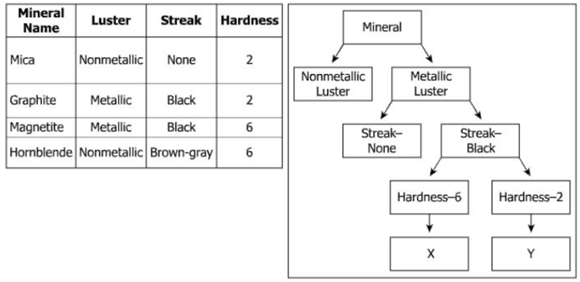
Graphite
300
The two characteristics used to classify igneous rocks.
1. how they formed
2. what they are made of (mineral color)
300
Metamorphic rocks that have a random interlocking texture.
Non-foliated
300
The breakdown of rocks into sediments and clasts.
Weathering
300
Describe the plate motion for all 3 types of plate boundaries.
1. Convergent: move together
2. Divergent: move apart
3. Transform: slide past each other
300
The layer of the mantle where convection currents occur.
Asthenosphere / Aesthenosphere
400
Calcite (CaCO3) belongs to this mineral group.
Carbonates
400
List 3 properties of intrusive and extrusive igneous rocks - be specific!
Intrusive: cools underground, cools slowly, large crystals, coarse texture
Extrusive: cools above ground, cools quickly, small crystals, fine texture
400
True or False: a non-foliated rock contains layers
False
400
The correct order of geologic processes to form a clastic sedimentary rock.
weathering -> erosion -> deposition -> compaction -> cementation
400
The reason deep sea trenches form; include the plate boundary they form at.
Subduction at a convergent plate boundary.
400
Geologists use this form of energy to identify the state of matter for the layers of the Earth.
Seismic waves
500
The hardness of a mineral is primarily a result of this characteristic.
Crystal structure; arrangement of atoms
500
List 3 colors associated with felsic minerals.
- light gray
- pink
- red
- yellow
- tan
- white
- clear
500
The 4 defining characteristics of metamorphic rocks.
1. folding
2. foliation
3. flat sheets
4. shiny
500
2 reasons why fossils are most commonly seen in sedimentary rocks.
1. Organisms can be preserved in sedimentary rocks
2. Fossils are burned and melted when rocks melt
3. Heat and pressure destroys fossils during metamorphism
500
An area over a plume of magma that is not at a plate boundary.
Hot Spot
500
Explain why the Earth has a magnetic field.
The movement of the liquid iron and nickel in the outer core.