ArrayLists
2D-Arrays
Searching/Sorting
Recursion
100
What is advantage of using an ArrayList vs a 1-D array?
It is flexible and dynamic in size and there are built-in methods you can utilize with ArrayLists too such as .add, .set
100
Consider the following code.
int[][] grid = new int[4][3];
int c = 1;
for (int i = 0; i < grid.length; i++) {
for (int j = 0; j < grid[i].length; j++) {
grid[i][j] = c;
c++;
}
}
What are the contents of the array?
1 2 3
4 5 6
7 8 9
10 11 12
100
Large or small datasets for binary Search?
Unsorted or sorted data for linear search?
Large, unsorted
100
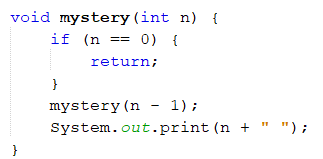
What is printed when mysterm(3) is called?
1, 2, 3
200
If an ArrayList called myList contains 10 integers and you do System.out.println(myList.size()); - what is printed ?
10
200
{3, 2 ,2}
{3,2,1}
{4,1,2}
If this 2D array was initialized as "myArray", how would you access the number 4? Assume there are no errors in this code above.
myArray[2][0]
200
Explain the difference between selection sort and insertion sort in detail
Selection sort finds the smallest number in an array and swaps the appropriate elements for each index, insertion sort compares adjacent elements and inserts the element where it needs to go.
200
What is returned when n=4?
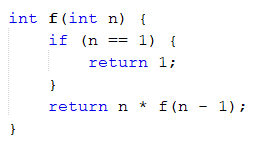
24
300
On a piece of paper, write the full code for creating an ArrayList of an object data type Dragon. Make sure all syntax is correct.
ArrayList<Dragon> myDragonList1 = new <Dragon>();
300
What are the contents of arr after the following code has been executed?
int[][] arr = { {3,2,1},{1,2,3}};
for (int row = 1; row < arr.length; row++)
{
for (int col = 1; col < arr[0].length; col++)
{
if (arr[row][col] % 2 == 1)
{
arr[row][col] = arr[row][col] + 1;
}
if (arr[row][col] % 2 == 0)
{
arr[row][col] = arr[row][col] * 2;
}
}
}
{ {3, 2, 1}, {1, 4, 8}}
300
How many checks will occur with a linear search on the following array if the target value is 17:
{12,9,5,20,27,17,40,20}
6
300
 What food manufacturing company headquartered in Battle Creek, Michigan, uses several animal mascots to sell its cereals, such as Newton the Owl, Tony the Tiger and a rooster named Cornelius?
Stack Overflow Error
400
ArrayList<Integer> list = new ArrayList<Integer>();
list.add(2);
list.add(3);
list.add(10);
list.add(2);
for(int i = 0; i < list.size() - 1; i++)
{
if(list.get(i) > list.get(i + 1))
{
System.out.print(list.get(i) + " ");
}
}
What is printed?
10
400
A two-dimensional array, imagePixels, holds the brightness values for the pixels in an image. The brightness can range from 0 to 255. What does the following method compute?
public int findMax(int[][] imagePixels)
{
int r, c;
int i, iMax = 0;
for (r = 0; r < imagePixels.length; r++)
{
for (c = 0; c < imagePixels[0].length; c++)
{
i = imagePixels[r][c];
if (i > iMax)
iMax = i;
}
}
return iMax;
}
The maximum brightness value for all pixels in imagePixel
400
How many checks will a computer need to do on the following array using a binary search if the target value is 19:
{3,5,10,12,15,20,22,19}
4
400
How many times is mystery() called in mystery(4)?
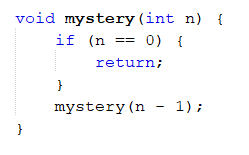
5 times
500
A class stores a list of integers representing daily temperatures. Write a method removeBelowAverage that removes all values that are strictly below the average of the list.
The method should:
- First compute the average of all values
- Remove all values less than the average
- Modify the original list
- Return the number of values removed
Starter code:
import java.util.ArrayList;
public class TemperatureUtils
{
public int removeBelowAverage(ArrayList<Integer> temps)
{
// to be implemented
}
}
public class TemperatureUtils
{
public int removeBelowAverage(ArrayList<Integer> temps)
{
// to be implemented
}
}
Syntax does not need to be perfect for this, but I would like to see the logic make sense and there needs to be a good attempt at syntax.
public static int removeBelowAverage(ArrayList<Integer> temps)
{
int sum = 0;
for (int num : temps)
{
sum += num;
}
double average = (double) sum / temps.size();
int removed = 0;
for (int i = temps.size() - 1; i >= 0; i--)
{
if (temps.get(i) < average)
{
temps.remove(i);
removed++;
}
}
return removed;
}
500
Given the following code segment, what is the value of sum after this code executes?
int[][] m = { {1,1,1,1},{1,2,3,4},{2,2,2,2},{2,4,6,8}};
int sum = 0;
for (int k = 0; k < m.length; k++)
{
sum = sum + m[m.length-1-k][1];
}
9
500
Consider the following algorithm, which implements the selection sort algorithm.
int[] elements = {4, 10, 3, 1, 2, 8, 9, 6};
for (int j = 0; j < elements.length - 1; j++) {
int minIndex = j;
for (int k = j + 1; k < elements.length; k++) {
if (elements[k] < elements[minIndex]){
minIndex = k;
}
}
int temp = elements[j];
elements[j] = elements[minIndex];
elements[minIndex] = temp;
}
What are the contents of the array elements after 1 pass of the outer loop?
[1, 2, 3, 4, 10, 8, 9, 6]
500
Consider the following code:
public static int mysteryRecur(int n){
if(n <= 0)
return 1;
else if(n <= 3)
return 3;
else
return mysteryRecur(n / 2) + n;
}
What is returned when the call mysteryRecur(20) is run?
38