Math
Formulas
Waves
Wave Parameters
Attenuation
Pulsed Waves
Transducers
System Operation
Contrast/Harmonics
Patient Care
Patient Care
1
What is the formula for wavelength?
λ = c/f
1
what is the reciprocal unit for msec?
kHz
1
What are the units for Period?
seconds or msec or µs
1
What is the dominant form of attenuation?
Absorption
1
What is the reciprocal of PRP?
PRF
1
What is B?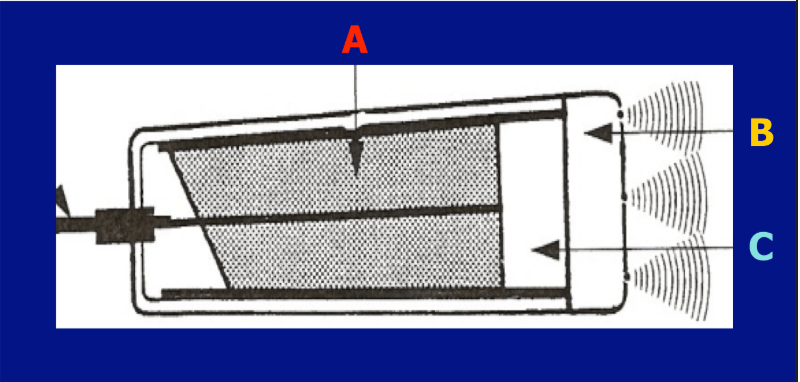
matching layer
1
How would you fix this image?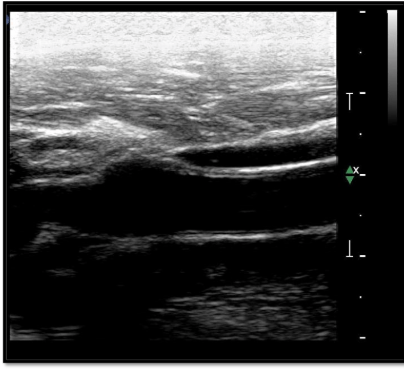
Move near field TGCs to the left and far field TGCs to the right
2
What is the scientific notation for 2,700?
2.7 x 10^3
2
What is the formula for axial resolution?
SPL/2
2
Ultrasound can be defined as a _______________, ______________ wave.
longitudinal, mechanical
2
Frequency and Period are both determined by the.....
source
2
Absorption _____ with increasing frequency
increases
2
The far zone is also referred to as the ___________ zone.
Frauenhofer
2
What is the difference between amplification and compensation?
amplification - all echoes equally increased
compensation - increases deeper echoes more
3
How many km are in 3000 m?
3 km
3
What is the formula for duty factor (DF)?
Duty factor(%) =
(PD (µs)/ PRP (µs)) x 100
3
What is the speed of sound in soft tissue?
1540 m/sec or 1.54 mm/µs
3
Does air or bone have a higher propagation velocity?
bone
3
What is the redirection of US waves in many different directions when they encounter structures that are small or irregular compared to the wavelength of sound?
- It occurs when the sound beam hits heterogeneous tissue, small reflectors, or rough surfaces.
Scattering.
3
This image was produced by which type of transducer?
curvilinear array (or curved linear)
3
Define "Standard Precautions"
A set of guidelines to minimize the exposure and risk of health care workers when in contact with a patient.
4
What is the reciprocal of 0.5 msec?
2 kHz
4
What is the formula for fractional bandwidth (FBW)?
FBW = Bandwidth (BW) / Operating frequency (Fc)
4
What is the audible frequency range of sound?
20–20,000 Hz
4
What is the The 3dB Rule?
A 3 dB INCREASE in output power will DOUBLE the beam intensity.
A 3 dB DECREASE in output power will HALF the beam intensity.
4
The area indicated by the red arrow can be described as __________ which indicates that there are ___________ reflected signals.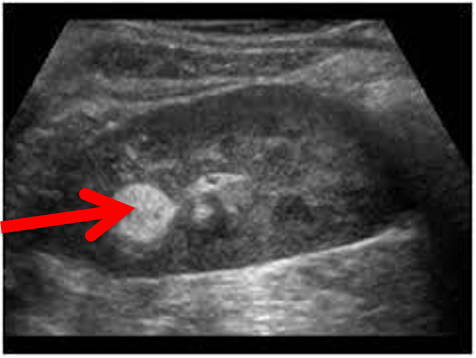
hyperechoic, highly
4
The reciprocal of frame time is _______.
And the reciprocal of seconds is _______.
Frame rate
Hertz
4
How is the frequency of a continuous wave transducer determined?
Determined by the frequency of the electrical signal created by the ultrasound system (electrical 𝑓 = acoustic 𝑓)
4
In this mode of ultrasound, the Y axis is depth and derived from “time of flight”.
B mode aka grayscale aka B scan
5
What is the formula for amplitude?
Amplitude = (max - min) / 2
5
Ultrasound frequencies are anything higher than _____ Hz
The frequency range used in diagnostic ultrasound is _________
20,000 Hz (20kHz)
2 - 12 MHz
5
If there is a large difference between 2 impedances, there will be nearly total what?
reflection
5
What is the 13 usec rule?
Pulse round trip time = 13µs for each cm of distance from the source to the reflector
5
What type of beam results from this phase delay profile - (give 2 descriptions)?
focused, un-steered beam
5
What are the 5 processes that happen in the receiver? List them in the order in what they happen.
Amplification
Compensation
Compression
Demodulation (detection)
Rejection
5
What are the 2 costs (drawbacks) of harmonic imaging?
Decreased amplitude in the far field
Decreased axial resolution
6
What are 2 formulas for intensity?
Intensity = Power / area
or
Intensity = Amplitude2 / area
6
Propagation velocity ______ with increasing bulk modulus.
increases
6
Name the 7 Sound Wave Parameters?(measurable attributes) and which are determined ONLY by the source.
Frequency, Period, Wavelength, Propagation speed, Amplitude, Power, Intensity
Frequency and Period are determined only by the source
6
The rate at which an ultrasound beam loses intensity as it travels through a medium (expressed per unit distance) is the definition of _________.
Attenuation coefficient
6
Calculate the pulse duration for a pulsed wave that has a period of 3 msec and rings (“is on”) for 4 cycles.
12 msec
6
Focal length is another name for:
NZL
(near zone length)
*** focal length and focal zone are 2 DIFFERENT THINGS
7
What is the formula for calculating the frequency of a pulsed wave transducer?
f0 =
crystal propagation speed (mm/usec) /
2 x crystal thickness (mm)
7
Compressibility ______ with increasing bulk modulus.
decreases
7
These waves have the same ________, but different ________.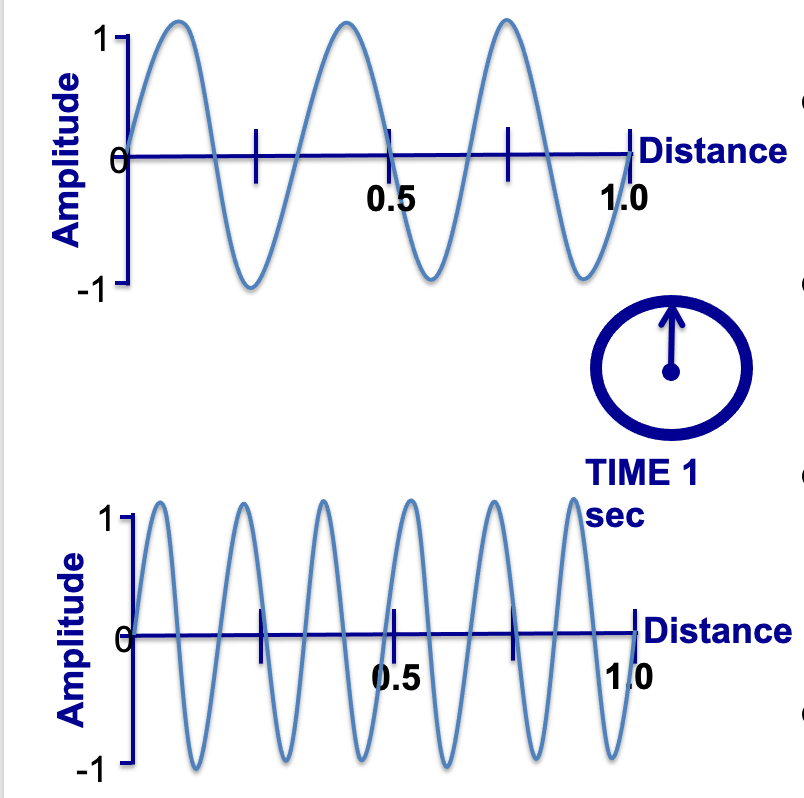
Propagation velocity, frequencies (or wavelength)
7
Snell's law is used to determine:
the presence and angle of refraction
7
For array transducers -
describe the difference between sequencing and phasing
Sequencing - Operated by applying voltage pulses to groups of elements in succession creating the image frame from one side to the other
Phasing - used for steering and focusing and operated by applying voltage pulses to most or all of the elements with small (< 1 µs) time differences between them
8
Calculate Log 50
1.7
Log 50 = Log (100/2)
= Log 100 - Log 2
= Log 2 - 0.3
= 1.7
8
What are the 2 forms of the formula for the change in decibels
Power form: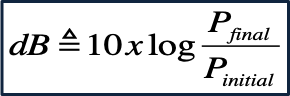
Amplitude form:
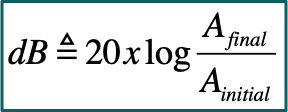
8
The blue and red waves have _______ interference. They both have an amplitude of 2V, so the green wave has an amplitude of ______V.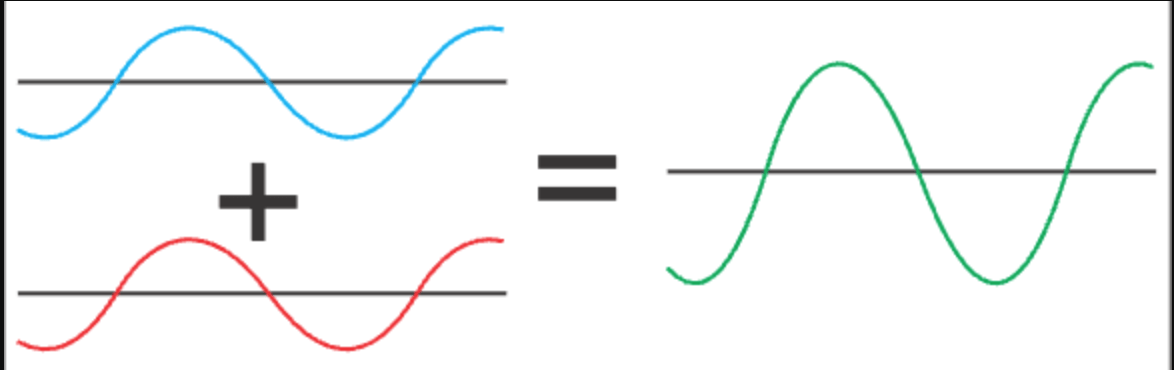
constructive, 4V
8
What are the two requirements for refraction to occur at the interface of 2 media?
1. Oblique incidence
2. Different propagation speeds
8
If "F" is 4 V, "A" is 5msec and the "C" is 20msec, calculate the DF.
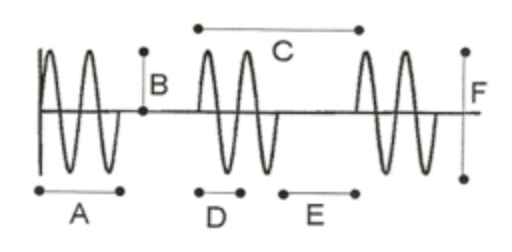
0.25 or 25%
8
______ and ______ describe transducer design, while ______ and ______ describe transducer operation.
linear; curved
sequencing, phasing
8
Which operation feature uses 1 transmit beam that is a little wider than normal and divides it into 2 creating 2 receive lines in the same space?
Parallel processing
9
What are 2 formulas used to calculate the NZL?
NZL = D2 / (4 x wavelength)
and
NZL =(D2 x f0) / 6 - for soft tissue
9
What happens to the wavelength when it moves from a medium with lower propagation velocity to a medium with higher propagation velocity?
Wavelength increases
9
Define "attenuation coefficient"
Attenuation that occurs with each centimeter the sound wave travels
Unit: dB/cm or dB/cmMHz
9
Both ______ and ________ resolution are determined by beamwidth, but in 2 different dimensions.
lateral and elevational
10
What is the formula for the intensity reflection coefficient (IRC)?
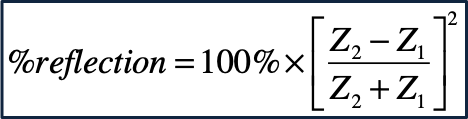
10
What happens to the beam intensity if the beam area is increased by a factor of 4?
Decreases by a factor of 4.
10
What sound beam incident angle gives the strongest reflection?
0 degrees
10
Name 3 adjustments a sonographer can make that will decrease the frame rate
increase depth
use multi-focus
widen the sector
10
What characteristics of the transducer will produce a higher beam divergence vs. a lower beam divergence?
Higher beam divergence (shallow depth of field) - smaller crystal diameter and lower frequency
Lower beam divergence (broad depth of field) - larger crystal diameter and higher frequency
10
Name 5 adjustments a sonographer can make that changes the amount of output power the machine allows
Frequency
Imaging mode
Depth
Image sector size
Focus
11
This gallstone demonstrates what 2 main types of attenuation?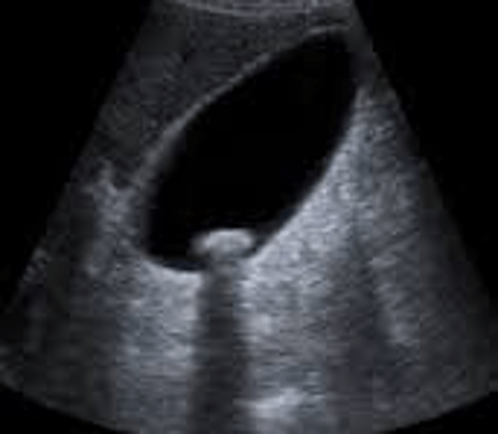
Absorption and reflection
11
To obtain the longest focal zone you need a _____ crystal diameter and a _______ frequency
large, high