ATOMS are sus because they make up everything
Elements be wildin'
Molecules more like moleCOOLs
Electrons are #dramatic
Compounds #together4ever
Bonds #attraction
100
Can atoms be seen with the naked eye?
Nope, you need a specialized type of microscopy called atomic force microscopy.
100
Were the Greeks correct in believed the only elements are air, fire, earth, and water?
NOOOO. There are 118 elements and none of them are air, fire, earth, or water.
100
What is a molecule?
When two or more atoms bond by sharing electrons.
100
What kind of charge do electrons carry?
A negative charge.
100
What is a compound?
When two different elements bond to form molecules.
100
Which kind of bond involves sharing electrons?
Covalent bond.
200
What makes up the nucleus of an atom?
Protons and neutrons.
200
True or false: Elements can combine to form more than one type of substance.
True. For example, hydrogen and water not only combine to form oxygen (H2O) but they also combine to form hydrogen peroxide (H2O2)
200
What kind of bond is seen in a water molecule?
Covalent bond. Hydrogen and oxygen share electrons so each hydrogen has 2 electrons in its outer orbit and oxygen has 8.
200
How many electrons does it take to fill the first energy shell of an atom?
2
200
True or false: the formula for a compound is always the same no matter how much there is of the compound.
True. It doesn't matter if you have 1 or 1,000 molecules of water, it will always be H2O.
200
Which kind of bond involves the transfer of electrons?
Ionic bond
300
When are atoms most stable?
When the outer energy shell is either full of electrons (8) or empty.
300
What does this number represent?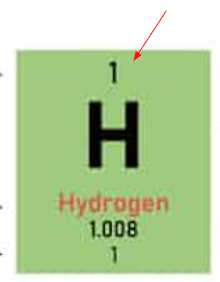
Atomic number or # of protons in an element.
300
What is an elemental molecule?
Molecules consisting of two or more atoms of the same element (ex: Oxygen)
300
True or false: an atom that loses an electron gains a negative charge.
False. Losing an electron means the atom is losing a negative charge because electrons are negatively charged.
300
What is an example of a compound molecule?
Water (H2O)
Salt (NaCl)
Glucose (C6H12O6)
Vinegar (C2H4O2)
300
What is the name of the movie character also known as OO7?
Bond...James Bond
400
What was really the only difference between the Bohr atomic model and the modern atomic model?
Bohr's model had not yet identified neutrons in the nucleus of the atom.
400
What is an element?
A substance that contains only one type of atom. It cannot be broken down into another substance with different properties. It is represented by chemical symbols of one or two letters.
400
Is oxygen (O2) an example of a diatomic molecule?
Yes, because it is made up of exactly TWO of the SAME atoms.
400
How does electron movement occur in electricity?
Electrons spend a short amount of time with each atom before being passed to the next. This flow of electrons through a conductive material is called electricity.
400
How are ionic compounds different from molecular compounds?
Ionic compounds are not held together by covalent bonds while molecular compounds are. Atoms in ionic compounds completely gain or lose electrons forming ionic bonds.
400
Why are the negative ion and positive ion attracted to each other in an ionic bond?
Because opposites attract!
500
What would make two separate atoms perfectly suited for each other?
Two separate atoms that would fill each other's outer energy shell to become stable. For example, sodium has 1 electron in its outer energy shell while chlorine has 7 electrons in its outer energy shell. If sodium loses its one electron to chlorine, they both become stable.
500
What is the chemical symbol for sodium?
Na
500
What does the number represent in the formula for a molecule? (i.e. O2)
How many atoms of each element are used.
500
What are 2 examples of good electrical conductors? 2 examples of poor electrical conductors?
Good: Sea water and metals (i.e. copper, gold, steel, silver, etc.)
Poor: Rubber, glass, oil, diamond, wood
500
Explain how ionic compounds are more easily broken down into their separate elements than molecular compounds. (Use NaCl a.k.a table salt as an example)
When you drop a crystal of salt into water, it dissolves rapidly. The sodium chloride crystal breaks down into its ions.
500
Identify which one is a covalent bond and which one is an ionic bond. 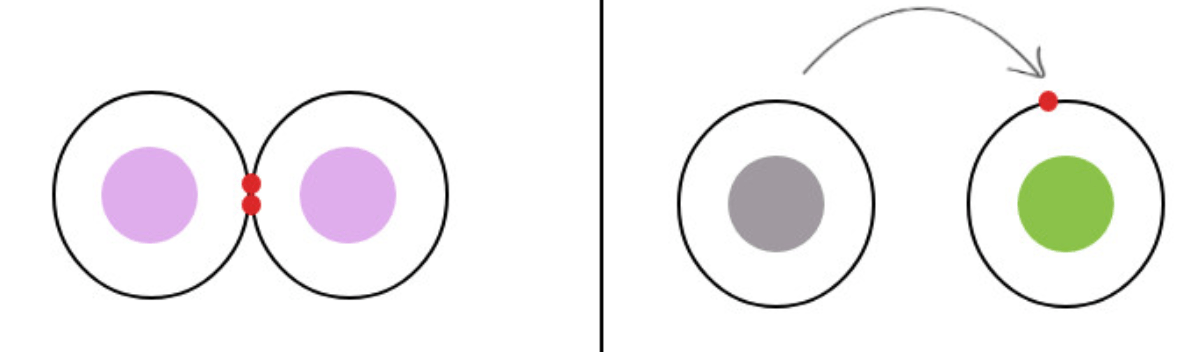
The left is covalent and the right is ionic.