Basics of Economics
Supply and Demand
Factors of Production
Economic Indicators
Miscellaneous
100
The study of how to best use limited resources to fulfill unlimited wants is called...
Economics
100
An object that a person requires to survive is called a...
Need
100
Name all four factors of production
Land, Labor, Capital, and Entrepreneurship
100
What is GDP?
Gross Domestic Product: The total value of final goods and services that are produced in a country.
100
What is it called when supply is significantly greater than demand?
Surplus
200
Name three things that can be scarce other than money.
Examples include: Knowledge, time, materials/resources, space, labor, etc.
200
When selling price of a product increases, what will supply do?
Increase
200
What are the four types of economies?
Market, Command, Traditional, and Mixed
200
What three kinds of people over the age of 16 are not included in the labor force?
Students, retired individuals, people who aren't looking for a job.
200
Name two examples of the government protecting customers in mixed economies?
Rent Control, Price Ceilings, Minimum Wage, etc.
300
"China produces roughly 1.33 billion dollars worth of stuffed animals annually". This is an example of a __________________ statistic.
Microeconomics
300
Give three examples of disincentives.
Speeding tickets, Sin Taxes, Classroom Consequences, Loss of Privilege, Extra Work, etc.
300
What are the three questions countries need to answer when they are deciding how they will use their limited resources?
What needs to be produced, how will it be produced, who will produce it
300
How would you measure the economic health of two countries with drastically different population counts?
GDP per capita
300
Both China and the United States can make 1,000 chocolate bars in a day. China can make 5,000 bananas in a day, whereas the United States can make 7,500 bananas in a day. China has a ______________ advantage making chocolate bars.
Comparative Advantage.
400
Tyson has the option to purchase a monster energy drink from his local convenience store or a Frappuccino from Starbucks. Tyson decides to get the monster to avoid the longer drive to starbucks. Which type of value is Tyson prioritizing?
Cost Value
400
What is an equilibrium point used for?
It gives an estimate as to the price point that consumers will be willing to buy at and the price point producers are willing to sell at. It also estimates how many of a product should be produced to meet demand.
400
Which type of economy incentives innovation the most.
Market economy
400
Name all four phases of the business cycle
Prosperity, Recession, Depression, Recovery
400
Give an example of a good that can either be a final good or intermediate good depending on the customer (you cannot use tires).
There's like a bajillion of them
500
Your friends ask you to hang out this Saturday and to go to a flea market with them, but your boss also calls and asks if you would like to do a paid training that will make you a more efficient worker. You decide to go take the trainings at work, name two opportunity costs by making this decision.
The fun from hanging out with friends, the possibility of finding cool new clothes, improving social standing with friends, missing out on an inside joke/core group memory, etc.
500
Come to the board and draw both a supply and demand graph on the same graph. Label the equilibrium point.
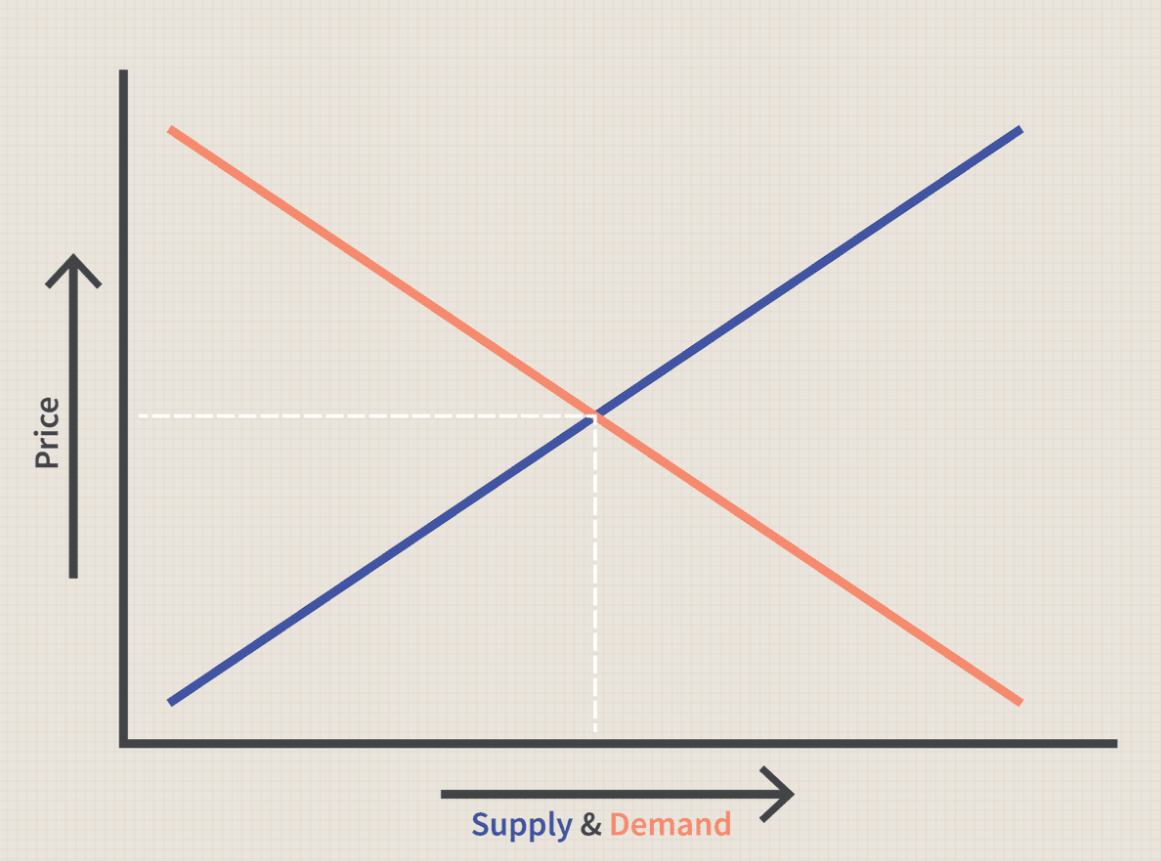
500
Name one issue with market, command, and traditional economies.
Market: Prone to corporate corruption, income inequality, prone to market crashes, economic instability
Command: Prone to government corruption, can slow down innovation, the public has less options for products.
Traditional: Almost fully stops innovation, requires demanding labor from most members, limited individual freedom.
500
When can governments consider themselves in a recession? (looking for a specific threshold)
GDP decreases for two consecutive quarters
500
What are three sources of government spending?
Transportation, Healthcare, Social Security, Paying off Debt, Food Stamps, Education, etc.