Sequences
Operations with Fractions
Powers and Roots
Rational and Irrational Numbers
Scientific Notation
100
What is the next pattern in the sequence below:
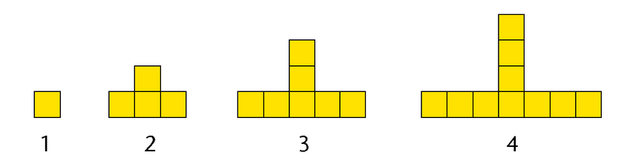
Two squares added to the bottom, and one square added to the top.
100
Solve:
2/5 x 3/4
Simplify your answer.
3/10
100
15^2
225
100
An irrational number cannot be turned into a ______.
Fraction
100
When multiplying numbers in scientific notation, or numbers with exponents, you ______ the exponents.
ADD.
200
Is the following sequence increasing or decreasing?
State the next term.
-2, -4, -6, -8, ...
Decreasing, -10
200
Solve:
3 1/2 x 1 1/4
15/4
or
3 3/4
200
0.2^ 2
0.04
200
Convert the following repeating decimal to a fraction:
0.8888...
8/9
200
(2 x 10^3) x (5 X 10^4)
10 x 10^7
300
State a conjecture for the following sequence:
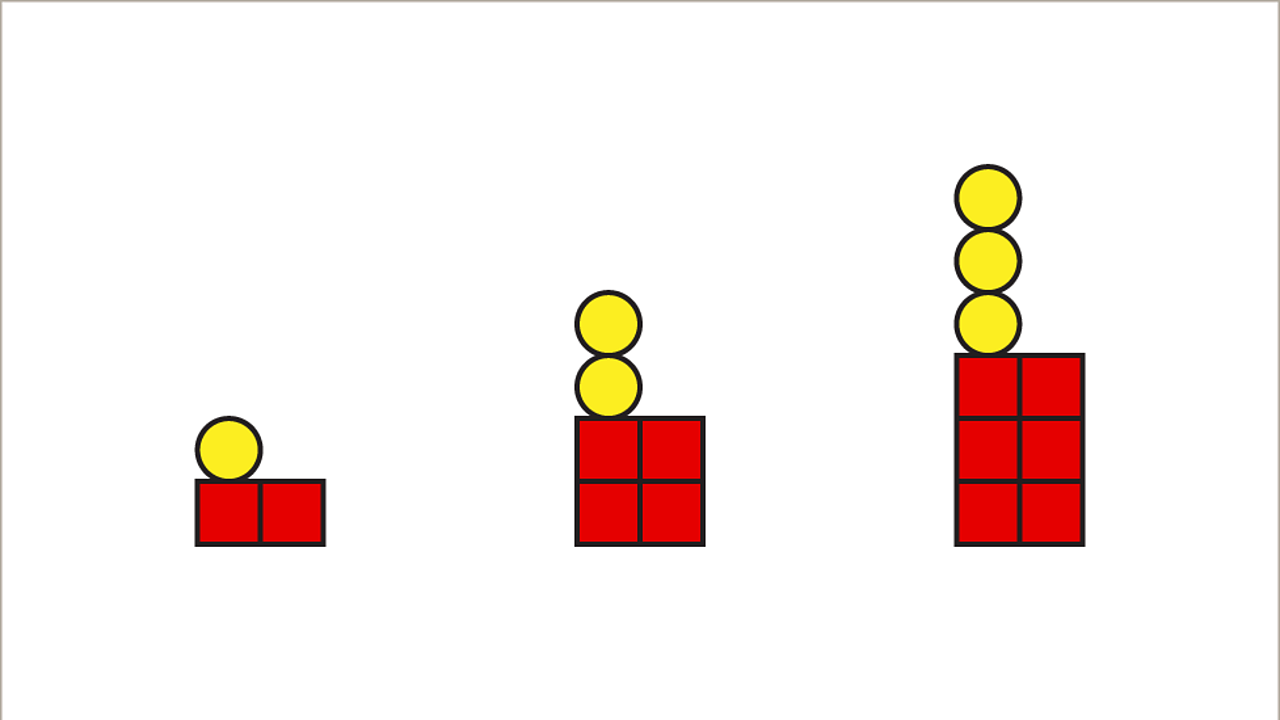
The sequence is adding two squares and one circle to each figure.
The next figure has 8 squares on the bottom and 4 circles on top.
300
Solve:
3/5 + 4/6
Simplify your answer.
19/15
or
1 4/15
300
x^2 = 196
X = 14
300
Convert the following repeating decimal to a fraction:
0.67676767...
67/99
300
14 x 10^4
_________
7 x 10^3
2 x 10^1
400
What is the next 5 terms in the following sequence:
2/333, 4/333, 6/333, ...
8/333, 10/333, 12/333, 14/333, 16/333
400
Solve:
8/15 divided by 4/7
Simplify your answer.
14/15
400
(1/3)^3
1/27
400
What is the estimate of the square root of 42?
About 6.48
400
(3.4 x 10^3) + (2.5 x 10^3)
Write your answer in STANDARD form.
5900
500
State whether the sequence is decreasing, increasing or neither and state the next three terms.
|5 - 3|, |5 - 4|, |5 - 5|, |5 - 6|, |5 - 7|, ...
Neither.
3, 4, and 5.
500
Solve: 2 3/5 - 1 1/3
Simplify your answer.
13/5 - 4/3
39/15 - 20/15 = 19/15 or 1 4/15
500
x^3 = 64,000
40
500
Convert the following repeating decimal to a fraction.
1.535353...
152/99
500
(2.7 x 10^-3) - (1.6 X 10^-4)
Keep you answer in SCIENTIFIC FORM.
2.54 x 10^-3