History
Primary and Secondary Sources
Facts vs. Opinion
Define
Residential Schools
Indigenous Studies
100
List four examples of primary sources.
Artifacts, Coins, Ancient writings, paintings, Newspapers, Military uniforms, weapons, documents, oral histories, diaries, music, buildings, film & footage, pictures, memoirs
100
Determine whether the following are Facts or Opinions.
a) Hitler was a madman ___________________
b) There is no reason to fight a war ___________________
Opinion
Opinion
100
Define History.
History: is the record of past events written after careful study.
100
What were wampum belts used for? What did they represent
Wampum belts were used to symbolize an agreement between two first nations groups. They were also used between Canada and First Nations as an agreement that they would live together on the land, but follow separate paths (and not intervening with each other).
They represent a treaty or contract. (By European standards).
200
List three reasons why we study history? Be specific.
History helps us make decisions (private and public) by providing examples. Helps us determine progress or backlash based on our decisions.
To understand trends: Literature and the Arts, Music, Fashion, Entertainment & Technology.
Strengthens our heritage and culture by drawing on great accomplishments and recognizing our mistakes.
History builds empathy through studying the lives and struggles of others.
200
List two examples of secondary sources
Biographies, history books, textbooks, encyclopedias, documentaries, web pages, journal articles written about past events.
200
Define Assimilation
Assimilate: cause (something) to resemble; liken.
Assimilation in Canada: is based on the idea that once contained indigenous peoples will adopt western practices and be absorbed into Canadian society.
200
Why were residential schools located in remote locations in Canada? Give 2 specific reasons.
To keep the system hidden from the Canadian public
So students couldn’t escape or if they ran away they could die
So students could not access their families or communities
200
What are the “94 calls to action”? Provide a brief example.
The 94 calls to action are actionable steps created by the Truth and Reconciliation Commission of Canada in 2015 to redress the legacy of residential schools and advance reconciliation.
Students may provide any example from the 94 calls to action for a mark.
300
List three (3) problems historians face when studying history.
Bias: a prejudice in favour of or against one thing, person, or group compared with another, usually in a way considered to be unfair.
Distortion: when facts are altered or misinterpreted. Reasons: comprehension & memory, words & language, new discoveries etc.
Fragmentation: Pieces of the story but not the whole thing. Some missing information.
- Lack of the entire Picture
- Historians must make Educated Guesses
- Documents and evidence of what really happened can be destroyed.
- Example: Casualties in war - usually approximated - Not all people are accounted for . 6-9 million Jews were persecuted and killed during the Holocaust.
Perception: “Point of view”, The way which people see truths depending on their background, beliefs and personal experience.
-Many wars and battles are written from the perspective of the winner.
300
What is a residential school and what was its purpose?
The residential school system was a network of government-funded, church-run boarding schools designed to forcibly assimilate Indigenous children into Euro-Canadian culture. Operating for over 150 years (from the 1830s to 1996), the system saw more than 150,000 First Nations, Inuit, and Métis children taken from their families and communities.
The primary goal of the system was aggressive assimilation, "to kill the Indian in the child"
300
What was the purpose of the early Peace & Friendship Treaties?
To secure trade relations and military alliances between indigenous people and the first European settlers.
400
What was the Royal Proclamation of 1776?
Royal Proclamation of 1763 stated that no European settlement could be established before the Crown secured the lands by negotiating a Treaty with Indigenous Peoples.
In other words, the crown had to negotiate the land purchase with the indigenous before it could be settled on by Europeans.
500
What are some of the promises given to the indigenous people by the Canadian government in the Numbered Treaties? List 4 examples.
Land to be set aside for First Nations use, known as “reserves”
Money to be paid to a First Nation every year, known as “annuities”
Hunting and fishing rights on vacant Crown land
Schools and teachers on reserves, to be paid by the government
Things like farm equipment and animals, ammunition and clothing to be provided by the government.
600
Using the Map below, label the area of treaty 45 ½ and treaty 72. Explain the surrendered territory for each treaty in the space below.
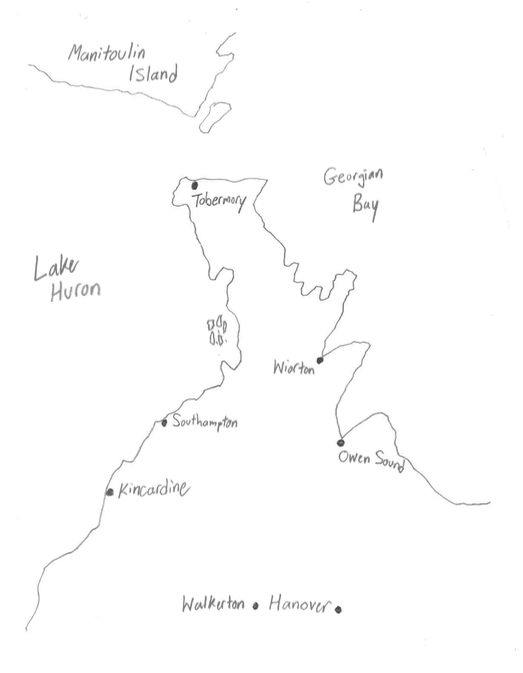
Treaty 45 ½ - Surrendered the land south of Owen Sound and Southampton for European Settlement. The Peninsula was for Indigenous use and would forever be protected. They would also have ownership of the fishing islands and fishing resources.
Treaty 72 - Surrendered most of the peninsula to European settlement and established 5 small reserves for the indigenous people to live on. Fishing rights remain.