Who's Eating Who
Biome Sweet Biome
It's Giving...Photosynthesis
We Were on A Cycle
Besties
100
What is the frog’s trophic role in this food chain?
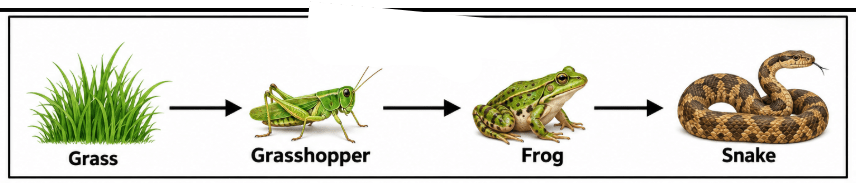
A. Producer
B. Primary consumer
C. Secondary consumer
D. Tertiary consumer
What is C. Secondary consumer?
100
Climates are classified according to two major factors:
a. elevation and precipitation
b. elevation and latitude
c. latitude and temperature
d. precipitation and temperature
What is d. precipitation and temperature?
100
The collective mass of all living things in a particular area or at a specific trophic level of an ecosystem is known as...
a. Biomass
b. Population Size
c. Biomagnification
d. Apex Trophism
What is a. Biomass?
100
Which organisms play an important role in nitrogen fixation so plants can absorb nitrogen?
a. bacteria
b. earthworms
c. corn
d. birds
What is a. bacteria?
100
An observer notes that the various birds in her yard feed on are using different parts of the tree for nesting sites and food. This is an example of _______________.
a. division of labor
b. resource conservation
c. resource partitioning
d. mutualism
What is c. resource partitioning?
200
What may happen if the snowshoe hare was removed from the food web pictured?
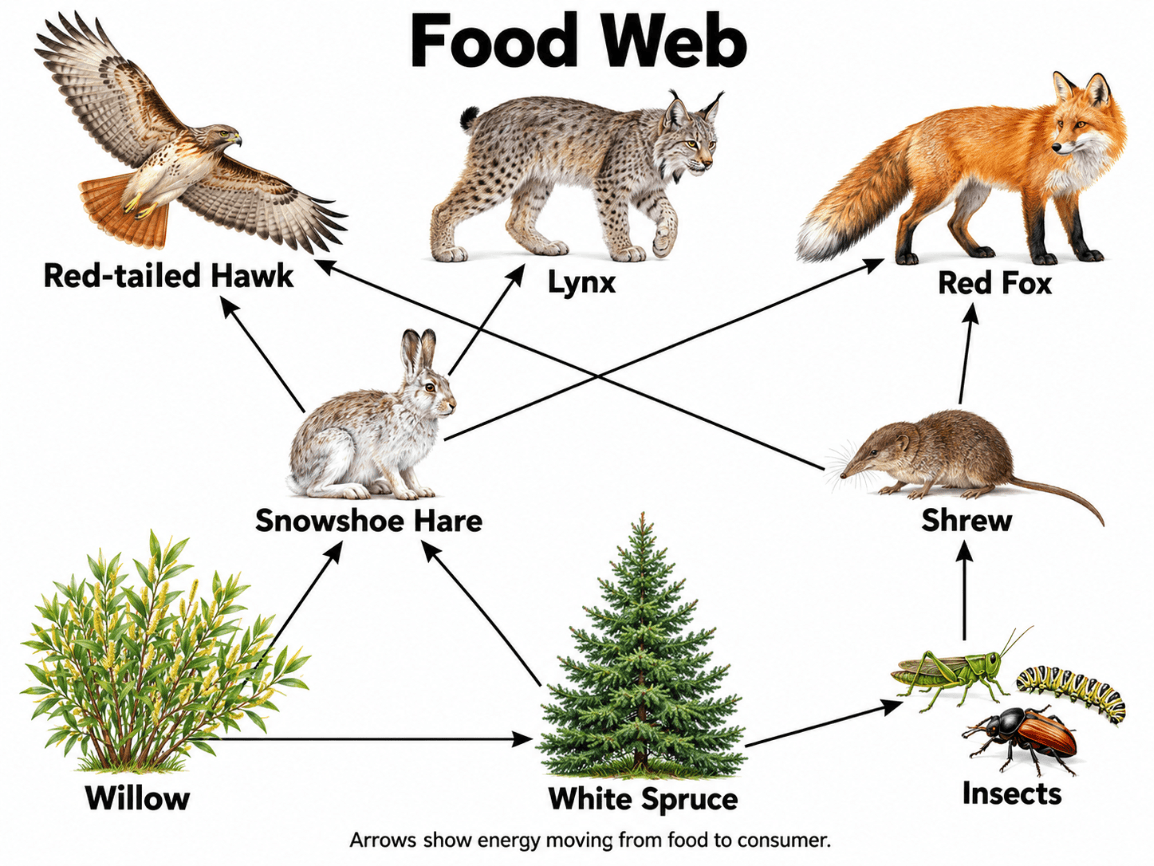
a. The insects in the habitat would increase
b. The shrew population would decrease due to being only hawk food source
c. The willow tree population would decrease
d. Foxes would dies due to no food source.
What is b. The shrew population would decrease due to being only hawk food source?
200
Which biome has permanently frozen subsoil, a short growing season, and mostly mosses, lichens, and low-growing shrubs?
A. Boreal forest (taiga)
B. Tundra
C. Temperate grassland
D. Chaparral
What is B. tundra?
200
A grassland has a GPP of 25 kg C/m²/yr. Producers use 15 kg C/m²/yr for respiration. What is the NPP?
A. 10 kg C/m²/yr
B. 15 kg C/m²/yr
C. 40 kg C/m²/yr
D. 375 kg C/m²/yr
What is A. NPP = GPP − R = 25 − 15 = 10 kg C/m²/yr?
200
Which biogeochemical cycle does not have a significant atmospheric gas phase?
A. Carbon cycle
B. Nitrogen cycle
C. Phosphorus cycle
D. Water cycle
What is C. Phosphorus cycle?
200
A bee receives nectar from a flower while transferring pollen between flowers. What relationship does this illustrate?
A. Parasitism
B. Commensalism
C. Mutualism
D. Competition
What is C. mutualism?
300
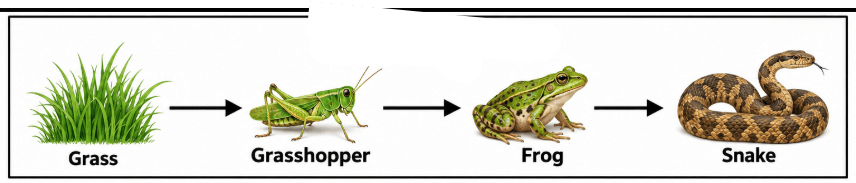
Using the food chain above, suppose the grass stores 20,000 kJ of energy available to consumers. Assuming approximately 10% transfers at each step, how much energy reaches the snake?
A. 20 kJ
B. 200 kJ
C. 2,000 kJ
D. 18,000 kJ
What is A. 20 kJ?
300

Using the graph to the right, what biome would have annual precipitation of 45cm and an annual temperature of 25 degrees celsius.
What is subtropical desert?
300
A forest has an NPP of 12 kg C/m²/yr, and producer respiration is 18 kg C/m²/yr. What is its GPP?
A. 6 kg C/m²/yr
B. 15 kg C/m²/yr
C. 30 kg C/m²/yr
D. 216 kg C/m²/yr
What is C. GPP = NPP + R = 12 + 18 = 30 kg C/m²/yr?
300
A forest is replaced with a paved parking lot. After a rainstorm, which change in the water cycle is most likely?
A. Increased infiltration and decreased surface runoff
B. Decreased infiltration and increased surface runoff
C. Increased transpiration and increased groundwater recharge
D. Decreased precipitation and increased condensation
What is B. Decreased infiltration and increased surface runoff?
300
Cattle egrets forage (feed) in fields among cattle. The egret gets easy access to flying insects stirred up by the cattle, and the cattle don't care if they are there or not.

What is commensalism?
400
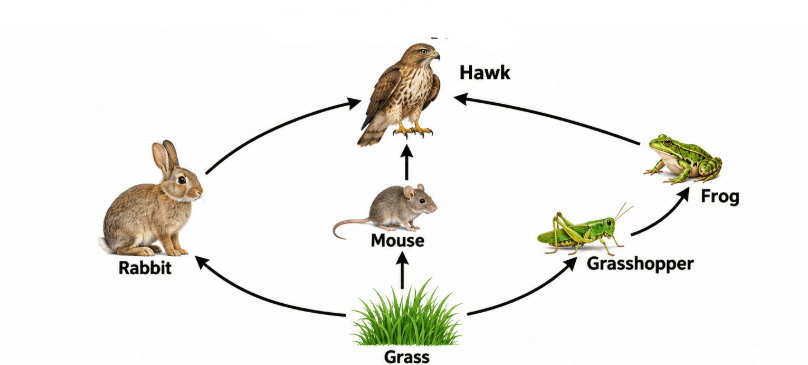
Which statement correctly describes the hawk’s trophic roles in this food web?
A. It is a primary consumer when eating mice and a secondary consumer when eating frogs.
B. It is a secondary consumer when eating mice and a tertiary consumer when eating frogs.
C. It is a tertiary consumer when eating either mice or frogs.
D. It is an omnivore because it eats several animal species.
What is B. Eating mice places the hawk at the third trophic level; eating frogs places it at the fourth?
400
Two locations receive similar amounts of precipitation each year. One supports a temperate forest, while the other supports tundra. Which factor best explains the difference?
A. Tundra receives more direct sunlight throughout the year.
B. Forests require less water than tundra vegetation.
C. Lower temperatures and a shorter growing season limit tree growth in tundra.
D. Higher decomposition rates prevent trees from growing in tundra.
What is C. Lower temperatures and a shorter growing season limit tree growth in tundra?
400
The equation for photosynthesis...
What is 6CO2 + 6H2O + Light Energy = C6H12O6 + 6O2?
400
A forest is cleared and burned to create farmland. Which statement best explains how this change could increase atmospheric CO₂ in two ways?
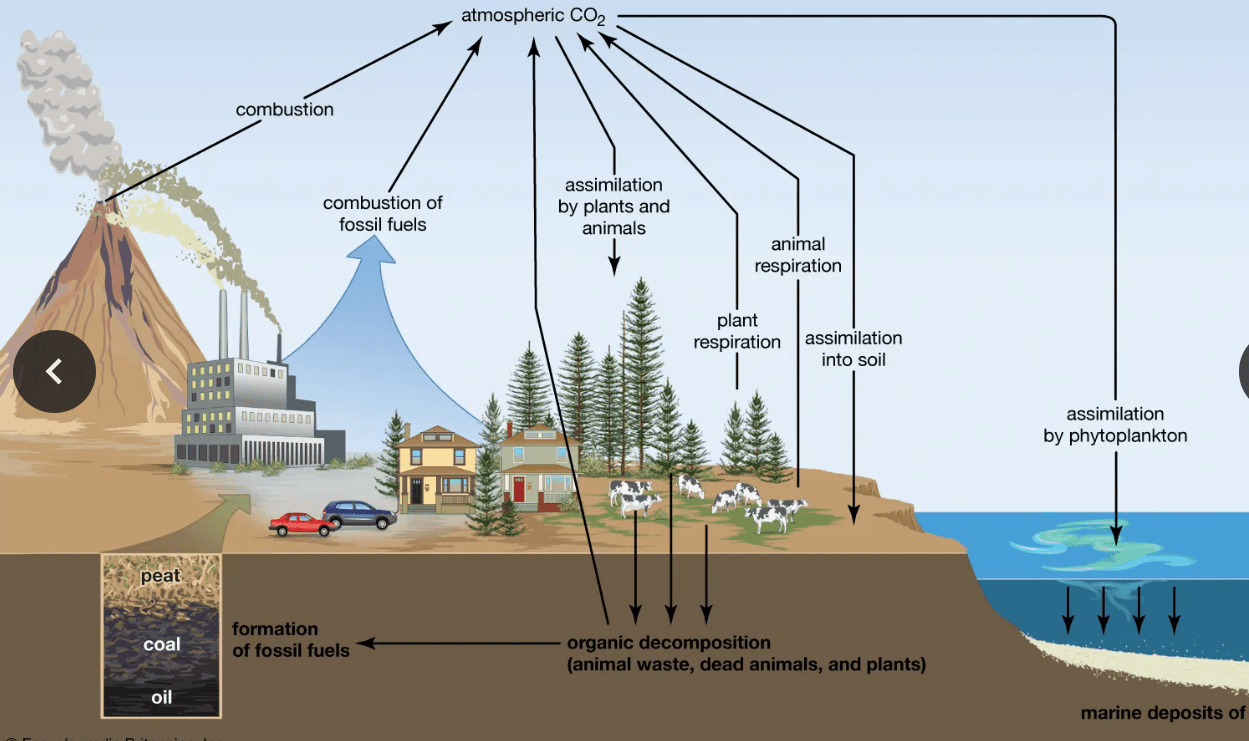
A. Burning releases stored carbon, and fewer trees remain to remove CO₂ through photosynthesis.
B. Burning removes CO₂, and fewer trees remain to perform cellular respiration.
C. Burning converts carbon into nitrogen, and farming increases nitrogen fixation.
D. Burning stores carbon in the soil, and fewer trees remain to release oxygen.
What is A. Burning releases stored carbon, and fewer trees remain to remove CO₂ through photosynthesis?
400
A tick feeds on a deer’s blood. Birds sometimes eat ticks off the deer. Which answer correctly identifies these relationships?
A. Tick–deer: mutualism; bird–deer: parasitism
B. Tick–deer: parasitism; bird–deer: mutualism
C. Tick–deer: commensalism; bird–deer: mutualism
D. Tick–deer: parasitism; bird–deer: commensalism
What is B. Tick–deer: parasitism; bird–deer: mutualism?
500
A disease sharply reduces the frog population. Assuming hawk numbers initially remain stable and hawks compensate by eating more rabbits and mice, which combination of changes is most likely?
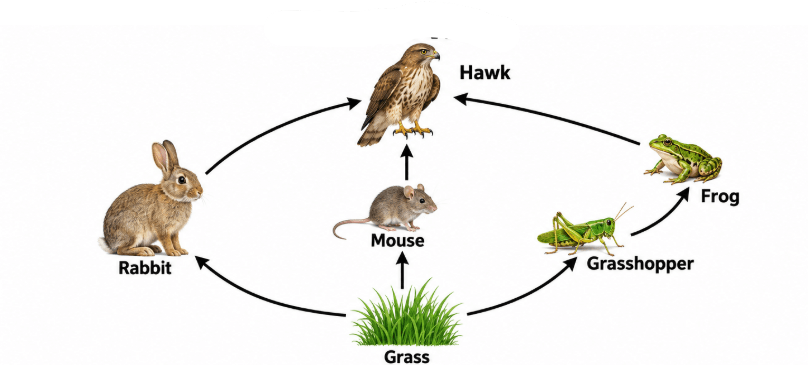
A. Grasshoppers decrease; rabbits and mice increase.
B. Grasshoppers increase; rabbits and mice increase.
C. Grasshoppers decrease; rabbits and mice decrease.
D. Grasshoppers increase; rabbits and mice decrease.
What is D. Fewer frogs reduce predation on grasshoppers, while the hawks’ shift in diet increases predation on rabbits and mice?
500
A biome has mild, rainy winters and hot, dry summers. After a wildfire, many native shrubs resprout from their roots, and some seeds germinate in response to fire-related cues. Which biome and adaptation best match this description?
A. Tropical rainforest; broad leaves maximize sunlight absorption.
B. Chaparral; fire adaptations allow plants to recover after periodic burns.
C. Temperate grassland; shallow roots prevent water loss.
D. Boreal forest; needle-shaped leaves promote rapid decomposition.
What is B. Chaparral; fire adaptations allow plants to recover after periodic burns?
500
An ecosystem initially has a GPP of 40 kg C/m²/yr and an NPP of 16 kg C/m²/yr. After temperatures rise, producer respiration increases by 25%, while GPP remains unchanged. What is the new NPP?
A. 4 kg C/m²/yr
B. 10 kg C/m²/yr
C. 12 kg C/m²/yr
D. 20 kg C/m²/yr
What is B. Initial R = 40 − 16 = 24. New R = 24 × 1.25 = 30. New NPP = 40 − 30 = 10 kg C/m²/yr.?
500
Which sequence correctly traces nitrogen from the atmosphere into proteins in the animal shown?
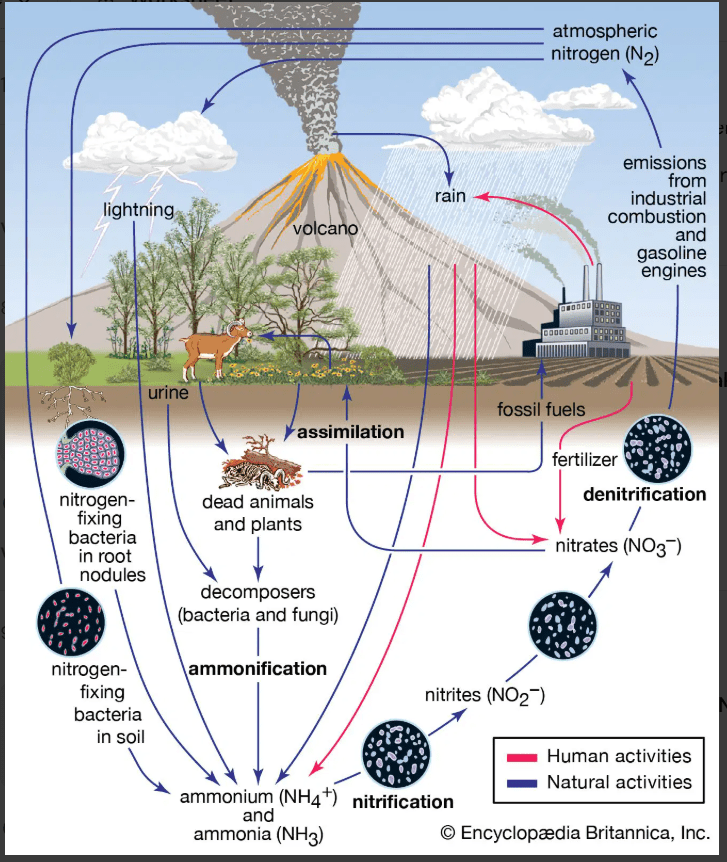
A. Denitrification → plant assimilation → animal consumption
B. Nitrogen fixation → nitrification → plant assimilation → animal consumption
C. Plant assimilation → nitrogen fixation → animal consumption
D. Nitrification → denitrification → animal consumption
What is B. Nitrogen fixation → nitrification → plant assimilation → animal consumption?
500
Following several mild winters, a rabbit population increases. A few months later, the fox population also increases. Which explanation best accounts for the delay?
A. Foxes must wait for rabbits to reach carrying capacity before hunting them.
B. Increased prey availability improves fox survival and reproduction, but population growth takes time.
C. Rabbits become less nutritious as their population increases, slowing fox reproduction.
D. Predator populations increase only after prey populations begin to decline.
What is B. Increased prey availability improves fox survival and reproduction, but population growth takes time?