Types of Chemical Reactions
Coulomb's law and Periodic Trends
Electronegativity and Chemical Bonds
Lewis Structures and Dipoles
Mystery
100
What type of chemical reaction is this reaction called?
4 Al(s) + 3 O2(g) → 2 Al2O3(s)
Synthesis
100
According to coulomb's law, what happens to the force of attraction as the distance between the nucleus and valence electrons increases?
The force of attraction will decrease
100
Electronegativity:
F: 3.98
Li: 0.98
What type of bond is created? Explain why
Ionic Bond, electronegativity difference is >2.0
100
What are the delta + and delta - symbols called?
Partial Charges
100
What type of bond is being formed? Why?
Ionic Bond. Mg is a metal and is donating its electrons to Cl, which is a nonmetal. Nonmetals are more electronegative and will take electrons from metals
200
What type of chemical reaction is this reaction called?
Cu + 2 AgNO3 → 2 Ag + Cu(NO3)2
Single Replacement
200
Coulomb's law tells us that the greater the nuclear charge (q₁) and the shorter the distance between the nucleus and the outermost electron (r), the stronger the attraction between the nucleus and the electron. As a result, the electron will require more energy to remove. Which periodic trend does this text describe?
Ionization Energy
200
Electronegativity
O: 3.44
C: 2.55
What type of bond is created? Explain why
Polar Covalent Bond, electronegativity is between 0.5 and 1.7 (0.89)
200
Which Law explains why molecules can be formed from dipole or partial charge attraction?
Coulomb's Law of Electrostatic Force
200
Is this molecule a polar molecule? Why or why not.
Yes, the negative poles are the Cl ions and the positive pole is the Mg ion. This are full charges, not partial charges
300
What type of chemical reaction is this reaction called?
H2CO3 (aq.) → CO2 (g) + H2O (l)
Decomposition
300
Fill in the Blank. According to Coulomb's Law, as the atomic number increases within a period, the nuclear attraction for electrons will also increase, thus pulling the electron(s) closer to the nucleus. The Coulombic attraction of the nucleus of an atom for its electrons is referred to as the ___________ of the atom.
Electronegativity
300
Electronegativity
C: 2.55
N: 3.04
What type of bond is formed? Why?
Nonpolar Covalent Bond. Electronegativity difference is <0.50 (0.49)
300
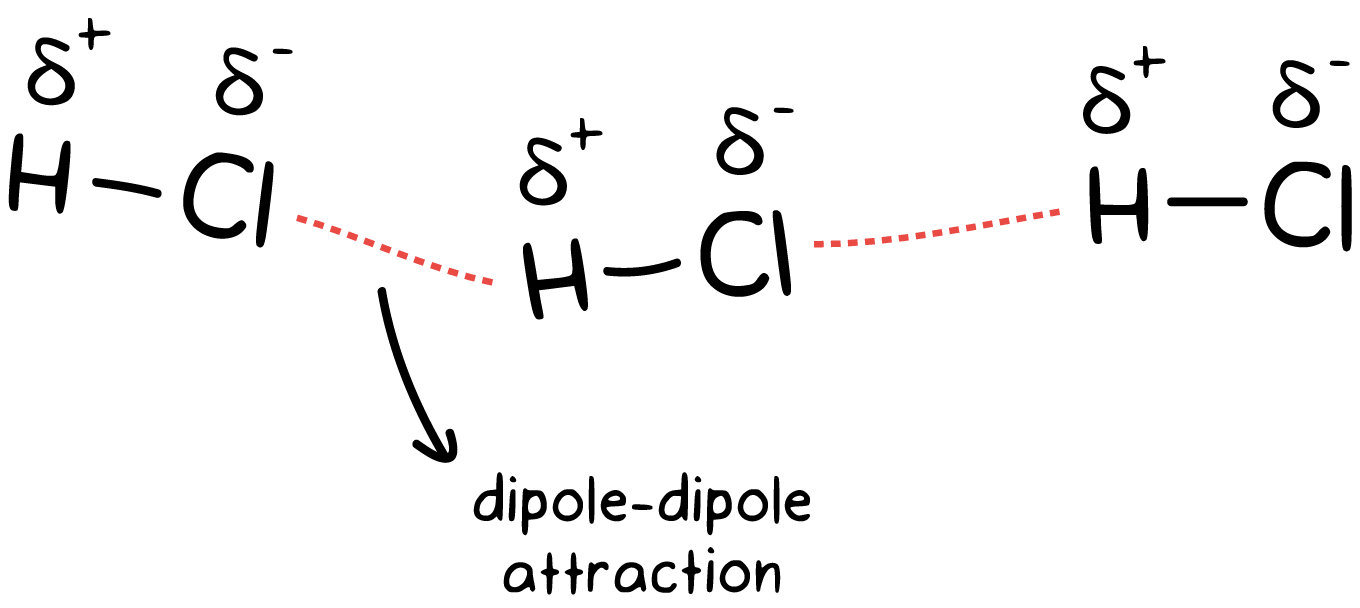
Explain why this molecule is exhibiting dipole - dipole attraction.
Dipole-dipole forces are attractive forces between the positive end of one polar molecule and the negative end of another polar molecule. H-Cl is a polar molecule. Cl is the negative end of a polar molecule while H is the positive end of a polar molecule.
300
Which element has a higher electronegativity and which element has a higher ionization energy?
Cl has a higher EN and IE. Since Cl is taking electrons, it is more electronegative. Cl is taking electrons from Mg which means it takes less IE to take electrons from Mg than Cl
400
What type of chemical reaction is this reaction called?
BaCl2 (aq.) + Na2SO4 (aq.) → 2 NaCl (aq.) + BaSO4 (s/ppt.)
Double Replacement
400
Fill in the blank. ______________ increases from top to bottom within a group because: There is bigger distance between the protons in the nucleus and the outer electrons, decreasing the attraction forces according to Coulomb's Law.
Atomic Radius
400
Electronegativity
Be: 1.57 O: 3.44
F: 3.98 P: 2.19
Which pair makes an ionic bond between Be and O or F and P?
Be and O because while the electronegativity difference is 1.87, Be is a metal and O is a nonmetal. F and P have an electronegativity difference of 1.79 but both are nonmetals so there is no ionic bond.
400
Which element contains the partial negative pole in this molecule?

Oxygen, it has more valence electrons so its more electronegative so it ends up drawing in electrons closer to its atom
400
How many valence electrons would you draw in a Lewis Structure of MgCl2?
12, each chlorine would have 6 drawn valence electrons since the 7th VE is in a bond
500
What type of chemical reaction is this reaction called?
C6H12O6 + 6O2 → 6CO2 + 6H2O + energy
Combustion
500
Ionization energy determines how much energy is required to remove an electron from an atom. When an electron is removed from an atom and donated to another atom, what are the names of the created ions?
Anion (gained an electron) and Cation (lost an electron)
500
Helium, Argon, and Neon do not have an electronegativity. Why?
All noble gases have stable outer electron shells. Electronegativity is a measurement of the power of an atom to attract electrons. The Noble gases, like helium, neon, and argon all have full valence shells. This means they are very stable and have no need to bond.
500
Why dont all elements make the same number of bonds? Use the below model as evidence in your response

N, O, and F have different numbers of valence electrons (based on the model) so they need different numbers of bonds to make a full valence shell
500
What type of chemical reaction is depicted below?
Synthesis