PE vs KE
Specific Heat
Energy Transformation
Conservation of Mass
RANDOM!
100
Water freezing, then melting, then freezing, then melting is an example of a _______ _______ .
What is a physical change?
100
4.184 J/gC is this.
What is the specific heat of water.
100
Energy is not _______ or _________ – only transferred or transformed.
What is created ; destroyed ?
100
________ have a positive charge and neutrons are uncharged. _________ have a negative charge and move rapidly around the nucleus
What is Protons ; electrons?
100
Energy is the capacity to do _____ or produce _____.
What is work ; heat?
200
At point #1, why does KE=0?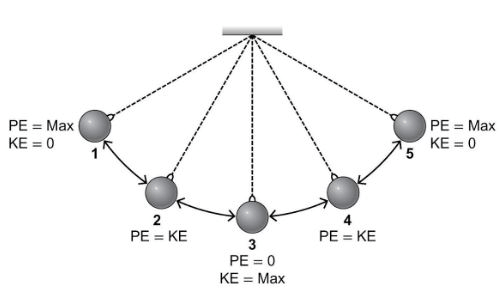
The pendulum is not in motion, therefor all energy is potential at that moment.
200
Specific heat is the amount of energy needed to raise ____ of a substance by ______.
What is one gram ; one degree Celcius?
200
This is the flow of energy through substances or between physical objects that are in contact with one another.
What is conduction?
200
In this system, matter cannot be exchanged with the surroundings but heat can.
What is a closed system?
200
This is the rate of energy flow (watts)
What is power?
300
______ _______ is the energy stored in the bonds of a molecule or compound.
What is Chemical energy?
300
Imagine that you transfer 25 Joules of energy to 12g of water and to 12g of methanol.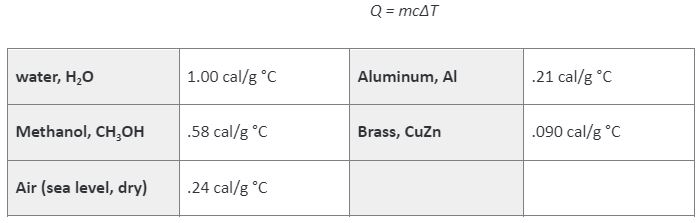 Which sample will be at a higher temperature and why?
What is methanol because of the lower specific heat?
300
This type of potential energy is released by breaking bonds between molecules and not reversible or repeatable.
What is a chemical potential energy?
300
This is an example of a type of reaction where mass is not conserved.
What is a nuclear (fission OR fusion) reaction?
300
Collisions (forces) transfer this from one ball to another in a game of pool/billiards.
What is kinetic energy?
400
Temperature is the measure of the average __________ _________ of the particles in a material.
What is kinetic energy?
400
Wood or an oven mitt don't heat up much when in contact with something hot. They are considered a/an _______ .
What is an insulator?
400
This is the transfer of thermal energy from one object to another and is measured in joules or calories.
What is heat?
400
How does the mass of a proton compare with the mass of a neutron?
What is they are basically equal?
400
These types of properties of substances, properties that can be observed using the naked eye, provide hints about what is occurring on an atomic scale.
What are bulk properties?
500
"This" plus "that" will equal the mechanical energy of a system.
What is potential plus kinetic?
500
How many calories of energy are needed to raise the temperature of 24g of aluminum from 14°C to 62°C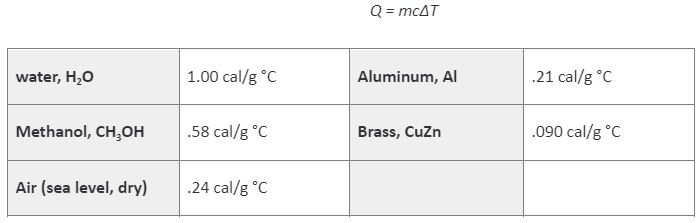 ?
?
What is 241.92 cal?
500
This is the term when materials expand when they are heated.
What is thermal expansion?
500
This is the reason you can feel the breeze. It's because all atoms/molecules have this.
What is mass?
500
How many grams of metal A with an initial temperature of 53 °C must mix with 1,258 g of water with an initial temperature of 26 °C to result in a final system temperature of 34.35 °C?
Water c = 4.184 J/g℃ ; Metal A c = 0.795 J/g℃
Start by calculating how much heat energy is needed to change the water’s temperature by 8.35 °C.
Assume heat energy gained is equal to heat energy lost.
2963.59g