Vectors and Motion
Displacement, Velocity, and Acceleration
Representing Motion
Reference Frames and Relative Motion
100
A car is moving to the left and slowing down. What direction does the car's acceleration vector point?
Right
100
A ball is moving to the left and accelerating to the left. Is the ball speeding up or slowing down?
Speeding up
100
On a velocity vs. time graph, what does the slope represent?
Acceleration
100
A student is sitting on a train that is moving at 20 m/s east. What is the student's velocity relative to the train?
0 m/s
200
A student walks 6 meters north and 8 meters east. What are the magnitude and direction of the student's displacement?
10 m
37 degrees east of north (or 53 degrees north of east)
200
A projectile is launched horizontally from a cliff. At the same instant, another identical ball is simply dropped from the same height. Which ball reaches the ground first?
They reach the ground at the same time
200
For a projectile launched at an angle, what does its vertical velocity vs. time graph look like?
A straight line with a constant negative slope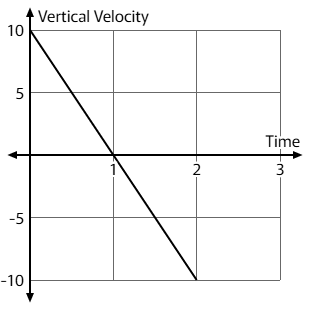
200
A train travels east at 20 m/s. A passenger walks toward the front of the train at 2 m/s relative to the train. What is the passenger's velocity relative to the ground?
22 m/s east
300
A projectile is launched with a velocity of 20 m/s at an angle of 30 degrees above the horizontal. Ignoring air resistance, what is the projectile's horizontal and vertical accelerations while it is in flight?
Horizontal acceleration =
0 m/s^2
Vertical acceleration =
-9.8 m/s^2
300
A car is driving east on a straight, level road with a speed of 20 m/s when it begins to accelerate eastward at a constant rate. After 5 s the car has a speed of 40 m/s to the east. The acceleration of the car during the 5 s time interval is:
4 m/s^2
300
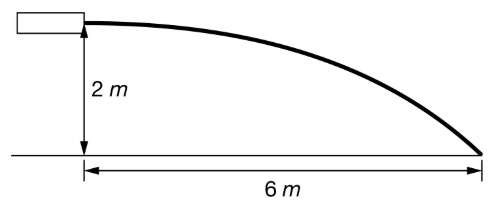
A pump provides water to a hose at a constant rate. When the hose is at a height of 2 m above level ground, the stream of water hits the ground a distance of 6 m from the end of the hose, as shown in the figure. If the end of the hose is moved to 4 m above the ground, about how far will the stream travel before hitting the ground?
8.5 m
300
A car travels east at 25 m/s. A second car travels east at 15 m/s. What is the velocity of the first car relative to the second car?
10 m/s
400
A projectile is horizontally launched (angle of 0 degrees) at a height of 10 m with a velocity of 20 m/s. Ignoring air resistance, what is the projectile's final velocity before it hits the ground (magnitude AND direction)?
24.4 m/s at 35 degrees below the horizontal
400
A projectile is moving upwards and towards the right. What direction is the projectile's acceleration?
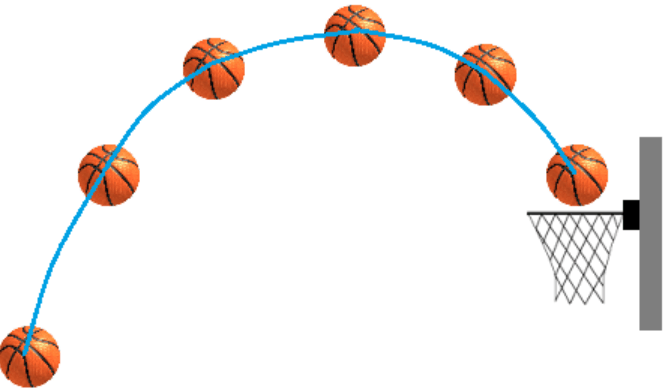
Straight downward
400
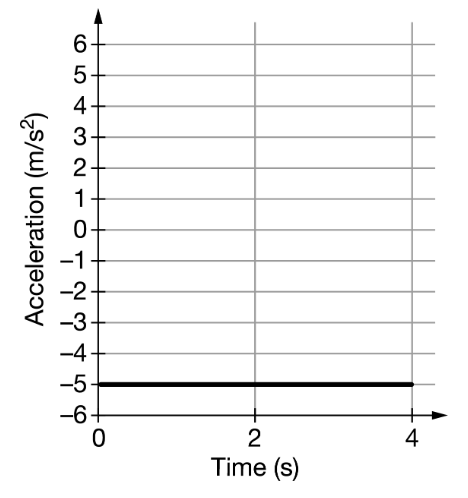
An object is released from rest near a planet's surface. A graph of the acceleration as a function of time for the object is shown for the 4 s after the object is released. The positive direction is considered to be upward. What is the displacement of the object after 2 s?
-10 m
400
A boat moves 4 m/s north relative to the water while the river flows 3 m/s east. A person standing on the riverbank observes the boat. What direction does the boat appear to move?
Northeast
500
Two projectiles are launched from the ground level with the same initial speed. Projectile A is launched at 30 degrees above the horizontal, while Projectile B is launched at 60 degrees. Both projectiles eventually land back at ground level.
Which projectile has a greater initial horizontal velocity? Which has a greater initial vertical velocity? Which has a greater range (goes the furthest)?
Greater initial horizontal velocity --> Projectile A
Greater initial vertical velocity --> Projectile B
Greater range --> Same range!
500
At the highest point of a projectile's trajectory, a student says:
Is the student correct? Explain why or why not.
The student is incorrect.
Only the vertical component of velocity is zero at the highest point. The projectile still has a horizontal velocity, so it is still moving.
500


500
A passenger on a train throws a ball straight upward. The train is moving at constant velocity relative to the ground. Describe the path of the ball as seen by:
A. The passenger on the train
B. An observer standing on the ground
A. Passenger: The balls travels straight up and straight back down
B. Ground Observer: The ball follows a curved/projectile path because it has the train's horizontal velocity while also moving vertically