Earth's Systems & Spheres
Resources on Earth
Ecological Footprint & Sustainability
Environmental Decisions & Policies
Hodgepodge
100
Identify each feedback loop:
A. A change causes effects that make the original change stronger.
B. A change causes effects that reduce the original change and move the system toward stability.
A. Positive feedback
B. Negative feedback
100
What is the difference between renewable and nonrenewable resources?
Renewable resources can be replenished as quickly as they are being used, and nonrenewable resources replenishes more slowly or not at all
100
As the human population grows, what must be minimized for Earth to sustainably support billions of people?
Ecological footprints
100
When making decisions about environmental problems, what three factors should be considered?
Ethics, impacts on different communities, and economic impact.
100
Environmental science studies interactions between what two major things?
Humans and the natural world
200
Label each part of the geosphere
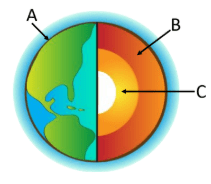
A. Crust
B.Mantle
C. Inner/Outer core
200
Which one does NOT belong: sunlight, wind, water, natural gas? Explain your choice.
Natural gas because it is nonrenewable; the others are renewable.
200
Which would most likely decrease a person's ecological footprint: driving alone every day or regularly using public transportation?
Regularly using public transportation.
200
A wetland naturally filters water and provides a beautiful place for people to enjoy, even though these benefits are not directly bought or sold.
What type of value do these benefits have?
Non-market value
200
Environmental science may require knowledge of biology, chemistry, geology, economics, politics, and ethics. What term describes a field that combines knowledge from many different areas?
Interdisciplinary
300
During a drought, a lake begins to dry up, and nearby plants die from lack of water. Which two spheres are interacting most directly?
Hydrosphere & Biosphere
300
What do water, soil, sunlight, coal, trees, and clean air all have in common?
They are natural resources.
300
Identify the revolution described by each statement:
A. Humans shifted from hunting and gathering to farming and domestication.
B. Improvements in medicine, sanitation, and farming increased human lifespans.
A. Agricultural Revolution
B. Industrial Revolution
300
Two companies are encouraged to reduce pollution. Company A receives a reduction in its taxes for switching to cleaner technology. Company B must pay an additional tax because it continues producing large amounts of pollution.
Which policy approach is being used for EACH company?
Company A = Tax break
Company B = Green tax
300
What economic term describes how many people want to use a product?
Demand
400
A lake begins to warm, causing some ice to melt. The darker water that is exposed absorbs more heat, causing even more ice to melt.
What type of feedback loop is occurring, and how do you know?
Positive feedback because the original warming leads to effects that cause even more warming/melting.
400
A town has a lake where everyone is allowed to fish. Each fisher catches as many fish as possible for personal benefit, and eventually the fish population collapses. What environmental concept does this best demonstrate?
Tragedy of the Commons
400
Two people produce the same amount of waste, but one uses significantly more resources. Who likely has the larger ecological footprint?
The person using more resources.
400
A government requires factories to follow specific pollution limits and gives penalties to companies that violate the rules.
Which environmental policy approach is being used?
Command-and-control
400
Greenpeace and Conservation International are examples of what type of organization?
NGOs / Non-governmental organizations
500
A volcanic eruption releases ash into the air, lava destroys nearby vegetation, and melted snow flows down the mountain.
Name all four spheres and identify what represents each one.
Geosphere = volcano/lava
Atmosphere = ash/air
Biosphere = vegetation
Hydrosphere = snow/water
500
Which of these could become effectively nonrenewable if overused: sunlight, wind, trees, or waves? Explain why.
Trees: if they are used faster than they can regrow/replenish, they can become effectively nonrenewable.
500
Rapid human population growth has led to an increase in what major environmental problem discussed in this unit?
Unsustainable resource use
500
A city wants to remove part of a wetland to build a new shopping center. The project would create jobs and benefit the local economy, but the wetland provides habitat for many species and helps support the entire surrounding ecosystem.
How might someone from each of the three environmental worldviews respond to this decision?
Anthropocentrism: May support the shopping center because of the jobs/economic benefits to humans, or base the decision primarily on how humans would be affected.
Biocentrism: May oppose removing the wetland because the plants and animals living there have value and would be harmed.
Ecocentrism: May oppose removing the wetland because it would disrupt the entire ecosystem, including its living and nonliving components.
500
The traditional supply-and-demand model does NOT account for what type of impacts?
Negative environmental impacts