Atomic Structure
Isotopes & Notation
Radioactive Decay
Half-Life
Nuclear Reactions
100
Which subatomic particles are located inside the nucleus and contribute to an atom's mass?
Protons and Nuetrons
100
Isotopes of the same element have the same number of _____ but different numbers of _____.
protons, neutrons
100
Which form of nuclear radiation consists of high-energy electromagnetic waves with no mass or charge?
Gamma Ray.
Gamma rays are pure energetic photon waves without mass or charge.
100
If you start with 100 g of a substance with a 10-year half-life, how much remains after 20 years?
25 grams
20 years=2 half lives. 100g --> 50g --> 25 g
100
What is the process of joining two light atomic nuclei to form a heavier nucleus?
Nuclear Fusion. Fusion joins small nuclei together, like hydrogen atoms combining in stars.
200
How many electrons are present in a neutral carbon-14 atom?
6
200
in the notation 63Cu, what does the 63 represent
the mass number (protons + neutrons)
200
Which radiation type has the lowest penetrating power and can be stopped by a piece of paper?
Alpha Particles. they are heavy (helium nuclei) and easily blocked by thin barriers.
200
Carbon-14 has a half-life of 5,730 years. If a sample decays from 40 g to 5 g, how many half-lives have passed?
3 half lives.
40g --> 20 g --> 10g --> 5g
200
Which reaction powers the Sun and other stars?
Nuclear Fusion.
The Sun fuses hydrogen nuclei into helium at extreme temperature and pressure.
300
What is formed when a neutral atom loses electrons?
be specific!
a cation with a positive charge?
300
how many neutrons are present in a neutral 11B atom?
6 neutrons
300
What particle is emitted during the beta decay of a radioactive nucleus? How did it get in the nucleus (where did
a high speed electron 0-1e. Beta decay converts a neutron into a proton and electron, expelling a fast electron.
300
Iodine-131 has a half-life of 8 days. From a 400 g sample, how much remains after 24 days?
50 g.
24 days / 8 days = 3 half-lives. 400 -> 200 -> 100 -> 50 g.
300
How are elements heavier than iron formed in stars?
during supernovae or kilonovae
400
How many electrons does an oxygen ion with a -2 net charge possess?
10 electrons
400
Neon has three isotopes: Neon-20 (90.92%), Neon-21 (0.26%), and Neon-22 (8.82%). What is its average atomic mass?
20.18 amu
(20 × 0.9092) + (21 × 0.0026) + (22 × 0.0882) = 20.18 amu.
400
When Radon-222 (²²²Rn) undergoes alpha decay, what daughter nucleus is produced?
218Po
the mass number drops by 4 and the atomic number by 2 (since 2 neutrons and 2 protons are lost)
400
Chromium-51 has a half-life of 28 days. If 127.5 g remains today, how much was present 56 days ago?
510 g.
56 days ago/28 days = 2 half-lives back. 127.5 × 2 × 2 = 510 g.
400
All chemical and nuclear reactions observe which fundamental physical law?
Law of conservation of mass/energy
mass and energy are conserved in all nuclear processes
500
What repulsive force must be overcome by the strong nuclear force for stable nuclei to exist?
proton-proton electromagnetic repulsion
500
Light elements (Atomic Number < 20) generally require what neutron-to-proton (n/p) ratio to remain stable?
1.0:1
Light stable nuclei have roughly equal numbers of protons and neutrons (1.0 ratio).
500
Carbon-14 (14C) undergoes beta decay. What daughter nucleus is created?
14N (nitrogen-14)
beta decay increases the atomic number by 1 and the mass number remains the same
500
what is the half life of this substance? 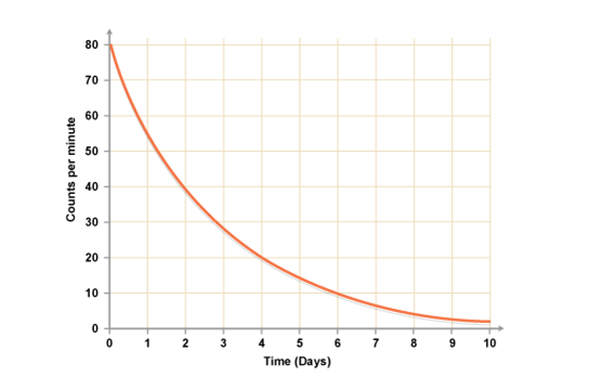
2 days
500
Calcium-40 (⁴⁰₂₀Ca) is the daughter nucleus produced by beta decay. What was the parent nucleus?
Potassium-40 (40K).
In beta decay, atomic number increases by 1. So parent p = 20 - 1 = 19