Inside the Atom
Atom/Ion/Isotope
Avg. Atomic Mass
Theory
ALL OF IT
100
A subatomic particle is located in the nucleus and has no electrical charge.

Identify the particle.
Neutron
100
Two atoms have the same number of protons but different number of neutrons.
Isotopes
100
In order to calculate the average atomic mass, what variables must be present in your mathematical representation?
1. The atomic mass for each isotope
2. The percent abundance for each isotope
100
During Rutherford's experiment, most alpha particles passed directly through the gold foil.
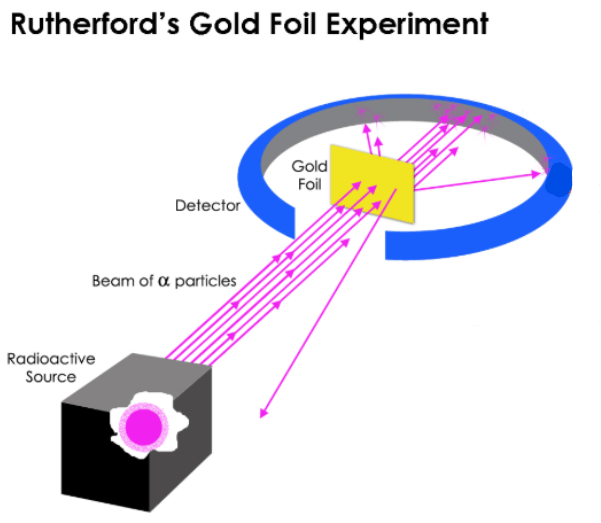
What does this observation suggest about atoms?
Atoms are mostly empty space
100
Scientists analyze an unknown element.
Evidence 1 : Every particle contains 10 protons.
Evidence 2 : The mass spectrum shows
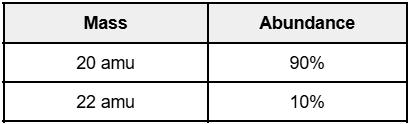
1. Determine whether the particles are different elements or isotopes.
2. Calculate the average atomic mass.
3. Explain why the periodic-table mass would not equal the mass of one individual atom.
They are isotopes of the same element because they all contain 10 protons
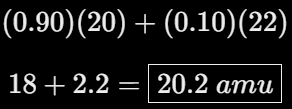
20.2 amu is a weighted average representing both isotopes, not the mass of an individual atom.
200
Atom X contains
15 protons
16 neutrons
15 electrons
Determine the Atomic Number, Mass Number, and Overall Charge.
Atomic Number = 15
Mass Number = 31
Charge = 0
200
A neutral sodium atom loses one electron. What happens?
Magnesium-24 gains two neutrons. What does it become?
The neutral sodium becomes a positive ion, Na+
Magnesium-24 becomes a new isotope, Magnesium-26
200
An element has:
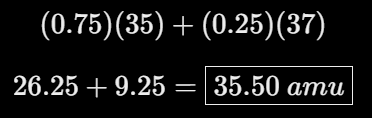
- X-35 = 75%
- X-37 = 25%
Calculate its average atomic mass.
200
JJ. Thompson changed the metal used in a cathode-ray tube, but the beam behaved the same way each time.

What conclusion does this evidence support?
The particles in the cathode ray are present in all atoms/matter, rather than being unique to one particular metal
200
An element has two isotopes:
- X-35
- X-37
Its average atomic mass is approximately 35.4 amu.
Without being given exact percentages, determine which isotope must be more abundant and explain your reasoning.
X-35 must be more abundant. The weighted average, 35.4, lies much closer to 35 than to 37, so the lower-mass isotope must occur more frequently.
300
Two students are having a disagreement.
Student A: "Electrons contribute equally to an atom's mass."
Student B: "Almost all of the atom's mass comes from the nucleus."
Choose a claim to support and provide particulate level reasoning.
I support Student B's claim.
Protons and neutrons each have approximately 1amu and are located in the nucleus, while electrons have negligible mass.
300
A particle contains
9 protons
10 neutrons
10 electrons
Identify the particle and classify it as an atom, ion, or isotope.
Justify your answer.
It is a negative Fluorine ion because it has one more electron than proton, its mass number is 19.
300
Element X contains:
- X-10: 80%
- X-11: 20%
Develop the mathematical representation and calculate it's average atomic mass.
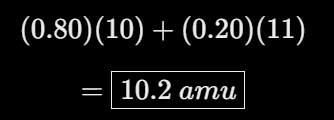
300
Two negatively charged ions from a cathode ray are sent through charged plates.
Particle X has a mass of 3
Particle Y has a mass of 9
Which would you predict will experience the greater deflection, and why?
Particle X, because the lower mass particle is easier to deflect
300
Particle A is boron-10.
Particle B is boron-11.
Construct an explanation describing:
- What must be the same about the two particles
- What must be different
- Why they are still classified as the same element.
They must have the same number of protons because they are both boron. They have different numbers of neutrons, which produces different mass numbers. They remain the same element because element identity depends on proton number.
400
An unknown particle has an atomic mass of 56amu, 26 protons, and a charge of +3
Determine the number of neutrons and electrons. Explain how you determine each.
Neutrons = 30
56 - 26 = 30
Electrons = 23
26 - 3 = 23
400
An unknown particle changes...
BEFORE: 16 p+ , 18 n0 , 16 e-
AFTER: 17 p+ , 18 n0 , 18 e-
Identify everything that changed about the particle.
1. Different element because proton number changed
2. Mass number changed from 34 amu --> 35 amu
3. The particle becomes an ion with a charge of -1
400
A student sets up their mathematical representation to calculate average atomic mass like so...
(24u + 25u + 26u) / 3 = 25
Explain the flaw in the students mathematical model.
The calculation assumes that all three isotopes occur in equal abundance. Average atomic mass must be a weighted average based on natural abundance.
400
List one advantage and limitation for Daltons Atomic model.

Advantage : It was the first official model of the atom.
Limitation : It lacked subatomic particles / detail
400
Scientists determine that an unknown particle has
- Atomic number of 15
- Mass number of 32
- A 3− charge.
Determine:
- Number of protons
- Number of neutrons
- Number of electrons
- Whether it is an atom, ion, and/or isotope.
- Protons = 15
- Neutrons = 17
- Electrons = 18
- It is a 3− ion and represents a specific isotope with mass number 32.
500
An atom changes from having
17 protons 18 neutrons 17 electrons
to
17 protons 20 neutrons 18 electrons
Identify TWO changes that occurred to the particle.
1. A different isotope - because the number of neutrons changed / doesn't match what's on the Periodic Table
2. A negative ion - because it gained an electron, making its proton to electron ratio uneven
500
Four particles are found
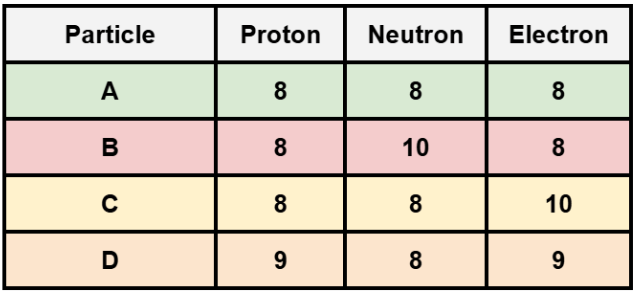
Which pair provides the best evidence for the existence of isotops?
A & B because they have the same number of protons but different number of neutrons
500
Two isotopes have masses of 50 amu and 52 amu.
The periodic table reports an atomic mass of 50.3 amu.
What can you infer about their relative abundances?
The 50 amu isotope must be much more abundant, because the weighted average lies much closer to 50.
500
A scientist proposes this atomic model:
"Negative particles exist inside the atom, but positive charge is spread evenly throughout the entire atom."
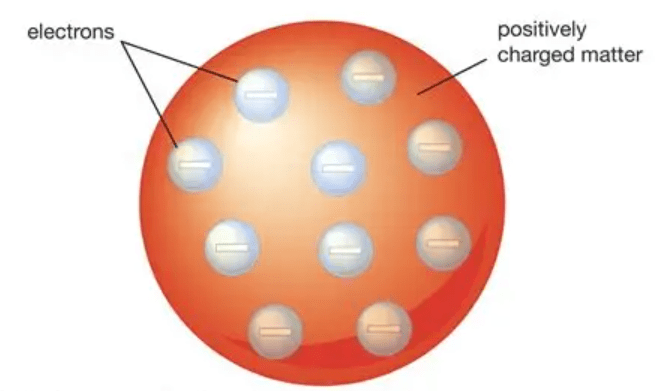
Which historical experiment provides the strongest evidence against this model?
Explain using an observation from that experiment.
Rutherford's gold foil experiment.
Some alpha particles were strongly deflected or bounced backward, which would be unlikely if positive charge were spread evenly throughout the atom.
500
Scientists test three proposed atomic models.
Model A: A solid indivisible sphere
Model B: Electrons embedded throughout a positively charged sphere
Model C: A small positive nucleus with electrons outside the nucleus
Experimental observations:
- Most alpha particles pass straight through.
- Some change direction slightly.
- A very small number bounce backward.
Which model is best supported, and why are the other two models less consistent with the evidence?
Model C is best supported. Most particles passing through shows atoms are mostly empty space, while strong deflections indicate a small concentrated positive nucleus. Model A does not include internal structure, and Model B spreads positive charge throughout the atom rather than concentrating it in a nucleus.