Cells
Organelles
Passive Transport
Active transport
Cell Membrane
100
List and describe the two types of cells.
Eukaryotic= more complex, nucleus, linear DNA, membrane-bound organelles
Prokaryotic= simple, no nucleus, circular DNA, lacking membrane-bound organelles
100
What is the function of the cell membrane?
determines what enters or exits the cell
100
What is passive transport?
1. no energy needed
2. materials move from an area of high concentration to low concentration
100
Define active transport
Molecule move from an area of low concentration to high concentration and require the use of energy (ATP).- molecules move up the concentration gradient.
100
What is another name for the cell membrane?
Fluid mosaic model OR plasma membrane
200
Identify the prokaryotic and eukaryotic cell

A= prokaryotic
B= eukaryotic
200
What is the function of the lysosomes?
Contains digestive enzymes which will breakdown molecules
200
What are the three types of passive transport discussed in class.
1. Simple Diffusion- movement of molecules from high to low 2. Osmosis- the diffusion of water across a semi-permeable membrane 3. Facilitated diffusion: using protein channels to move molecules that are too large or too charged to pass by simple diffusion.
200
Explain the process of endocytosis and exocytosis.
Endocytosis is the cell bringing a molecule (particle) INTO the cytoplasm and exocystosis is the cell bringing a molecule (particle) out of the cytoplasm.
200
Explain the structure of a phospholipid and any special characteristics of each.
(Glycerol with a phosphate) head= hydrophilic Fatty acid tail (two) = hydrophobic
300
What is the cell theory?
1. all cells come from pre-existing cells
2. cells are the basic unit of structure and function of living things
3. all living things are made up of one or more cells
300
Explain the function of the nucleus and what small organelles it produces.
Control center of cell, holds DNA, makes ribosomes
300
Define the following terms: solute, solvent and solution
solute= the material being dissolved
solvent= the material doing the dissolving (i.e. water)
solution- the combination of both solute and solvent
300
Explain the process of endocytosis and draw it.
The cell membrane wraps around an object and pinches off to let it into the cell 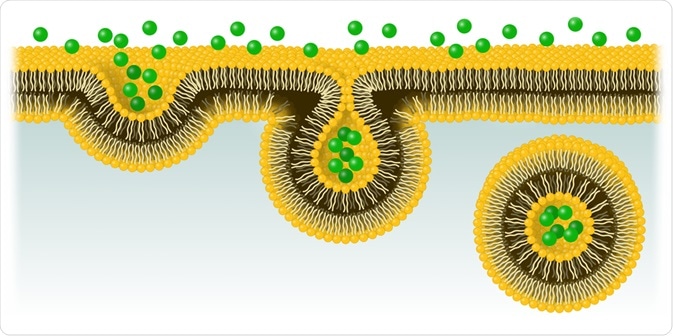
300
Where would the components of the cell membrane be synthesized in the cell.
rough ER= proteins
smooth ER= lipids
400
If viewing a cell under a microscope, how would you be able to identify the cell as either a plant or animal cell.
Plant- square, cell wall, LARGE central vacuole and chloroplast
animal cell- round, small vacuoles (if any)
400
EOC QUESTION: If an organism has a mitochondrial disorder, what issues would it have to deal with?
It would not be able to process food and create energy (mitochondria is the powerhouse of the cell)
400
Draw a picture of the blood cells in the following states:
Hypertonic, Isotonic, Hypotonic
shriveled cell, normal cell, fat cell
400
Explain the process of exocytosis and draw it.
Vesicles are filled with molecules inside the cell and then fuse with the plasma membrane and deposit the molecules outside the cell.
:max_bytes(150000):strip_icc()/exocytosis_2-5ae36dab04d1cf003cef3c48.jpg)
400
Why are there surface proteins and trans-membrane proteins?
Some of the "R" groups on the various amino acids will cause portions of the protein to be either hydrophobic or hydrophobic. Therefore some of the proteins will orientate themselves in the hydrophobic region and others in the hydrophilic region. Others will simply sit on the surface since they are hydrophilic.
500
Balmas will show you one real question from the test
IDK, we'll see
500
Compare the cell to a factory. Which organelles would be the following parts of a factory?
-Control Center
-Factory workers (they MAKE the product)
-Packaging department (before it leaves)
-Shipping and labeling department
Nucleus, ribosomes, rough endoplasmic reticulum, Golgi apparatus
500
Indicate what type of passive transport would be used to move the following molecules across the cell membrane:
-small amounts of glucose
-large molecules
-water
-simple= glucose (small enough to pass through)
-facilitated diffusion= large molecule = due to either the size or charge of the molecule
-water= osmosis = water is the molecule
500
 What type of transport is represented and why?
Active transport: energy is being used and molecules are moving from low to high concentration.
500
Balmas will show you one question from the test
We will see