History of Atomic Structure
Atomic Structure
Periodic Table and Bohr Models
EMS
Nature of Science
100
This scientist proposed that electrons occupy particular energy levels around a small, positively charged nucleus.
Who is Niels Bohr?
100
The atomic number is equal to the number of these positively charged particles in an atom's nucleus.
What are protons?
100
Elements in Group 18 have full outer electron shells and are generally very unreactive. Name this chemical family.
What are the noble gases?
100
This wave property, represented by the symbol λ, is the distance from one crest to the next crest.
What is wavelength?
100
A student writes, 'The unknown metal produced a yellow flame.' Is this statement an observation or an inference?
What is an observation?
200
In a cathode-ray experiment, the ray moves toward a positively charged plate and away from a negatively charged plate. What charge must the particles in the ray have, and which scientist used this evidence?
What is a negative charge, discovered by J. J. Thomson?
200
An electrically neutral atom is labeled aluminum-27 and has atomic number 13. Determine its numbers of protons, neutrons, and electrons.
What are 13 protons, 14 neutrons, and 13 electrons?
200
An unknown element is in Group 17, Period 3. Identify its chemical family, its number of valence electrons, and the charge of its common ion.
What are the halogens, seven valence electrons, and a 1− ion? (The element is chlorine.)
200
A spectrometer identifies three visible-light wavelengths:
Sample A = 450 nm
Sample B = 550 nm
Sample C = 700 nm
Which sample has the greatest frequency and energy, and what relationship supports the choice?
What is Sample A (450 nm), because shorter wavelength means higher frequency and higher photon energy?
200
Students test whether the identity of a metal salt affects the color produced in a flame test. Name the independent and dependent variables.
What are the type of metal salt (independent variable) and observed flame color (dependent variable)?
300
Dalton described atoms as indivisible solid spheres. After Thomson identified electrons inside atoms, which part of Dalton's model had to be revised?
What is the claim that atoms are indivisible? Atoms contain smaller, negatively charged particles.
300
A neutral calcium-40 atom becomes Ca²⁺. How many protons, neutrons, and electrons are in the calcium ion?
What are 20 protons, 20 neutrons, and 18 electrons?
300
A Bohr model has this electron arrangement, from the innermost shell outward: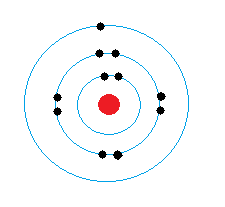
Identify the neutral element, its period, and its chemical family.
What are sodium (Na), Period 3, and the alkali metals (Group 1)?
300
Visible light has a wavelength of 600 nm. Calculate its frequency using c = λν and c = 3.00 × 10⁸ m/s. (1 nm = 10⁻⁹ m.)
What is 5.00 × 10¹⁴ Hz?
300
UNKNOWN SALT — FLAME COLOR RESULTS (6 trials)
Violet █████ (5)
Yellow █ (1)
One trial disagrees with the others. What should the researchers do before confidently identifying the unknown?
What is repeat the trial with clean equipment and controlled flame conditions to check for contamination or observation error?
400
GOLD-FOIL RESULTS (1,000 alpha particles)
Passed straight through: 980
Deflected: 18
Bounced backward: 2
What two features of atomic structure best explain this pattern?
What are mostly empty space and a tiny, dense, positively charged nucleus?
400
PARTICLE DATA TABLE
Sample A: 8 protons | 8 neutrons | 10 electrons
Sample B: 8 protons | 10 neutrons | 8 electrons
Are these atoms of different elements, isotopes of the same element, or neither? Also identify Sample A's charge.
What are isotopes of oxygen, with Sample A carrying a 2− charge (O²⁻)?
400
Sulfur has atomic number 16 and belongs to Group 16, Period 3. Give its Bohr shell arrangement, the number of dots on its Lewis dot diagram, and its likely ion charge.
What are 2–8–6, six Lewis dots, and a 2− charge (S²⁻)?
400
A photon has frequency 7.50 × 10¹⁴ Hz. Find its energy with E = hν, where h = 6.626 × 10⁻³⁴ J·s. Is its energy greater or smaller than a photon at 5.00 × 10¹⁴ Hz?
What is 4.97 × 10⁻¹⁹ J, greater than the lower-frequency photon?
TEACHER NOTE: E = (6.626 × 10⁻³⁴)(7.50 × 10¹⁴) = 4.9695 × 10⁻¹⁹ J.
400
THREE REPEATED GOLD-FOIL TRIALS (500 alpha particles each)
Trial 1: straight 491 | deflected/rebounded 9
Trial 2: straight 492 | deflected/rebounded 8
Trial 3: straight 490 | deflected/rebounded 10
Does this evidence consistently support the claim that atoms are mostly empty space? Explain using the data.
What is yes? In every trial at least 490 of 500 particles passed straight through, so the result is reproducible and supports a mostly empty atom
500
A heated gas produces only three distinct spectral lines (430 nm, 500 nm, and 650 nm), rather than every possible wavelength. Rutherford's model did not specify permitted electron energies; Bohr's model did. Which model better explains the observations, and why?
What is Bohr's model? Electrons occupy discrete energy levels and emit photons of specific energies when moving to lower levels.
500
A student's lab report says Samples X and Y must be different elements because their masses and electron counts differ.
Sample X: 12 protons, 12 neutrons, 10 electrons
Sample Y: 12 protons, 13 neutrons, 12 electrons
Evaluate the claim and correctly identify both samples, including any ionic charge.
What is an incorrect claim? Both are magnesium isotopes: X is magnesium-24 with a 2+ charge, and Y is neutral magnesium-25.
500
THREE MYSTERY BOHR MODELS
Element A: 2–8–1
Element B: 2–8–7
Element C: 2–8–8
Which element would not react at all with the other elements?
What is element C
500
In a flame test, Element A emits violet light at 430 nm and Element B emits red light at 650 nm. Calculate the energy of one photon from each using E = hc/λ (h = 6.626 × 10⁻³⁴ J·s; c = 3.00 × 10⁸ m/s). Which emission represents the larger electron energy drop? Justify your conclusion.
What are about 4.62 × 10⁻¹⁹ J for A and 3.06 × 10⁻¹⁹ J for B? Element A has the larger energy drop because its photon carries more energy.
500
Two teams design a flame-test investigation to identify an unknown metal.
PLAN A: Use one uncleaned wire for every salt; observe each only once; identify the unknown from memory.
PLAN B: Clean equipment between salts; maintain the same burner conditions; collect three trials per salt; compare the unknown with labeled reference samples.
Which design provides stronger evidence? Give two reasons, and identify one limitation that can still affect identification.
What is Plan B? Cleaning and controlling conditions reduce contamination; repeated trials and known references improve reliability. A limitation is that different substances or mixtures may show similar or overlapping flame colors.