Octet Rule and Bonding
Ionic Compounds
Covalent Compounds
Lewis Structures
VSEPR & Shapes
Polarity and IMFs
100
This rule explains why atoms gain, lose, or share electrons.
Octet rule
100
The charged particles that move freely when an ionic compound dissolves in water.
electron
100
The prefix used to indicate seven atoms in a covalent compound
hepta
100
These electrons are shown as dots in a Lewis structure.
lone pairs
100
What does VSEPR stand for
Valence shell electron pair repulsion
100
The weakest intermolecular force present in all molecules.
dispersion
200
The type of bond formed when electrons detach from their main atom and go into a shared cloud among many atoms.
Metallic Bond
200
Give a property of a covalent compound
- low melting points
-not soluble in water
- not conductive
200
The name of SO₃.
sulfite
200
The element that is never the central atom in a Lewis structure.
hydrogen
200
The molecular shape of a molecule with four bonding pairs and no lone pairs.
tetrahedral
200
The intermolecular force that occurs between polar molecules.
dipole-dipole
300
Name one reason hydrogen does not follow the octet rule.
1s orbital only holds 2 e
300
Write the formula for the compound formed by Ca and PO₄.
Ca3(PO4)2
300
What is the formula for nitrogen triiodide?
NI3
300
Draw the Lewis structure for H₂S.
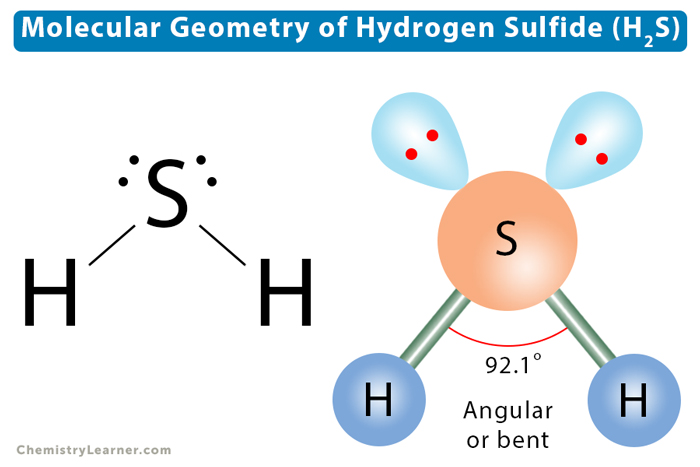
300
Predict the molecular shape of NH₃.
pyrimidal
300
Identify the type of intermolecular force responsible for water’s cohesion.
hydrogen bonding
400
This type of bond results from a large electronegativity difference and electron transfer.
ionic bond
400
Name the compound Fe(NO₃)₂.
Iron (II) nitrate
400
Name 4 diatomic elements
Bromine, Iodine, Nitrogen, Chlorine, Hydrogen, oxygen, fluorine
400
Draw the resonance structures for ozone (O3)
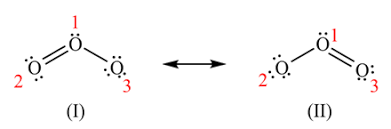
400
Explain how lone pairs affect bond angles compared to ideal angles.
Lone pairs squeeze bonds togethe,r causing them to shrink
400
Determine whether CH₃Cl is a polar or nonpolar molecule.
polar
500
Why do the noble gases rarely bond to form compounds
They already have a full octet and do not need to share or transfer electrons
500
Give the name and formula for a bond between ammonium and oxygen
(NH4)2O ammonium oxide
500
Name the compound N₂O₃
dinitrogen trioxide
500
What types of bonds are in NO2-
resonance causes 1.5-ish bonds
or a double and single bond
500
Predict the electron and molecular shape and approximate bond angle of a molecule with three bonding pairs and two lone pairs.
eg: trigonal bipyramidal
mg: t-shaped
bond angle: 90
500
Predict which substance would have the highest boiling point (CH₄, NH₃, H₂O)
H2O