Pavlovian Association Station
(Classical Conditioning)
(Classical Conditioning)
In classical conditioning, this automatic response occurs naturally without any prior learning or conditioning.
Unconditioned Response (UCR)
Whether you add something pleasant or take away something unpleasant, the ultimate goal of any reinforcement is always this.
To increase (or strengthen) a behavior.
True or False? Memory takes essentially meaningless information and changes it into meaningful patterns that you can store and use later.
True
You know an actor's face and all the movies he has starred in, but you just can't pull his name out of your head. This "tip-of-the-tongue" moment is this memory sin.
Blocking
Showing empathy toward others and regulating your emotions are core components of this type of intelligence.
Emotional Intelligence (EQ)
In John Watson's famous "Little Albert" experiment, this served as the unconditioned stimulus (UCS).
The loud noise
Buckling your seatbelt specifically to stop the annoying, high-pitched chiming sound in your car is an example of this operant conditioning concept.
Negative Reinforcement
Mr. Stringer used this analogy to compare it to our memory system.
Computer
You walk into the kitchen and completely forget why you walked in because your mind was distracted. This lapse in attention is this memory sin.
Absent-Mindedness
Traditional intelligence tests (IQ) focus heavily on evaluating these specific academic skills.
Math, logic, reading, writing, language, etc.
Every time Maya turns on her electric can opener, her cat comes running to the kitchen expecting tuna. The sound of the electric can opener has become this.
Conditioned Stimulus (CS)
A high schooler stays out past curfew, so their parents take away their car keys for two weeks. Taking away the car keys to stop curfew is this type of consequence.
Negative Punishment
These are the three core sequential steps of the Information Processing Model in order.
Encoding, Storage, Retrieval
Someone who cannot stop replaying a frightening car accident in their mind late at night is experiencing this memory sin.
Persistence
In the Marshmallow Test, preschoolers were tested on their ability to do this.
Exercise self-control
Marcus gets a painful cavity filled at the dentist while a high-pitched drill buzzes in his mouth. Months later, while browsing tools at a hardware store, hearing a power drill buzz makes his palms sweat and his heart race with anxiety. In this scenario, the buzzing sound of the drill acting as a trigger for anxiety represents this conditioning component.
Conditioned Stimulus (CS)
A soccer coach makes a player run extra sprint laps after showing up late to practice. Because an unwanted task was added to decrease tardiness, this is an example of this.
Positive Punishment
When trying to recall U.S. Presidents, our class data showed that you were most likely to remember the first presidents and the most recent presidents due to this effect.
Serial Position Effect
An eyewitness accidentally alters their recollection of a crime after police officers ask a leading, misleading question. This is an example of this memory sin.
Suggestibility
Preschoolers who successfully resisted eating the single treat used creative cognitive strategies, such as reframing the marshmallow as this.
A cloud or a picture of a marshmallow
Sarah gets stung by a wasp in her garden, which causes immediate pain and crying. Weeks later, simply walking into her garden makes her heart race with fear. Identify the UCS, UCR, CS, and CR in order.
UCS = Wasp Sting
UCR = Pain & Crying
CS = Garden
CR = Heartrate & Fear
Explain how positive reinforcement and negative reinforcement differ, and give one distinct example for each.
PR = Adds a desirable stimulus to increase a behavior
NR = Removes an unpleasant stimulus to increase a behavior
A graph that shows the serial position effect should have this shape.
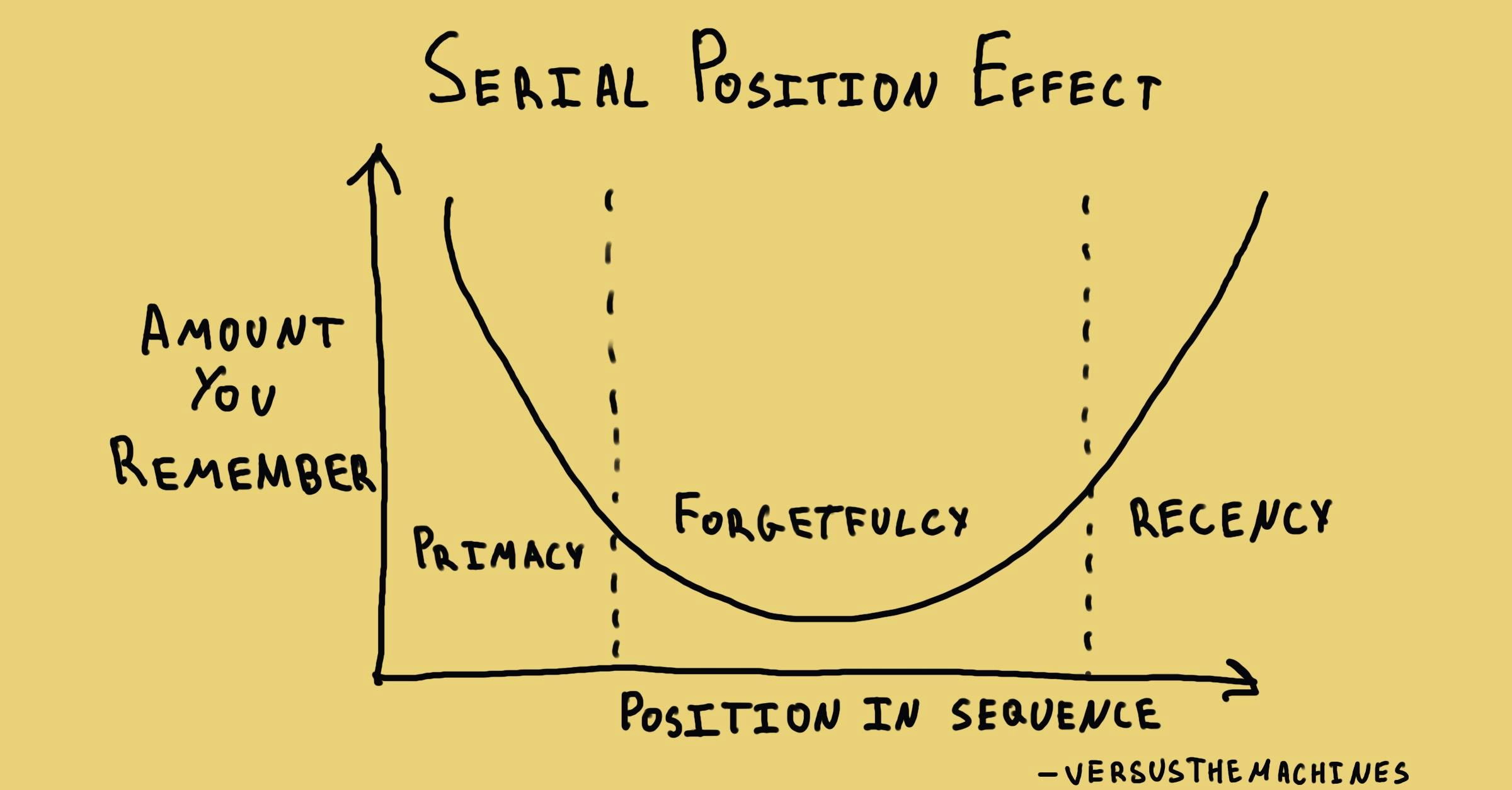
If you remember a childhood family vacation as awful simply because you are currently mad at your parents, you are experiencing this memory sin.
Bias
Brain scans revealed that "high delayers" showed greater brain activity in this impulse-control region, while "low delayers" activated this deep pleasure/desire region.
High Delayers = Prefrontal Cortex
Low Delayers = Limbic System