Kinetic & Potential Energy
Energy Transformations
Conduction, Convection, Radiation
Specific Heat
KE & PE Calculations
100
Give three examples of potential energy
Chemical
Elastic
Nuclear
Gravitational
100
Give an example of an energy transformation?
Photosynthesis
Solar (Radiant to Electrical)
100
Define each type of heat transfer
Conduction: The transfer of heat by contact
Convection: The circulation of heat by way of water/air
Radiation: The transfer of heat by waves
100
The amount of energy required to raise the temperature of a substance by 1ºC for every gram is called____?
Specific Heat
100
What is the formula for Kinetic and Potential Energy?
KE = 1/2 (m)(v)2
PE = (g)(m)(h)
200
List 4 types of Kinetic Energy?
Motion
Thermal
Radiant
Electrical
Mechanical (Potential + Kinetic)
200
State the law of conservation of Energy
Energy can not be created nor destroyed it can only be transformed
200
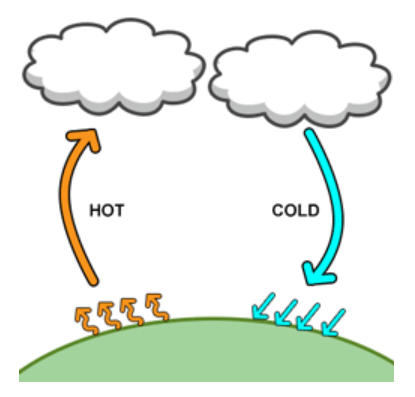
What type of heat transfer is taking place here?
Convection
200
A substance has a high specific heat. This means that... (choose all that apply)
a. It requires less energy to change temperature
b. It heats and cools off quickly
c. It requires more energy to change temperature
d. It heats up and cools off slowly
C and D
200
A exercise ball is on a table 5.5 meters above the ground. What is the mass of the ball if it has 65J of GPE?
1.2kg
300
List three examples of kinetic energy
A guy riding a bike (Motion or Mechanical)
The suns radiating heat
Hitting a baseball (Mechanical)
300
How is energy transformation different than energy transfer?
Energy transfer is the movement of energy from one location to another. Energy transformation is when energy changes from one type to another.
300
Which type of heat transfer can occur through space?
Radiation
300
A granite rock with a mass of 25 grams sits in the sun on a hot summer day. How much energy would the rock have to absorb in order to raise its temperature from 20°C to 25°C? (Specific heat capacity of granite is 0.1 J/gºC)
12.5J
300
A bowling ball with a mass of 5.35 kg travels down the lane at a velocity of 5 m/s. Calculate the kinetic energy of the ball.
66.875J
400
When is Kinetic energy at its highest point]

3
400
What type of energy do all energy transformations give off? This can also be described as "waste" energy
Thermal Energy
400
What type of heat transfer is used in a kitchen that uses ovens with fans inside? Justify your answer.
Convection. the air is circulated to help cook food
400
A 10 gram sample of Lead and a 10 gram sample of Gold were both heated using 100 Joules of energy. The temperature of the Lead sample rose 13℃ while the temperature of the Gold sample increased 30℃. Which statement best accounts for these results?
a. Lead is twice as dense as Gold
b. Atoms of Lead are smaller than atoms of Gold
c. Using equal masses results in different specific heat capacities
d. The specific heat of Gold is less than the specific heat of Lead
d. The specific heat of Gold is less than the specific heat of Lead
400
An object with a moving kinetic energy of 2160J has a mass of 120kg. What is its velocity?
6m/s
500
As a Skier moves downhill, some of the energy of the skateboarder is...
a. Potential
b. Kinetic
c. Kinetic and Potential
d. Lost
c. Kinetic and Potential
500
A gasoline engine transforms approximately 34 percent of the fuel’s chemical energy into mechanical energy. If energy is conserved, what happens to the other 66%?
It is converted into mostly thermal energy
500
A cook carefully places some objects into very hot water. After one minute, which item is most likely too hot to touch?
a. Cloth Napkin
b. Wooden Pencil
c. Metal Spoon
d. Wooden Stick
C. Metal Spoon.
500
A 1-kg iron frying pan is placed on a stove. The pan increases from 20°C to 250°C. If the same amount of heat is added to a pan with a greater specific heat, what can you predict about the temperature of this second pan?
a. The second pan would reach a higher temperature
b. The second pan would reach a lower temperature
c. The second pan would reach the same temperature
d. no conclusion can be made from this data
b. The second pan would reach a lower temperature because it has a greater specific heat capacity, meaning it takes more thermal energy to increase its temperature
500
A Snowboarder going down a mountain has 98,000J of gravitational potential energy, 12,000J of kinetic energy and 4,000J of thermal energy. At the bottom of the mountain, he has 90,000J of kinetic energy. How much thermal energy does he have at the bottom of the mountain?
24000 J