Atomics Basics
Parts of an Atom
Periodic Table
States of Matter
Ions and Isotopes
100
This is the smallest unit of an element that retains the identity of that element.
What is an Atom?
100
This subatomic particle has a negative charge.
What is the Electron?
100
These are the horizontal rows on the periodic table.
What are periods?
100
This state of matter has particles that are tightly packed and vibrate in place.
What is solid?
100
A neutral atom has equal numbers of these two subatomic particles.
What are protons and electrons?
200
This is a well-supported explanation of natural phenomena.
What is a scientific theory?
200
These two subatomic particles are found in the nucleus.
What are protons and neutrons?
200
These are the vertical columns on the periodic table.
What are Groups?
200
According to kinetic molecular theory, as temperature increases, this also increases.
What is the kinetic energy of particles?
200
This subatomic particle must be gained or lost for a neutral atom to become an ion.
What is an electron?
300
This theory states that all matter is made up of these tiny particles.
What is the Atomic Theory?
300
This subatomic particle has a neutral charge and an approximate mass of 1 amu.
What are neutrons?
300
Elements in the same group tend to have similar physical and chemical properties because they have similar numbers of these.
What are valence electrons?
300
In this state of matter, particles move quickly and are far apart.
What is a gas?
300
Two atoms of the same element have different numbers of neutrons. They are examples of these.
What are Isotopes?
400
This part of an atom determines which element the atom is.
What is the Proton?
400
This number represents the total number of protons and neutrons in an atom.
What is Atomic Mass?
400
These elements are located in Group 18 and have full valence electron shells.
What are the Nobel Gases?
400
This change of state occurs when a solid absorbs heat and becomes a liquid.
What is melting?
400
A neutral atom gains one electron. What type of ion does it become?
What is an Anion?
500
This is the currently accepted atomic model, in which electrons are represented as likely to be found in a region around the nucleus.
What is the Electron Cloud Model?
500
An atom contains 12 protons, 12 neutrons, and 12 electrons. State its atomic number, mass number, and overall charge.
Atomic Number = 12, Mass Number = 24, overall charge 0 (neutral)
500
These highly reactive metals have one valence electron that they can easily lose.
What are Alkali Metals?
500
According to the states-of-matter model used in this unit, this state has the highest kinetic energy.
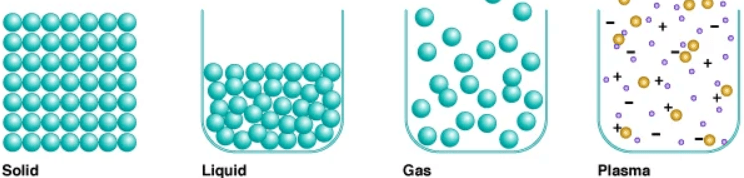
What is plasma?
500
An atom has 13 protons and 10 electrons. Identify its charge and explain how you know.
Its charge is +3 because it has three more protons than electrons