STATES OF MATTER
CLASSIFYING MATTER
CHEMICAL REACTIONS
PROPERTIES & CHANGES
ENERGY & LCM
100
What are the three main states of matter?
Solids, liquids, gases
100
What is an element?
An element is a pure substance made of only one type of atom.
100
What is a chemical reaction? Give a one-sentence definition.
A change in which matter becomes an entirely different substance. A new substance forms.
100
Give two examples of physical properties used to identify matter.
Intensive properties, density
100
What happens to particle motion when heat is added to a substance?
Particles move faster.
200
Describe the particle arrangement of a solid.
Particles are tightly packed and vibrate in place.
200
What is a compound?
A compound is made of two or more elements chemically bonded together.
200
In a chemical reaction, what do we call the substances we start with?
Reactants
200
Give two examples of chemical properties.
Flammability, reactivity, temperature of combustion, toxicity, oxidation.
200
Describe what happens to temperature during a phase change while heat is added.
When heat increases, temperature increases.
300
Which state of matter has an indefinite shape but a definite volume?
Liquid
300
What is a molecule?
A molecule is two or more atoms bonded together (can be same or different elements).
300
In a chemical reaction, what do we call the substances formed at the end?
Products
300
What is a physical change? Give an example.
A physical change alters appearance or state but not composition. No new substance is formed (e.g., tearing paper).
300
State the Law of Conservation of Mass.
Matter cannot be created nor destroyed in a closed system.
400
How does particle movement change when a substance goes from a liquid to a gas?
Particles move faster and spread farther apart.
400
Which term best describes the image? Atom, compound, element, or molecule?
Compound
400
Balance this very simple word idea: If 2 hydrogen atoms and 1 oxygen synthesize. What is the formula for the end result? (Write the chemical formula.)
H2O
400
List three signs that a chemical reaction occurred.
Color change, bubbles, flames/fire/smoke, unintentional change in temperature, formation of gas or solid in addition to existing matter.
400
A sealed container holds reactants and products of a chemical reaction. According to the Law of Conservation of Mass, what should happen to the mass measured before and after the reaction?
The mass will remain the same before and after the reaction (start mass= end mass).
500
Are phase changes of matter chemical or physical changes?
Physical changes
500
Is this a pure substance or a mixture?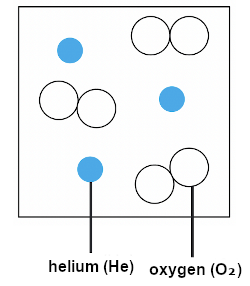
Mixture
500
Describe why new substances form during a chemical reaction (one or two sentences).
Chemical bonds break and new bonds form, rearranging atoms into new substances.
500
Explain the difference between intensive extensive properties. Provide one example of each.
Intensive properties do not depend on amount (e.g., density). Extensive properties depend on amount (e.g., mass).
500
Does the following change uphold the law of conservation of mass?
No