Seed dispersal
Adaptation
Natural Selection
Artificial Selection & Genetic Modification
Random
100
What are the biotic seed dispersal methods?
A. Wind
B. Hitchhiker
C. Wind
D. Animals eating/storing seeds
B. Hitchhiker seeds: Hooking/grabbing onto animals
C. Being eaten and pooped out by animals and being picked up by animals and stored for later
100
A TRAIT that helps an organism to survive and reproduce in its environment
Adaptation
100
How does Natural Selection occur?
Only the strongest creatures survive and reproduce passing on their genetics
100
What is the definition of? The process by which humans use animal breeding and plant breeding to selectively develop particular phenotypic traits.
Artificial selection
100
Which fossil layer is the oldest?
A. Top layer
B. Middle layer
C. Bottom layer
Bottom layer
200
Which is an example of an animal behavior that directly affects plant reproduction?
A. Rabbits eating grass and other vegetation in a meadow
B. Foxes digging dens beneath bushes and shrubs
C. Wolves marking their territory by rubbing against plants
D. Birds eating fruits and spreading seeds in their droppings
D. Birds eating fruits and spreading seeds in their droppings
200
An organism's ability to survive and produce offspring that reach reproductive age, ensuring the passing of genes to the next generation
Reproductive success
200
Why do we see so much variation in the beak types in birds? Like the different sizes and shapes of the beak?
The different sizes and shapes of beaks in birds is caused by what they are adapted to eat.
200
What are humans trying to change when using artificial selection?
Traits and characteristics
200
Plants need nutrients, water, and sunlight to survive which would be a beneficial adaptation for plants to have?
A. Large leaves
B. Little leaves
C. Short shallow roots
D. Long deep roots
Large leaves
Long deep roots
300
What is an example of an adaptation that would help seeds go further distances?
A. Heavy outer shell on seed
B. Long puffy lightweight seeds
C. Smelly outer fruit on seed
B. Long puffy lightweight seeds
300
A group of fish have been observed to show changes in mouth structure over many generations. What is this change a result of?
Fish adapting to the food source for survival.
300
When animals are looking for a mate they will use elaborate displays, mating calls and fighting to choose who gets to reproduce and who does not. What do all of these behaviors show the potential mate that why will be able to do?
A. Survive
B. Be nice
C. Have good genetics
D. Look cool
A. Survive
C. Have good genetics
300
What is this an example of? A red footed tortoise breeder is hoping to have tortoise with more red on their scales. So they only let their two tortoise with the reddest scales reproduce.
Artificial selection
300
What is the difference in genotype and phenotype?
Genotype is an organism's genetic code or ingredients list.
Phenotype is the observable result of that code/recipe, influenced by genes and environment
400
How does seed dispersal increase the chance for successful plant reproduction?
A. Seed dispersal keeps all seeds close to the parent plant, which helps them share water and nutrients from the same soil, increasing their chance of survival.
B. Seed dispersal moves seeds away from the parent plant, reducing competition for sunlight, water, and nutrients. This gives seeds a better chance to grow in new areas where they won't have to compete with their parent plant or siblings.
C. Seed dispersal moves all the seeds from the parent plant together to a new location, so the new plants will be close together which helps them share water and nutrients from the same soil, increasing their chance of survival.
D. Seed dispersal helps plants move to shadier areas, which is good because all plants need shade to grow well and reproduce.
B. Seed dispersal moves seeds away from the parent plant, reducing competition for sunlight, water, and nutrients. This gives seeds a better chance to grow in new areas where they won't have to compete with their parent plant or siblings.
400
What is most likely to happen to moth populations in the picture shown?
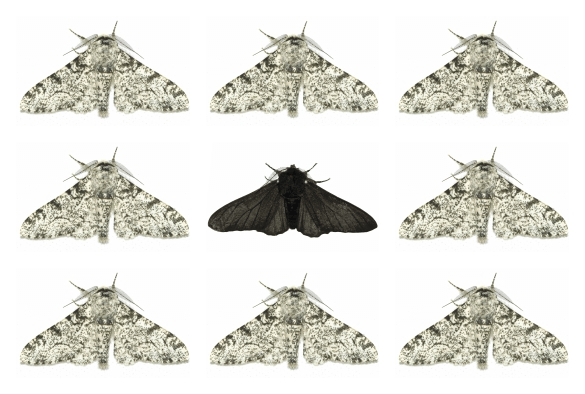
Dark moths--hunted easily, dark moths--population decreases.
400
Do environment or genetics or both play a role in how a creature is the way they are?
Both environment and genetics play a role in how creatures look and behave.
400
What are the negatives to Genetically Modified Organisms GMOs
Could not be good for humans with allergies
Unknown outcomes of GMOS in ecosystems
Very expensive and up for debate globally
400
What do different fossil layers show scientists?
A. The passage of time
B. How the environment changed over time
C. Animals that used to be in that area
D. Extinction events of the past
All of the above
500
A student observes three different types of seeds and their adaptations:
Seed A: Has hooks and barbs on its outer surface
Seed B: Has a light, fluffy structure with parachute-like fibers
Seed C: Has a waterproof coating with hollow air pockets inside
Which statement best uses evidence to explain how these seed adaptations increase the probability of successful plant reproduction?
A. The different seed structures help protect the seeds from being eaten by animals, which is the main factor that increases reproductive success in plants.
B. Seeds A, B and C use the same dispersal method of being buried by animals, who are storing up food for the winter. This method ensures the seeds will land in locations far from the parent plant, reducing competition for resources and increasing the chances that offspring will survive and grow.
C. These seeds have different dispersal methods: Seed A attaches to animal fur, Seed B floats on wind currents, and Seed C drifts on water. These methods ensure the seeds will land in locations far from the parent plant, reducing competition for resources and increasing the chances that offspring will survive and grow.
D. Seed A, B, and C all have adaptations that make them heavier so they fall close to the parent plant, ensuring the offspring grow in a location that is already known to support plant life.
C. These seeds have different dispersal methods: Seed A attaches to animal fur, Seed B floats on wind currents, and Seed C drifts on water. These methods ensure the seeds will land in locations far from the parent plant, reducing competition for resources and increasing the chances that offspring will survive and grow.
500
A population of wildflowers grows in a meadow with rocky, dry soil. Water is scarce in this environment, especially during the hot summer months. The wildflowers in this population show variation in their root systems.
Which statement best explains how this root variation affects the plants' probability of surviving in this meadow during dry conditions?
A. Plants with deep taproots are more likely to survive than plants with shallow roots, because deep roots can reach water sources far below the surface.
B. Plants with shallow roots are more likely to survive than plants with deep roots, because shallow roots can absorb nutrients from decomposing leaves on the soil surface more efficiently.
C. Plants with thick roots are more likely to survive than plants with thin roots, because thick roots can store more sugar and will be more likely to be eaten by animals.
D. Plants with branching roots are more likely to survive than plants with single roots, because branching roots provide better stability against strong winds.
A. Plants with deep taproots are more likely to survive than plants with shallow roots, because deep roots can reach water sources far below the surface.
500
The mating season for white-tailed deer is just two to three months long. Male deer grow antlers before each breeding season. They use their antlers to fight each other to establish dominance in bachelor herds and earn the right to mate with certain females.
Studies have shown that males with larger antlers typically win more fights. These dominant males tend to be older, stronger, and healthier than the males they defeat. Female deer often prefer to mate with dominant males. Researchers have observed that fawns born to dominant males have higher survival rates during their first winter compared to fawns from subordinate (not dominant) males.
Scientists claim that this aggressive fighting behavior increases the chances of successful reproduction for the entire deer population.
Based on the evidence from the information above, which statement best supports this claim?
A. Fighting behavior ensures that all the males get an opportunity to mate, increasing genetic diversity in the population.
B. The fighting behavior results in the healthiest and strongest males passing on their genes, producing offspring with better chances of survival.
C. Fighting behavior makes the males stronger so they are better able to protect their young from predators.
D. The fighting behavior extends the length of the mating season, so more females come to the mating grounds
B. The fighting behavior results in the healthiest and strongest males passing on their genes, producing offspring with better chances of survival.
500
What are the positives to Genetically Modified Organisms GMOs
Increased Crop Yield
Resilience to pest and disease
Environmental Tolerance
500
If we ran an experiment where half of the plants got sunlight and others were kept in the dark. Which group of plants would grow the best?
The plants in the sunlight since they need that to make food.