Organic Structures and Nomenclature
Formulas and Isomers
Physical Properties and Trends
Organic Reactions and Chemical Tests
Organic Reaction Pathways
Biomolecules and Polymers
Analytical Techniques
Chemical Synthesis and Design
100
Identify the class and functional group of the following compound:
CH₃CH₂CHO
Class: aldehyde
Functional group: carbonyl group at the end of the carbon chain, (-CHO)
IUPAC name: propanal
100
Discriminate between saturated and unsaturated hydrocarbons.
Saturated hydrocarbons contain only carbon–carbon single bonds. Unsaturated hydrocarbons contain at least one carbon–carbon double or triple bond.
100
Identify the strongest intermolecular force between molecules of:
- propane
- propanone
- propan-1-ol
- Propane: dispersion forces
- Propanone: dipole–dipole interactions
- Propan-1-ol: hydrogen bonding
100
Describe how bromine water can be used to distinguish between an alkane and an alkene.
An alkene rapidly decolourises orange or brown bromine water through an addition reaction. An alkane produces no immediate colour change under normal conditions.
100
Identify the reagent and conditions required to convert ethene into ethanol.
CH₂=CH₂ + H₂O → [steam, H₃PO₄ catalyst] CH₃CH₂OH
This is a hydration or addition reaction.
100
Identify the bond that joins:
- amino acids in a peptide
- monosaccharides in a disaccharide
- Peptide bond
- Glycosidic bond
Both are formed through condensation reactions involving the removal of water.
100
An amino acid moves 3.6 cm while the solvent front moves 8.0 cm. Calculate its retention factor.
Rf = distance moved by amino acid / distance moved by solvent
Rf = 3.6 / 8.0
Rf = 0.45
100
State the balanced equation for the Haber process and identify the catalyst used.
N₂(g) + 3H₂(g) ⇌ 2NH₃(g)
An iron catalyst is used.
Typical industrial conditions include approximately 450°C and high pressure.
200
Discriminate between the class and functional group of an organic compound containing an (-OH) group.
The class is alcohol, while the functional group is the hydroxyl group.
200
Discriminate between empirical, molecular and structural formulas.
- An empirical formula shows the simplest whole-number ratio of atoms.
- A molecular formula shows the actual number of each type of atom in a molecule.
- A structural formula shows how the atoms are bonded or arranged.
200
Explain why boiling points generally increase as the carbon-chain length increases within the alkane homologous series.
Longer alkanes have more electrons, greater molecular surface areas and more polarisable electron clouds. This produces stronger dispersion forces, requiring more energy to separate the molecules.
200
Identify the reaction type and product when ethene reacts with hydrogen.
CH₂=CH₂ + H₂ → ?
This is an addition and reduction reaction.
CH₂=CH₂ + H₂ → [Ni catalyst] CH₃CH₃
The product is ethane.
200
Determine the reagent required to convert bromoethane into ethanol and identify the reaction type.
CH₃CH₂Br + NaOH → [aqueous, heat] CH₃CH₂OH + NaBr
The reagent is aqueous sodium hydroxide, and the reaction is substitution.
200
Explain the formation of a zwitterion from a 2-amino acid.
The carboxyl group donates a proton to the amino group. This produces a molecule containing both a positively charged ammonium group and a negatively charged carboxylate group.
H₂NCHRCOOH ⇌ ⁺H₃NCHRCOO⁻
The overall charge of the zwitterion is zero.
200
Explain why different amino acids produce different Rf values during paper chromatography.
Amino acids have different attractions to the stationary and mobile phases. An amino acid that is more soluble in the mobile phase travels further. An amino acid with stronger intermolecular attractions to the stationary phase travels less.
200
State the three main equations involved in the Contact process.
Production of sulfur dioxide:
S(s) + O₂(g) → SO₂(g)
Oxidation of sulfur dioxide:
2SO₂(g) + O₂(g) ⇌ 2SO₃(g)
Formation of sulfuric acid:
SO₃(g) + H₂O(l) → H₂SO₄(aq)
Industrially, sulfur trioxide is first absorbed into concentrated sulfuric acid to form oleum, which is then diluted:
SO₃ + H₂SO₄ → H₂S₂O₇
H₂S₂O₇ + H₂O → 2H₂SO₄
300
Apply IUPAC nomenclature to name:
CH₃CH₂CH(CH₃)CH₂OH
2-methylbutan-1-ol
The longest chain containing the hydroxyl group has four carbon atoms. Numbering begins from the end closest to the hydroxyl group.
300
Determine the five structural isomers of C₆H₁₄
- Hexane
- 2-methylpentane
- 3-methylpentane
- 2,2-dimethylbutane
- 2,3-dimethylbutane
300
Explain why ethanol has a higher boiling point than ethane.
Ethanol molecules form hydrogen bonds because they contain hydroxyl groups. Ethane molecules experience only weaker dispersion forces. More energy is therefore required to separate ethanol molecules.
300
Apply Markovnikov’s rule to determine the major product when propene reacts with hydrogen bromide.
CH₃CH=CH₂ + HBr → CH₃CHBrCH₃
The major product is:
2-bromopropane
Hydrogen adds to the double-bonded carbon that already has more hydrogen atoms.
300
Determine the products formed when propan-1-ol and propan-2-ol are separately oxidised.
Propan-1-ol is a primary alcohol:
CH3CH2CH2OH --[O]--> CH3CH2CHO --[O]--> CH3CH2COOH
It forms propanal and then propanoic acid.
Propan-2-ol is a secondary alcohol:
CH3CH(OH)CH3 --[O]--> CH3COCH3
It forms propanone.
300
Discriminate between addition and condensation polymerisation.
Addition polymerisation joins unsaturated monomers by opening their carbon–carbon double bonds. No small molecule is eliminated.
Condensation polymerisation joins monomers containing two functional groups and eliminates a small molecule, commonly water.
300
During electrophoresis, the buffer pH is higher than an amino acid’s isoelectric point. Determine the amino acid’s overall charge and direction of movement.
When the buffer pH is greater than the isoelectric point, the amino acid is predominantly negatively charged. It moves towards the positive electrode, or anode.
300
Compare the production of ethanol by fermentation and the hydration of ethene.
Fermentation:
C₆H₁₂O₆ --[yeast, anaerobic, 30–40°C]--> 2C₂H₅OH + 2CO₂
Fermentation uses renewable plant material but is slow and produces dilute ethanol.
Hydration of ethene:
C₂H₄ + H₂O ⇌ C₂H₅OH
It uses steam, a phosphoric acid catalyst, high temperature and high pressure. It is faster and produces purer ethanol but commonly uses ethene obtained from non-renewable fossil fuels.
400
Determine the condensed structural formula of 3-ethyl-2-methylhexane.
CH₃CH(CH₃)CH(CH₂CH₃)CH₂CH₂CH₃
400
Explain why but-2-ene forms cis and trans geometrical isomers but but-1-ene does not.
Rotation is restricted around the carbon–carbon double bond. In but-2-ene, each carbon in the double bond is bonded to two different groups, allowing cis and trans arrangements.
In but-1-ene, the first carbon of the double bond is bonded to two hydrogen atoms. Therefore, geometrical isomerism is not possible.
400
Explain why the solubility of alcohols in water generally decreases as their carbon-chain length increases.
The hydroxyl group can form hydrogen bonds with water, but the hydrocarbon chain is non-polar. As the carbon chain becomes longer, the non-polar region has a greater influence, and the molecule becomes less soluble in water.
400
Predict the observations when primary, secondary and tertiary alcohols are heated separately with acidified potassium dichromate(VI).
- Primary alcohol: orange solution turns green as the alcohol is oxidised to an aldehyde and then a carboxylic acid.
- Secondary alcohol: orange solution turns green as the alcohol is oxidised to a ketone.
- Tertiary alcohol: no colour change because it is not readily oxidised under these conditions.
400
Determine the product of the reaction between ethanoic acid and propan-1-ol. State the catalyst and name the reaction type.
CH₃COOH + CH₃CH₂CH₂OH ⇌ CH₃COOCH₂CH₂CH₃ + H₂O
The product is propyl ethanoate.
Conditions:
- concentrated sulfuric acid catalyst
- heating under reflux
This is a condensation or esterification reaction. It is reversible.
400
Explain why HDPE is generally stronger and denser than LDPE.
HDPE contains relatively straight, unbranched polymer chains. The chains pack closely together, producing stronger dispersion forces and greater crystallinity.
LDPE contains more branching. This prevents close packing, weakens the intermolecular forces between chains and lowers its density and strength.
400
An infrared spectrum contains:
- a strong absorption close to 1700 cm⁻¹
- no broad absorption between 3200 and 3600 cm⁻¹
The compound has the molecular formula C₃H₆O. Deduce a possible structure.
The absorption close to 1700 cm⁻¹ indicates a carbonyl group. The absence of a broad hydroxyl absorption rules out an alcohol.
A possible structure is propanone:
CH₃COCH₃
Propanal would also have the molecular formula C₃H₆O, so additional spectral evidence would be required to discriminate between them.
400
Write the half-equations and overall equation for a hydrogen fuel cell operating under acidic conditions.
Anode:
2H₂(g) → 4H⁺(aq) + 4e⁻
Cathode:
O₂(g) + 4H⁺(aq) + 4e⁻ → 2H₂O(l)
Overall:
2H₂(g) + O₂(g) → 2H₂O(l)
500
Identify the chiral carbon atoms in 3-methylhexan-2-ol.
CH₃CH(OH)CH(CH₃)CH₂CH₂CH₃
Carbon 2 and carbon 3 are both chiral because each is bonded to four different groups.
Chiral carbons: C2 and C3
500
An organic compound contains 40.0% carbon, 6.7% hydrogen and 53.3% oxygen by mass. Its molar mass is 60.0 g mol⁻¹. Determine its empirical and molecular formulas.
Assume a 100 g sample:
n(C) = 40.0 / 12.01 = 3.33
n(H) = 6.7 / 1.008 = 6.65
n(O) = 53.3 / 16.00 = 3.33
Divide by 3.33:
C:H:O = 1:2:1
Empirical formula:
CH₂O
Empirical formula mass:
12.01 + 2(1.008) + 16.00 = 30.03 g mol⁻¹
60.0 / 30.03 ≈ 2
Molecular formula:
C₂H₄O₂
500
Three compounds have the following boiling points:
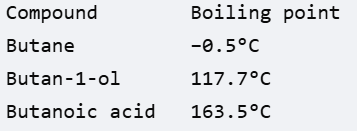
Butane experiences only dispersion forces. Butan-1-ol forms intermolecular hydrogen bonds and therefore has a higher boiling point.
Butanoic acid forms strongly hydrogen-bonded dimers, with two hydrogen bonds between pairs of molecules. This creates stronger intermolecular attraction and gives butanoic acid the highest boiling point.
500
Determine the organic product and reaction type when 2-bromopropane is heated with concentrated ethanolic sodium hydroxide.
Hydrogen and bromine are removed from adjacent carbon atoms, forming an alkene.
CH₃CHBrCH₃ + NaOH → [ethanol, heat] CH₃CH=CH₂ + NaBr + H₂O
The organic product is propene, and the reaction is an elimination reaction.
500
Determine a three-step reaction pathway to convert ethane into ethanoic acid. Include reagents, conditions and equations.
Step 1: Ethane to chloroethane
CH3CH3 + Cl2 --(UV light)--> CH3CH2Cl + HCl
Reaction type: substitution.
Step 2: Chloroethane to ethanol
CH3CH2Cl + NaOH --(aqueous, heat)--> CH3CH2OH + NaCl
Reaction type: substitution.
Step 3: Ethanol to ethanoic acid
CH3CH2OH + 2[O] --(acidified K2Cr2O7, reflux)--> CH3COOH + H2O
Reaction type: oxidation.
500
Use the amino acid symbols Ala, Gly and Ser to represent the formation of the tripeptide alanylglycylserine.
Ala + Gly + Ser → Ala-Gly-Ser + 2H₂O
The tripeptide is named: alanylglycylserine
Two peptide bonds form through two condensation reactions, producing two water molecules.
500
An organic compound produces:
a molecular ion peak at m/z=60
a strong infrared absorption near 1700 cm⁻¹
a very broad infrared absorption from approximately 2500 to 3300 cm⁻¹
Deduce the identity of the compound.
The strong absorption near 1700 cm⁻¹ indicates a carbonyl group. The very broad absorption from 2500 to 3300 cm⁻¹ indicates the hydroxyl group of a carboxylic acid.
A molecular mass of 60 is consistent with C₂H₄O₂.
The compound is:
ethanoic acid, CH₃COOH
500
In a Haber process trial, 10.0 mol of nitrogen reacts with 24.0 mol of hydrogen.
N₂(g) + 3H₂(g) → 2NH₃(g)
The process produces 12.8 mol of ammonia.
Determine:
- the limiting reagent
- the theoretical amount of ammonia
- the percentage yield
For 10.0 mol of nitrogen, the hydrogen required is:
n(H₂) = 3(10.0) = 30.0 mol
Only 24.0 mol of hydrogen is available, so hydrogen is the limiting reagent.
Using the mole ratio:
3H₂ : 2NH₃
n(NH₃)theoretical = 24.0 × 2/3 = 16.0 mol
Percentage yield:
(actual yield / theoretical yield) × 100
(12.8 / 16.0) × 100 = 80.0%
Therefore:
Limiting reagent: H₂
Theoretical ammonia yield: 16.0 mol
Percentage yield: 80.0%