OUR SUN
HR diagram
Universe
Asteroids
Comets
Meteors
Comets
Meteors
Planets in our solar system
100
According to our present theories of stellar evolution, our sun will change next into
Red Giant
100
One of the most obvious features of the HR diagram is called the main sequence. Where does it appear in the diagram
Runs vertically down the diagram from top left to bottom right
100
Billions of stars in the same region of the universe are called
galaxies
100
Compared with the Earth's orbit, the comet's orbit has
more eccentricity
100
Which of the following is not a characteristic of the JOVIAN planets?
A) they have low average density.
B) they have orbits outside the asteroids.
C) their composition lacks hydrogen.
D) they have large diameters.
their composition lacks hydrogen.
200
The probable fate of our sun is
to expand as a red giant, undergo a nova outburst and end as a white dwarf
200
Write the color a star appears for each surface temperature range listed below.
orange-red
blue
yellow
white
Write the color a star appears for each surface temperature range listed below.
orange-red <3,000°C
blue 25,000°C−50,000°C
yellow 4,500°C−5,500°C
white 7,500°C−11,000°C
200
Based on the red-shift data on galaxies, most astronomers infer that the universe is currently
Expanding
200
The photograph below shows an impact crater approximately 1 mile wide located in Diablo Canyon, Arizona. Describe the event that produced this crater.
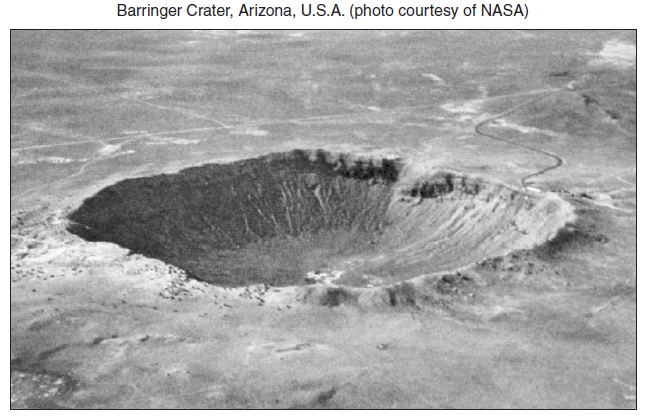
Barringer Crater was caused by the impact of a meteorite (or meteor or comet or asteroid).
200
Compared to the JOVIAN planets, terrestrial planets are
( two things)
more dense and less massive.
300
A red giant star would most likely have a temperature of
The temperature T in degrees Celsius (°C) is equal to the temperature T in Kelvin (K) minus 273.15:
T(°C) = T(K) - 273.15
5,000ºC
300
Suppose star F is plotted on the H-R diagram directly to the left of star C. Which statement is true for star F?
It is hotter than star C.
300
In which list are celestial features correctly shown in order of increasing size?
A) galaxy → solar system → universe → planet
B) solar system → galaxy → planet → universe
C) planet → solar system → galaxy → universe
D) universe → galaxy → solar system → planet
C) planet → solar system → galaxy → universe
300
Specific mass extinction of living organisms and global climatic changes in geologic history are inferred by most scientists to have been caused by
the impact of asteroids or large meteors on Earth’s surface
300
Which planet has the least distance between the two foci of its elliptical orbit?
venus
400
What is the full life cycle of our sun, from start to finish
Nebula, Protostar, main sequence star, red giant, planetary nebula, white dwarf, black drawf
400
Vega is a blue-white star that is about 60 times brighter than the Sun. Which letter shows the region of the H-R diagram where Vega should be located?
D
400
What is the name usually given to the group of objects consisting of a sun and any planets, comets, and other objects that orbit it?
Solar System
400
A belt of Asteroids is located an average distance of 503 million kilometers from the Sun. Between which two planets is this belt located?
Mars and Jupiter
400
Three planets known as gas giants because of their large size and low density are
Jupiter, Saturn, and Uranus
500
Describe what will happen to our sun during the planetary nebular phase which will allow it to then transition into the white drawf phase
The outer parts grow bigger and then fall off and drift into space
500
Write the letter that best represents each class of stars.
____ Giants
____ Supergiants
____ White Dwarfs
____ Main Sequence
Write the letter that best represents each class of stars.
B Giants
A Supergiants
E White Dwarfs
D Main Sequence
500
According to the Big Bang theory, which graph best represents the relationship between time and the size of the universe from the beginning of the universe to the present?
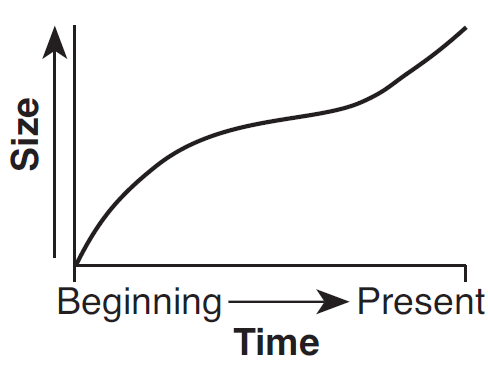
B)
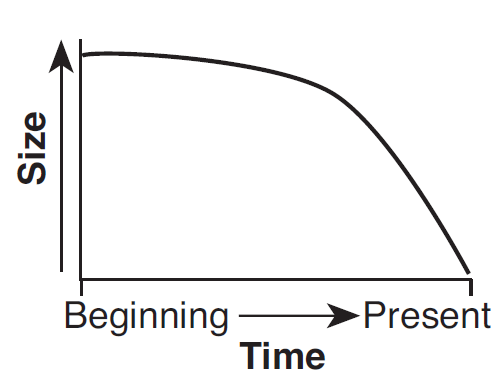
C)
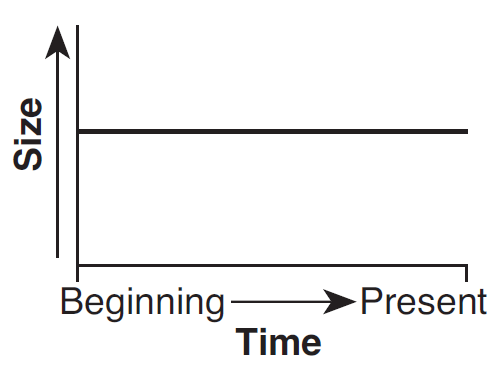
D)
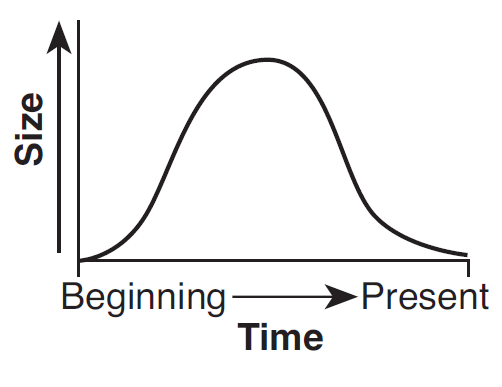
500
PUT ON YOUR THINKING HATS
The Moon has many more impact craters visible on its surface than Earth has on its surface. State two reasons that Earth has so few visible impact craters.
Friction from Earth's atmosphere causes many meteors to burn up; Many meteors fall into the ocean so craters aren't visible; Old craters are eroded away; Vegetative growth may hide evidence of a crater; Plate tectonics has destroyed some craters; Deposition has buried some craters
500
The diagram below represents two photographs of the moon, A and B, taken at full moon phase several months apart. The photographs were taken using the same magnification. Each photograph was cut in half and the halves placed next to each other.
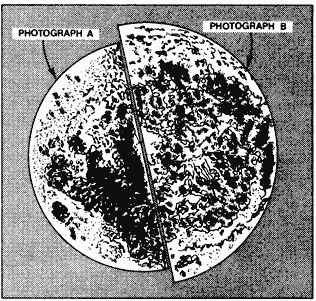
The distance from the Earth to the moon changed