Geologic Principles
Age Dating
Types of Preservation
Vocabulary
Geologic Divisions of Time
100
This geologic principle states that: In undisturbed rock layers, the oldest rocks are found on the bottom."
What is the Geologic Principle of Superposition?
100
This is a definition for Absolute Age Dating.
Answers will vary, but should be similar to: "What is the numerical age, in years, of a rock or object?"
100
This type of fossil happens when minerals fill the spaces between an organisms tissues. Then the tissues decay and leave the minerals behind.
What is a Mineral Replacement? (aka permineralization/petrification)
100
These are the preserved remains or evidence of ancient living things.
What is a fossil?
100
This is the largest division of Geologic Time.
What is an EON?
200
This geologic principle states that: "Rocks that contain a section of another rock were deposited after the rocks that are found inside of them."
What is the Principle of Inclusions?
200
This is a definition for Relative Age Dating.
Answers will vary, but should be similar to: "What is the age of rocks and geologic features compared with other rocks and features nearby."
200
This type of fossil is created when an organism becomes completely encased by a substance like tar or ice, that keeps the organism from decaying.
What are Preserved Remains?
200
These are atoms of the same element that have different numbers of neutrons.
What are Isotopes?
200
This is the smallest division of geologic time, excluding "Ages."
What is an Epoch?
300
This geologic principle states that: "Features that pass through or across other layers of rock were formed after the layers of rock that they transverse."
What is the Principle of Cross Cutting Relationships?
300
How much of a radioactive isotope is remaining after two half-lives?
What is 25%, or 1/4?
300
This type of fossil forms when gases and liquids are squeezed out of the organism by heat and pressure. It leaves only the Carbon Atoms behind.
What is a Carbon Film?
300
This is the time required for half of an unstable parent isotope to decay into a stable daughter isotope.
What is a half-life?
300
This geologic division of time is larger than an Epoch, but smaller than an Era.
What is an Period?
400
This geologic principle states that: "Layers of sedimentary rock are first formed in flat layers going side to side."
What is "Original Horizontality?"
400
Use the diagram of the rock wall to tell how the "Star" fossil relates to the "Lightning" fossil.
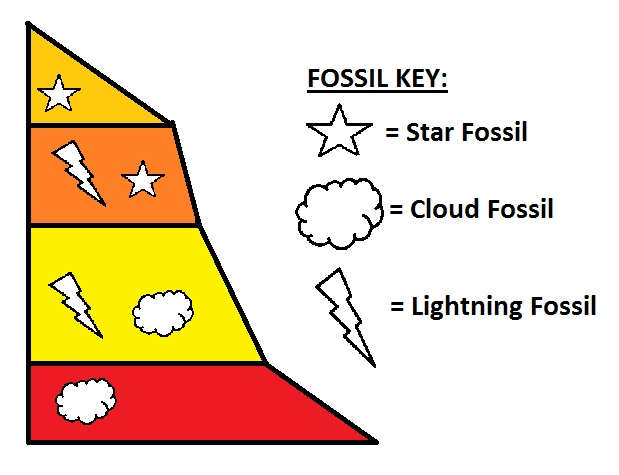
What is the "Star" Fossil is younger than the "Lightning" fossil, but they both existed at the same time?
400
This type of fossil is made when a mold gets filled in.
What is a Cast?
400
These are species that existed on Earth for a short length of time, were abundant, and inhabited many locations.
What are Index Fossils?
400
This geologic Division of Time is larger than a Period, but is smaller than an Eon.
What is an Era?
500
This geologic principle states that: "Layers of rock initially extend out in all directions (side to side). Similar layers that are separated by an erosional feature are the same layer."
What is Lateral Continuity?
500
Using the Half-Life Graph of Uranium 238 predict how old a sample is that contains 12.5% of the parent isotope.
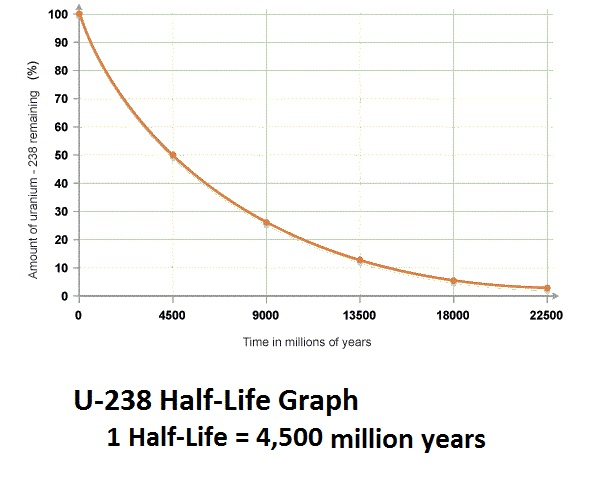
What is 13,500 million years, or 13.5 billion years old?
500
This type of fossil does not contain the actual living thing. It is evidence that the living thing existed.
What is a Trace Fossil?
500
This is the process of an unstable element naturally changing into another element that is stable.
What is Radioactive Decay?
500
This is how scientists decided where to place divisions in geologic time.
What are major changes to the fossil record?