8.34
8.35
8.36
8.37/8.38
8.39/8.40
100
Before the rise of "King Cotton," what were the two primary cash crops of the colonial-era South?
Tobacco and Rice
100
Identify the small percentage of the Southern white population that constituted the "Planter Aristocracy" and describe the dual-role influence they exerted on the social and political conditions of the region.
They constituted a small elite (often less than 5% of the white population) who owned a disproportionate number of slaves. Their influence was dual: socially, they set the standard for honor and refinement, and politically, they controlled state and local governments, ensuring the legal and economic protection of slavery.
100
Name two specific restrictions imposed by the Slave Codes that legally undermined the enslaved person's humanity and prevented organized political resistance, often concerning literacy or movement.
Slaves were forbidden from learning to read or write; they could not leave the plantation without a pass; they could not gather in large groups without a white person present
100
What specific technology did Samuel Slater bring to the United States in 1789 by memory, and what was the lasting title he earned for successfully recreating this British manufacturing innovation in America?
He brought the design for the textile spinning machine (or water-powered frame/mill). His title was the "Father of the American Industrial Revolution."
100
What was the common name of the federally funded road project begun in 1811 that stretched from Cumberland, Maryland, to Vandalia, Illinois?
The National Road
200
Name at least three of the five primary states of the Deep South—excluding North Carolina and Tennessee—that came to define the 19th-century "Cotton Belt" and collectively produced the vast majority of the nation's cotton exports.
Georgia, Alabama, Mississippi, Louisiana, and Texas
200
What was the term for the largest group of white farmers in the South who generally owned no slaves or very few, and what was their primary social or psychological motivation for upholding the system of chattel slavery?
They were the Yeoman Farmers or Plain Folk. Their primary motivation was the preservation of their social status (they were not at the bottom of the social hierarchy) and the maintenance of white supremacy (the promise of being superior to the enslaved population).
200
Beyond running away, name two common, subtle, and daily forms of passive resistance used by enslaved persons to reclaim a measure of control and disrupt the efficiency of the plantation economy.
Feigning illness; Breaking tools or machinery; Slowdowns (working inefficiently or slowly); Stealing
200
The American Industrial Revolution was launched by the massive growth of the textile industry. What was the central input for these mills—a cash crop that linked the North and South—and what specific power source fueled the earliest factory locations?
Cotton
200
The completion of the Erie Canal in 1825 had two profound economic effects on New York State. Name the two major American cities—one on the Great Lakes and one on the coast—whose commercial fortunes were fundamentally secured by the canal's opening. 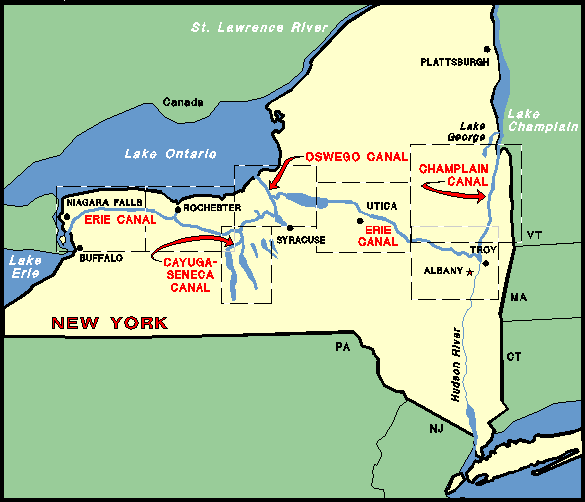
Buffalo (on Lake Erie) and New York City (on the Atlantic coast).
300
What mechanical bottleneck did Eli Whitney's Cotton Gin solve in 1793, and what was the immediate, paradoxical social consequence of this efficiency on the South's labor system?
It quickly separated the seeds from short-staple cotton fiber; it dramatically increased the demand for enslaved labor for planting and harvesting.
300
What primary constitutional doctrine, frequently invoked by Southern political leaders, was used to assert the right of slave states to ignore federal law or secede from the Union, and what political condition did it aim to protect?
The doctrine of States' Rights (or Nullification/Secession). It was invoked to protect the states' power to define and perpetuate the institution of slavery without interference from the federal government, especially regarding territories or fugitive slave laws.
300
What was the unique characteristic of the 1831 Nat Turner Revolt in Southampton County, Virginia, that set it apart from other slave rebellions in the U.S., and what was the immediate, severe legislative response across the South?
It was the deadliest and only sustained large-scale slave revolt in the U.S. where the rebels killed dozens of white people. The legislative response was the enactment of stricter, harsher Slave Codes
300
What manufacturing principle, pioneered by Eli Whitney beyond the cotton gin, allowed for the rapid assembly and repair of complex machinery and established the American method of production that would dominate future global industry?
Interchangeable Parts
300
What specific river-based technological challenge did Robert Fulton's Clermont and its successors overcome, and what critical geographical area—essential for cotton and agricultural trade—did steamboats subsequently open to two-way commerce?
Mississippi River Valley
400
By the 1840s, how did the value of U.S. cotton exports compare to the combined value of all other American exports, a relationship that led to the coining of what powerful political and economic phrase?
The value of cotton exports exceeded the value of all other U.S. exports combined, leading to the phrase "King Cotton."
400
Unlike the North, the South lacked large, diversified urban centers. What specific social effect did this agrarian focus and lack of urban development have on two key areas of Southern life: the development of a large middle class and the rate of public education?
The lack of robust urban centers hindered the growth of a large, diversified, non-agricultural middle class (merchants, industrialists, professionals) and generally kept rates of public education and literacy lower than in the industrialized North.
400
What specific art form did enslaved people use to discreetly communicate messages, often embedded with directions for escaping or subtle coded resistance, that became a profound expression of their oppression and hopes for freedom?
Spirituals (or Gospel songs)
400
What was the primary demographic of the labor force in the Lowell System of textile mills, and what was the key feature of their living arrangement that the company used to attract them while maintaining control?
Young, unmarried women from New England farms
400
What specific agricultural and environmental catastrophe served as the dominant push factor for the massive wave of Irish immigration to the U.S. in the mid-1840s?
Potato Famine
500
Located at a strategic point on the Mississippi River, what two related commercial functions did Memphis serve in the antebellum South, making it the central hub for both agricultural commerce and human trafficking?
It was the largest inland cotton market/shipping port AND a major hub for the internal slave trade.
500
While the Planter Aristocracy focused on the monoculture of cash crops like cotton, what was the characteristic economic goal and primary staple crop of the vast majority of Yeoman Farmers who owned small tracts of land in the South?
Their goal was self-sufficiency (or subsistence farming). Their primary staple crop was Corn (not cotton), which was vital for feeding their families and livestock.
500
Besides the physical deprivation and constant labor, what was the most potent psychological weapon slaveholders used to control the enslaved population, often involving selling family members?
The Threat of separating/selling family members (breaking up families).
500
The principle of interchangeable parts reduced the need for skilled artisans. This transformation is associated with what 19th-century term describing the increasing subdivision of labor into simple, repetitive tasks performed by less skilled workers?
Deskilling
500
What was the name of the secretive, anti-Catholic, anti-immigrant political movement of the 1840s and 1850s, whose members would reply, "I know nothing," when asked about their activities?
The Know-Nothing Party (or the American Party)