5.1 Food Security Definition
5.1 Food Security Causes
5.1 Food Security Impacts
5.1 Food Security
Strategies
Strategies
5.2 Energy Security
Definitions
Definitions
5.2 Energy Security
Causes
Causes
5.2 Energy Security
Impacts
Impacts
5.2 Energy Security
Strategies
Strategies
100
Define the term "Food Security."
When all people, at all times, have physical, social, and economic access to sufficient, safe, and nutritious food that meets their dietary needs and food preferences for an active and healthy life
100
Name one natural factor and one human factor that cause food insecurity.
Natural: Drought/Climate Change. Human: Population growth, poverty, or war.
100
Define "Malnutrition."
A condition resulting from insufficient nutrients, which reduces resistance to disease and the ability to work
100
What is "Hydroponics"?
The technique of growing plants in water-based nutrient solutions instead of soil.
100
Define "Energy Security."
The reliable availability of energy sources at an affordable price with consideration of environmental impacts.
100
State two causes of energy insecurity.
Fossil fuel depletion, population growth, or supply disruption (e.g., piracy, war).
100
State one impact of energy insecurity on industry.
Increased costs for production, leading to job losses or economic recession.
100
Name one way to increase energy efficiency in a home.
Improving insulation (walls/windows) or using low-energy appliances.
200
What is "Salinisation"?
An increase in salt content in agricultural soils, irrigation water, or drinking water, often caused by inefficient farming and poor irrigation.
200
How does "Over-cropping" lead to food insecurity?
It involves continuously growing crops without letting the soil rest, leading to nutrient depletion, land degradation, and lower yields.
200
State two social impacts of food insecurity.
Forced migration, political unrest/destabilization, or increased poverty.
200
Name two ways farmers can protect pollinating insects.
Reducing pesticide use, adopting organic methods, or planting crops that flower at different times.
200
Distinguish between "Renewable" and "Non-renewable" energy.
Renewable sources (solar, wind) can be replenished naturally and quickly; non-renewable sources (coal, oil) exist in finite amounts and take millions of years to form
200
How does "Population Growth" impact energy security?
It increases demand faster than new resources can be developed, putting pressure on already strained electrical grids.
200
How does energy insecurity affect education?
Students are unable to study at night without light or access internet resources, limiting their future employment opportunities
200
What is "Rationing" in the context of energy?
Strategically stopping power to parts of the grid (rolling blackouts) to allow the system to function under high pressure.
300
Explain the difference between "Food Availability" and "Food Access."
Availability refers to whether a sufficient quantity of food exists, while Access refers to how possible or affordable it is for individuals to obtain that food.
300
Explain how the demand for biofuels in countries like Brazil impacts food supply.
Large areas of arable land (e.g., 14% of Brazil's cropland) are diverted to grow energy crops like sugarcane, reducing the land available for food production and driving up prices.
300
Describe the "Poverty Cycle" related to food insecurity.
Undernourished people are often too ill to work; this lack of income prevents them from buying or growing food, keeping them trapped in a cycle of hunger and poverty.
300
Evaluate the use of Genetically Modified (GM) crops. Provide one "pro" and one "con."
Pro: Increased yields or resistance to pests/drought.
Con: Potential gene flow to wild species or high costs of seeds for small farmers.
300
Define "Photochemical Smog" and its primary cause.
A mixture of pollutants (brown haze) formed when nitrogen oxides and VOCs react with sunlight; it is linked to the combustion of fossil fuels
300
Explain how the 2022 war in Ukraine impacted European energy security.
Many European countries relied heavily on Russian natural gas (over 40% in some areas). The war disrupted these supplies, leading to shortages and record-high prices.
300
Describe the health impact of using "Biomass" for cooking in energy-insecure homes.
Burning wood or dung indoors leads to smoke inhalation, causing chronic lung damage and respiratory diseases.
300
Describe the "Waste-to-Energy" strategy used in Oahu, Hawaii.
Incineration plants burn non-recyclable waste at high temperatures to produce electricity, powering thousands of homes while reducing landfill volume.
400
Explain how land degradation is a cause of food insecurity
poor crop growth and lower yields; Soil erosion; water inefficiency; salinisation; habitat loss; economic impact
400
Explain how food security insecurity slows economic development
Reduced human capital and labor productivity; Long-term development costs; increased healthcare expenditures; suppression of education and innovation; Political instability and reduced investment; "The Hunger Trap."
400
Identify three features of subsistence agriculture shown in Fig. 1.1.
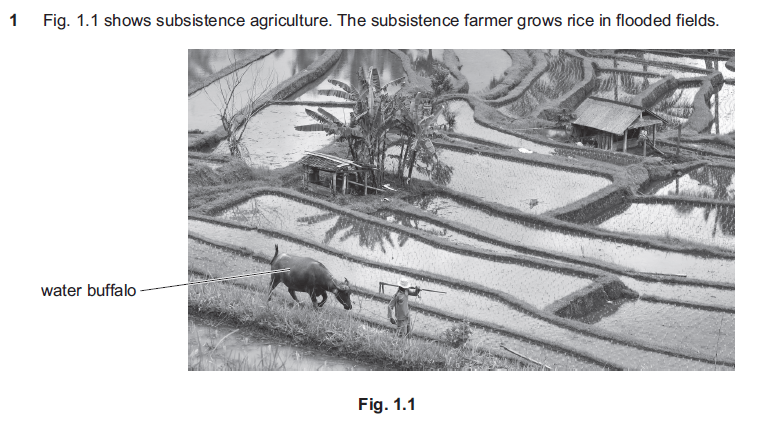
house present; other crops seen / bananas also growing; small fields / small plots of land / small scale; no mechanisation / buffalo used for ploughing; farmer has hand tools / farmer doing manual labour; buffalo used for, meat / milk; farmer working alone;
400
Distinguish between "long-term Energy Security" and "Short-term energy security."
long-term Energy Security: the supply of energy in line with the proposed economic development of an ares, requires planning and ensuring supply for future needs
Short-term energy security: supply of energy systems that are abler to react to sudden changes in energy supply
400
List the 5 causes of energy insecurity
Population growth
Global energy resource distribution
Energy needs of countries in different income groups
Climate Change
Supply distribution
400
How can energy insecurity cause civil unrest
Groups can compete to control energy rich mines; conflict between areas that are scarce in energy with those that aren't; war can break out when one country wants to control the enrgy resources of another
400
Rationing can also be used to manage energy security.
Evaluate rationing as a strategy for managing energy security.
positive (max 3):
allows all people to have some access to energy;encourages people to conserve energy; encourages development of energy conservation strategies;
negative (max 3):
limits industrial production;limits economic development;can cause unemployment;can be a cause of conflict;
500
Explain how this type of agriculture can affect food security.
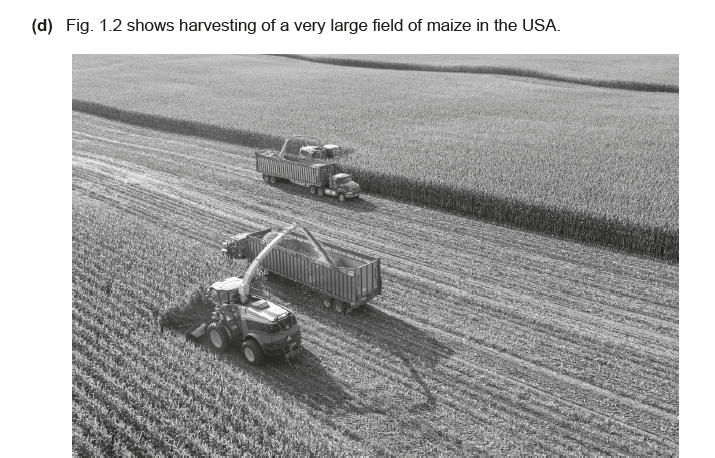
Decreasing:
increase in homogeneity or monoculture / unsustainable production;increased risk of disease;increased susceptibility to pests;increased susceptibility to climate changeincreased reliance on fertilisers;soil degradation; nutrient loss from soil / compaction or loss of soil structure (e.g. soil erosion);
Increasing:
extensive agriculture or farming / mechanisation; (leads to) increased yield or large yield / increased food production; production meets demand / crops can be stored / less food wastage;
500
Beyond economic growth, explain how chronic food insecurity can lead to political instability and forced migration within a region.
sharp increases in food prices or prolonged shortages can cause riots; loss of confidence in the government ; forced migration to look for food in other countries; resource conflict; international pressure
500

grow a larger variety of crops / keep farm animals; use fertilisers; use pest-resistant crops / high-yielding seeds or crops; use pesticides / biological control / insecticides / herbicides; grow cash crops; become a commercial farmer / intensification / extensification / mechanisation / agroforestry / keep more buffalo / improve food storage
500
Explain how population growth is a cause of energy insecurity
Population growth is occurring at a faster rate than the supply and development of new energy sources, inustrialization and increasing populations have resulted in more demand on available resources
500
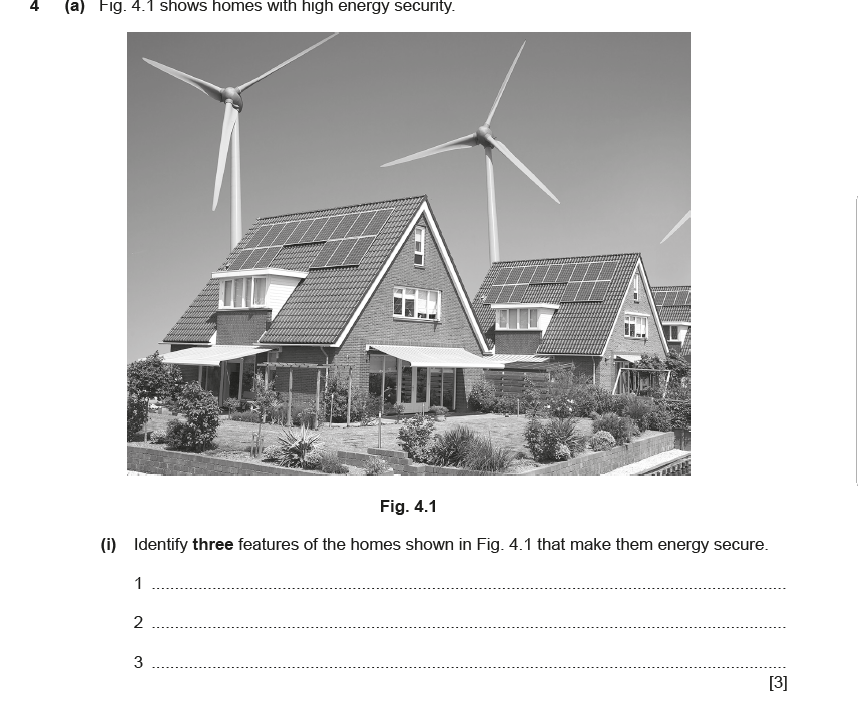
solar, panel / collector / heater;
wind turbine;
(wind and solar are) renewable;
(wind and solar are) carbon neutral / do not emit CO2;
windows are shaded / blinds on windows (for temperature control);
double-glazing on windows (reduces heat transfer / insulates);
500
max 3 from benefits:
reduces demand for, fossil fuels / imported energy; reduces production of, carbon dioxide / greenhouse gases / air pollution; mitigates, climate change / global warming; saves money / cheaper electricity bills;
max 3 from limitations:
not all people have access to the technology; homes difficult to adapt; expensive to buy / set-up / maintain; weather dependent / not always reliable production of energy;