Molecular Structure
Transcription
Translation
Gene Regulation
Mutations & Biotech
100
DNA is a type of ____ which is made up of _____
nucleic acid, nucleotides
100
Where does transcription occur in prokaryotes?
Where does transcription occur in eukaryotes?
cytoplasm in prokaryotes
nucleus in eukaryotes
100
What is the start codon?
What amino acid does it code for?
AUG
methionine
100
Define gene regulation.
Process that controls which genes are turned on/off in cells. What determines what proteins and how many of each are made in a cell.
100
What is the technique used to separate molecules based on their size and charge.
Gel electrophoresis
200
What are nucleotides made up of?
a phosphate group, a pentose sugar, and a nitrogenous base.
200
What is the difference between the coding strand and the template strand?
Coding strand - has the same sequence as the RNA transcript.
Template strand - also known as the non-coding strand. Complementary to the gene being transcribed. Strand of DNA that is read by RNA polymerase to make the RNA transcript
200
Where does translation occur in prokaryotes?
Where does translation occur in eukaryotes?
prokaryotes: ribosomes in cytoplasm
eukaryotes: ribosomes in cytoplasm
200
Differentiate between positive and negative gene regulation?
+ = When a regulatory protein, called an activator, binds to DNA and enhances the initiation of transcription.
- = When a regulatory protein, repressor, binds to DNA and inhibits the initiation of transcription.
200
Describe the difference between a silent and missense mutation. Give an example of each one.
Silent: no change to the amino acid chain (substitution)
Missense: different amino acids bonded together (addition/deletion)
300
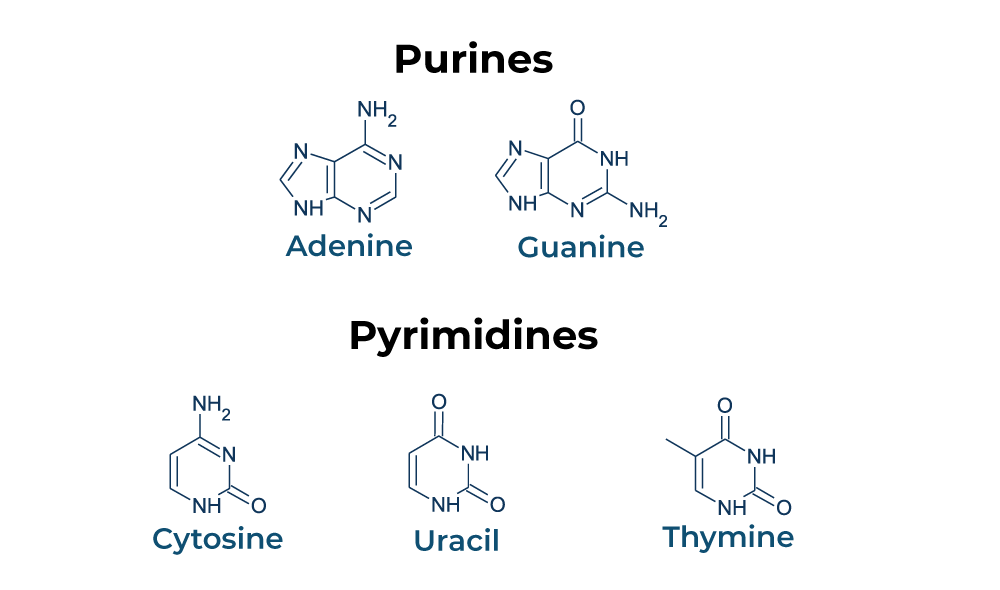
What is the difference, structure-wise, between purines and pyrimidines?
What bases are purines?
Purines have a double ring structure and pyrimidines have a single ring.
300
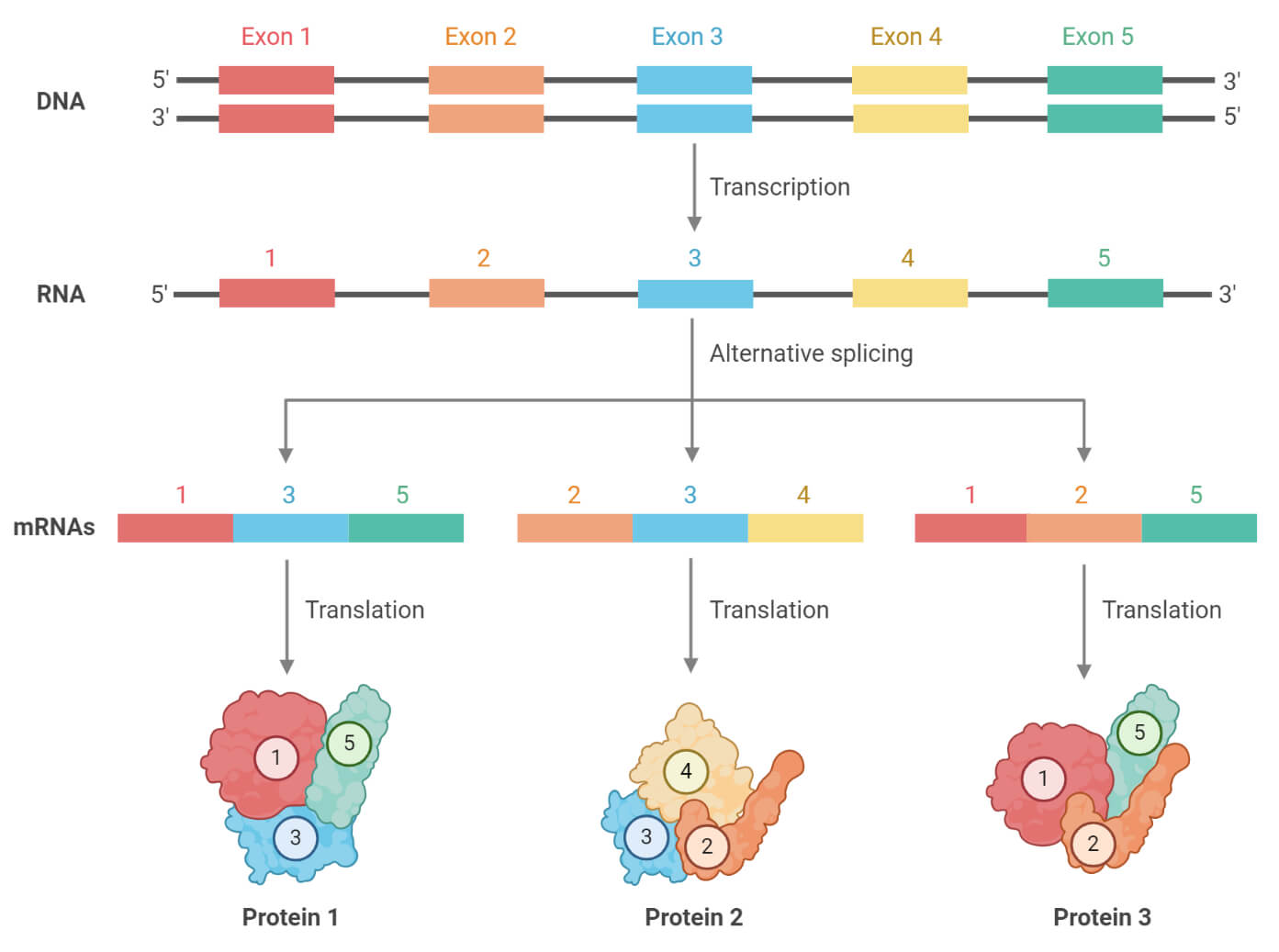
Describe what alternative splicing is.
Creating different mRNA molecules from the same primary transcript.
300
Select three of the types of RNA. Describe their function:
mRNA
tRNA
rRNA
snRNA
mRNA: copy of gene to be translated to a protein
tRNA: brings amino acids to ribosome
rRNA: makes up ribosomes
snRNA: helps cut out introns in RNA processing
300
Explain how an inducible operon such as the lac operon works.
Normally turned off. Must be turned on.
Active repressor protein binds to the operator in the absence of lactose. If lactose is present, it is an inducer. It will bind to the repressor and change it shape, making it not able to bind to the operator. Transcription of the genes will occur.
300
Name and describe the function of 3 enzymes involved in DNA replication.
1) helicase: unwind double helix
2) DNA Polymerase: Elongation of new strands, elimination of RNA primer
3) ligase: join Okazaki fragments
4) primase: joins RNA nucleotides to make RNA primer
5) topoisomerase: relax supercoiled DNA
400
What are 3 differences between DNA and RNA?
DNA- has deoxyribose, double-stranded, one type
RNA - has ribose, single-stranded, 3 types(mRNA, tRNA, rRNA)
:max_bytes(150000):strip_icc()/dna-versus-rna-608191_sketch_Final-54acdd8f8af04c73817e8811c32905fa.png)
400
Explain what the promoter region of a gene is.
the promoter region is a DNA sequence upstream of the gene where transcription factors and RNA polymerase binds to initiate transcription of the gene that follows.
400
Describe what the A site, P site, and E site are on a ribosome.
A site - the location on the ribosome where the incoming (amino with a tRNA) binds to the protein chain
P site - where ribosome catalyzes the formation of peptide bonds between the amino acids.
E site - the location where the rRNA molecule is released from the ribosome after it has delivered its amino acid to the protein chain
400
Describe the role of each of the following in an operon:
Promoter:
Operator:
Structural genes:
Regulatory gene:
Co-repressor or inducer:
Promotor: binds RNA polymerase
Operator: binds regulatory protein
Structural Genes: codes for mRNA of protein
Regulatory gene: codes for repressor
Co-repressor or inducer: molecule that binds to repressor to change its shape
400
1. What are restriction enzymes?
2. What is their role in Gel Electrophoresis?
3. What organisms naturally have them?
4. How are they named?
1. Enzymes that cut DNA in specific sequences.
2. Cut DNA up into small pieces so it will separate at different rates through the gel
3. prokaryotes (bacteria)
4. after the bacteria they were first discovered in. Number based on when it was discovered.
500
Describe the four levels of protein structure.
Primary-sequence of amino acids
Secondary- hydrogen bonding (alpha helix or beta pleated sheet)
Tertiary-side chain binding-3 dimensional shape
Quarternary-multiple bonding of polypeptides
500
Describe 3 processes involved in RNA processing.
5' cap: modified guanine nucleotides added to 5' end to help mRNA bind to ribosome
Poly A tail: string of adenine nucleotides added to 3' end. Protects from hydrolytic enzymes
Removal of introns: snRNA and spliceosomes remove noncoding regions
500
1. What level of protein structure is made on the ribosomes?
2. What types of bonds hold amino acids together?
3. What type of reaction occurs when amino acids are bonded together?
4. How does the polypeptide that is made on the ribosome become "mature" and fully functional?
1. primary - sequence of amino acids
2. covalent (peptide bonds)
3. condensation/dehydration rxn: removal of water
4. Get a 3D structure: the polypeptide must further fold by creating hydrogen bonds (alpha helix or beta pleated sheet) and bonds between side chains or R groups
500
Explain what epigenetic changes are.
Give two examples of epigenetic changes to DNA.
Changes to DNA due to environmental factors, not mutations to the genetic code that alter gene expression.
500
Describe how to transform bacteria.
1. Make bacterial cells competent: add CaCl2 or heat shock
2. Add DNA to competent cells (ice/heat/ice)
3. Add broth & incubate (to produce antibiotic resistant proteins)
4. Plate on agar containing selective medium (antibiotics)
5. Incubate