Solutions to Differential Equations
Modeling with Differential Equations
Logistic Growth
Euler's Method
(Calculator)
(Calculator)
???
100
The result of applying separation of variables on (do not integrate)
dy/dx=3xy^2
dy/y^2=3xdx
100
What is the solution to the differential equation
dy/dx=ky
y=Ce^(kx)
100
The carrying capacity for the following differential logistic equation
(dP)/dt=0.5P(3-P/1000)
L=3000
100
Write the equation of the tangent line created with Euler's Method to estimate f(1) given the following conditions
dy/dx=1+y, y(0)=0, and h=0.5
y-0.5=1.5(x-0.5)
100
The logistical growth model differential equation for
f(x)=y(t)
dy/dt=ky(1-y/L)
200
Let y=f(x) be the particular solution to the differential equation
(dy)/dx=(x^2+1)/e^y
with the initial condition f(1)=0. What is the value of the constant of solution y
-1/3
200
A population y grows according to the equation
dy/dt=ky
where k is a constant and t is measured in years. If the population doubles every 12 years, then what is the value of k?
k=ln(2)/12
200
Biologists stocked a lake with 400 trout. The carrying capacity for the trout is estimated to be 10,000. After 2 months the amount of trout in the lake is 545. Determine the amount of trout in the lake when the rate of change of the population is at a maximum
5000 trout
200
If given that
f(2)=1 ; dy/dx at x=2 is 6; step size is 0.1
What is the approximation of f(2.1)
1.6
200
The rate of change of the volume function, V(t), of water in a swimming pool is directly proportional to the cube root of the volume. If V=27 when dV/dt=5, what is a differential equation that models this situation?
(dV)/dt=5/3V^(1/3)
300
The GENERAL solution of the differential equation
(dy)/dx=(4x^3+3x^2+1)/(3y^2)
y=sqrt(x^4+x^3+x+C
300
The value of a car t years after it is purchased is given by the decreasing function V, where V(t) is measured in dollars. The rate of change of the car's value in dollars per year is proportional to the car's value. Which of the following differential equations can be used to model the value of the car where k is a constant.
(dV)/dt=kV
300
Consider the population P(t) and it's logistic differential equation shown below.
(dP)/dt=P/100(1-P/350)
Find
lim_(t->∞)P(t)
350
300
Consider the differential equation below with the initial condition f(1)=0.5. What is the approximation for f(1.2) if Euler's method is used with step size 0.1
1.41
300
Explain why the following slope field cannot represent the differential equation
dy/dt=0.4y
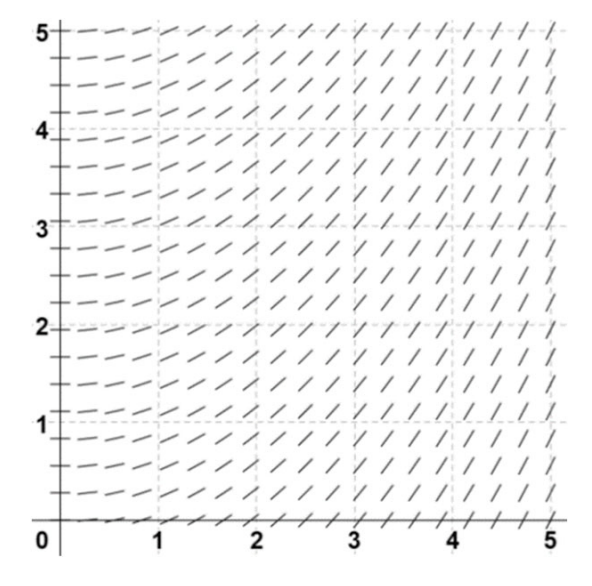
The slope changes are dependent on t, not on y
400
The general solution for the differential equation
dy/dx=(2xy)/(x^2+2)
y=C(x^2+2)
y=e^C(x^2+2)
400
As a glacier melts, the volume V of the ice, measured in cubic kilometers, decreases at a rate modeled by differential equation
where t is meausred in years. The volume of the glacier is 400 cubic kilometers at time t=0. At the moment when the volume of the glacier is 300 cubic kilometers, the volume is decreasing at a rate of 15 cubic kilometers per year. What is the volume in terms of time t?
V=400e^(-0.05t)
400
Consider the follow logistic growth model equation
(dy)/dt=0.5(y-y^2/10)
Find the solution equation y(t) assuming that b=1
y(t)=10/(1+e^(-0.5t)
400
Using Euler's method approximate y(2) using a step size of 0.5 given the following:
dy/dx=1+y ; y(1)=2
Then find the error between the actual value of y(2) and the approximation. Note that
y=3e^(x-1)-1
y(2)=5.75
Error=|7.15-5.75|=1.4
400
CHALLENGE
Choose another team to challenge to a question involving a general solution to differential equations. If the opposing team accepts the challenge, the first to find the correct solution will win the points. If both teams get it incorrect, every other team has a chance to answer. If the opposing team declines then the challengers automatically get the points. (normal penalty applies).
dy/dx=y^2sin(x)
500
Find the particular solution for the differential equation below with initial condition f(4)=-1
dy/dx=xy^4
y=(2/(46-3x^2))^(1/3)
500
The amount of bacteria in a petri dish increases at a rate proportional to the amount present. At time t=0, the amount of bacteria in the dish is 10 grams. At time t=2, the amount of bacteria in the dish is 30 grams. What is the amount of bacteria in the dish at t=6?
270 grams
500
Given that y=f(t) is a solution to the logistic differential equation
dy/dt=y/5-y^2/1500
where t is time in years what is
lim_(t->oo)f(t)
300
500
Using Euler's method, consider the following differential equation with initial condition
dy/dx=x+x^2+y ; y(1)=3
Approximate y(7) with a step size of 2
249
500
Anime Clue
The name of the Denji's devil dog in Chainsaw Man :)
Pochita